Geographical Advantages and Population Growth: Emerging as a New Growth Engine in the Southern Region
From AI-Manufacturing Convergence to Bio Cluster: Opening a New Industrial Hub
Myeongji International New City, located in the Busan-Jinhae Free Economic Zone, is transforming into both a "great place to live" and a "gateway to the future." The changes are so significant that they can be described as revolutionary.
Park Seongho, Commissioner of the Busan-Jinhae Free Economic Zone Authority, emphasized, "We plan to make Myeongji International New City the 'international business hub and the center of residential, business, and commercial activities' within the Busan-Jinhae Free Economic Zone."
Myeongji International New City, which is being developed as a "premium international business city" across 6.4 km² (1.94 million pyeong) in the Myeongji-dong area of Gangseo-gu, Busan, boasts excellent geographical accessibility as it is located at the center connecting Busan New Port, the world's second-largest transshipment port, and Gimhae Airport, the region's air logistics hub. With the future opening of the new Gadeokdo Airport and Jinhae New Port, there are high expectations for industrial growth and job creation.
The Myeongji District development project is being carried out on a total area of 6.4 km² with a total investment of 3.6856 trillion KRW. The development is divided into two phases: Phase 1 has already been completed, while Phase 2 will see an investment of 1.5741 trillion KRW to expand residential and business facilities on a site of approximately 1.922 km² (580,000 pyeong).
As Phase 2 development accelerates, the local community is paying close attention to Myeongji International New City. In May last year, construction on the second section of Phase 2 began, and currently, ground improvement works are underway.
Myeongji-dong, which includes Myeongji International New City, has seen rapid population growth alongside its development. In February 2009, before development began, the population of Myeongji-dong was just 11,451 (4,229 households), but by March 2025, the population of Myeongji 1-dong had soared to 54,374 (21,503 households). This marks an increase of 42,923 people (17,274 households) over 15 years. Upon completion of the development, the population is expected to reach a total of 87,437 (32,831 households).
The Free Economic Zone Authority is also making every effort to expand transportation infrastructure. Currently, the access and arterial roads for the Myeongji District have been completed, and to accommodate the explosive future traffic demand, expansion projects for the main arterial roads in Phase 2 and the access road to Myeongji International New City are underway.
Improvements in transportation infrastructure are expected to alleviate traffic congestion caused by population influx and enable smoother entry and exit, contributing to making the city an even better place to live.
Myeongji International New City is transforming into the "R&D hub of the Busan-Jinhae Free Economic Zone," where manufacturing and artificial intelligence (AI) industries converge.
To this end, the Free Economic Zone Authority launched the Myeongji District Grand Design Project last year. The goal is to attract cutting-edge IT and bio-health innovation companies to Myeongji International New City and establish their R&D centers there.
To attract new growth and high-tech industries, the plan is to build large-scale knowledge industry centers and elevate the residential environment to a global standard to draw in top talent. Currently, R&D centers such as Descente Korea R&D Center, Prestige Biopharma IDC, and SA Geolab R&D Center are already established in Myeongji International New City.
Since September last year, the Free Economic Zone Authority has been holding manufacturing-IT convergence company meetings and providing AI adoption consulting support projects to build a digital ecosystem in the Busan-Gyeongnam region centered on Myeongji District.
Additionally, the authority has signed business agreements with organizations such as the Busan Regional Employment and Labor Office, Gangseo Fire Station, Busan Machinery Industry Cooperative, Busan New Port Hinterland Logistics Association, and Korea Marine Equipment Association to promote industrial accident prevention projects through the convergence of AI and manufacturing.
The Free Economic Zone Authority is also pursuing collaborative projects to introduce IT technologies such as cloud computing into various fields, including energy efficiency, ESG (environmental, social, governance) management, and medical, bio, and R&D sectors.
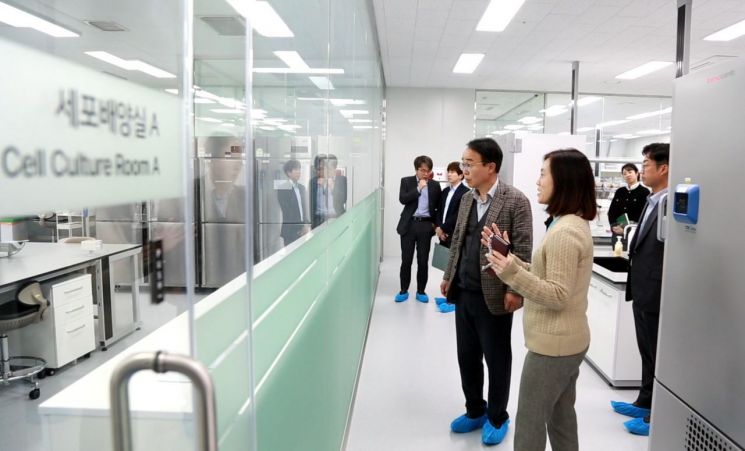
In November last year, the Prestige Biopharma Innovative New Drug Research Institute opened in Myeongji International New City. The Prestige Biopharma IDC (Innovative Discovery Center) is a bio-pharmaceutical R&D center with large-scale foreign investment, built on a 31,000 m² (9,500 pyeong) site with one basement floor and six above-ground floors. Construction began in January 2022 and was completed in October last year.
Prestige Biopharma, headquartered in Singapore, plans to focus even more on innovative new drug development as a "specialized antibody drug development company" by completing a "full value chain" system covering everything from the development of antibody biopharmaceuticals to clinical trials, commercialization, and production through the Prestige Biopharma Innovative New Drug Research Institute in Busan.
To this end, the company plans to hire about 100 researchers, mainly with master's and doctoral degrees, and is expected to contribute to strengthening biopharmaceutical technology capabilities, creating quality jobs, and revitalizing the local economy.
With the establishment of a global bio company's R&D center in Myeongji District, it is expected to have a positive ripple effect, not only attracting more global bio companies to the area but also fostering the concentration of related industries and activating industry-academia cooperation within the region, thereby forming a bio cluster.
Myeongji International New City is in the process of attracting two international schools: Royal Russell School and Wellington College. The Royal Russell Busan Campus is scheduled to begin construction in 2026 and aims to open in August 2028. The establishment of the Royal Russell Busan Campus is being pursued to provide global-level education in the Busan-Jinhae Free Economic Zone. Royal Russell School is located in the southern part of London, UK, and is renowned as a school supported by the British royal family.
The establishment of Wellington College International Busan Campus is also underway. In July last year, the Free Economic Zone Authority signed a business agreement with Busan City and Wellington College for the establishment of the school.
Wellington College plans to establish an international kindergarten and elementary school on a site of about 12,800 m² (3,900 pyeong) in Myeongji-dong, Gangseo-gu, with the administrative process currently in progress. The plan is to first establish the kindergarten and elementary school, and later add middle and high schools.
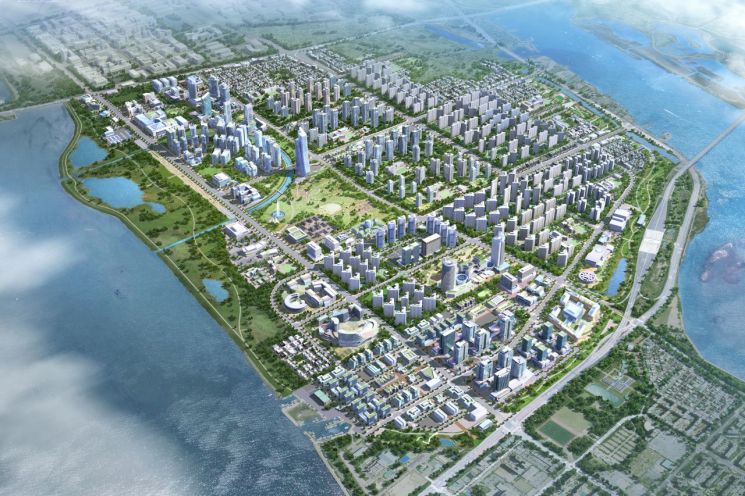
Currently, Myeongji International New City features state-of-the-art office buildings and premium business hotel convention centers for the international business environment. The city is also renowned for its premium residential environment. With the Western Busan Legal Town at its center, facilities such as the Myeongji National Assembly Library and Starfield City Myeongji have led to the saying, "Every aspect of residential life is completed within Myeongji International New City."
The Free Economic Zone Authority is working to attract medical institutions near the international schools. In particular, to attract foreign hospitals, the designated site was changed in 2020 to allow for the establishment of domestic university hospitals and general hospitals, opening up the possibility for domestic hospitals as well.
Cultural infrastructure is also being developed to enhance residents' quality of life. In May this year, the Nakdong Art Center is scheduled to be completed within Neighborhood Park No. 1. The Nakdong Art Center is expected to become a cultural hub, offering a variety of performances and cultural arts programs to local residents. With a global educational environment, premium residential complexes, and an excellent industrial base centered on high-tech industries, the area is receiving strong interest from foreign investors.
Commissioner Park Seongho stated, "We will foster Myeongji District as a hub for the bio and IT industries, making it a new growth engine for the local economy and continuously creating quality jobs where young people can realize their dreams. By creating a 'livable city and a premium residential area where everyone wants to live' with harmonized educational, transportation, and living infrastructure, we will work to build a world where both employment and quality of life are improved together."
© The Asia Business Daily(www.asiae.co.kr). All rights reserved.
![Clutching a Stolen Dior Bag, Saying "I Hate Being Poor but Real"... The Grotesque Con of a "Human Knockoff" [Slate]](https://cwcontent.asiae.co.kr/asiaresize/183/2026021902243444107_1771435474.jpg)

















