210,000 Tons of Stockpiled Rice Released, but "No Decisive Effect"
Rice Prices Double Bread Prices in a Year
The Japanese government mobilized policy measures such as releasing stockpiled rice to stabilize soaring rice prices, but retail rice prices have risen for 14 consecutive weeks.
According to the Yomiuri Shimbun on the 15th, the Ministry of Agriculture, Forestry and Fisheries announced that the average price of 5kg rice sold at 1,000 supermarkets nationwide from the 31st of last month to the 6th of this month was 4,214 yen (about 41,850 won), up 8 yen (about 80 won) from the previous week.
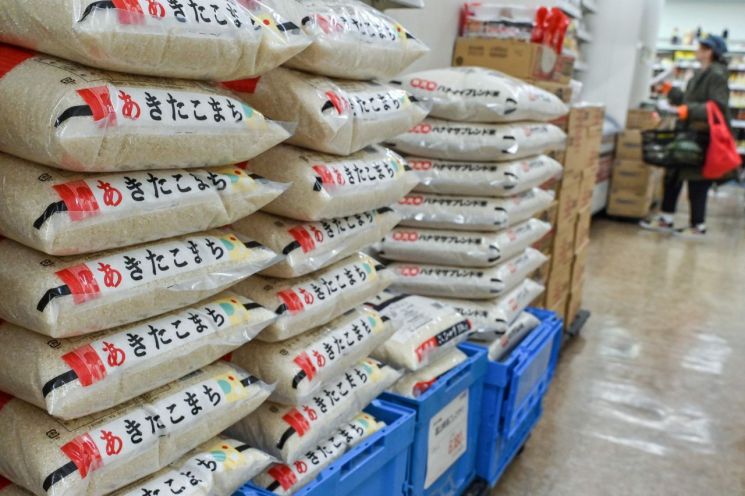
This price is more than double the 2,068 yen recorded in the same period last year. Retail rice prices have continued to rise for 14 consecutive weeks. Since last summer, rice prices in Japan have surged significantly due to a shortage in distribution volume. Japanese media have likened this to the 1918 rice riot incident, calling it the "Reiwa (令和, current emperor's era) Rice Riot."
The Japanese government released 210,000 tons of stockpiled rice twice last month to increase supply. Although stockpiled rice has been sold at some stores since the end of last month, rice prices continue to rise. Accordingly, the Ministry of Agriculture, Forestry and Fisheries plans to conduct additional monthly stockpiled rice auctions until July to increase supply. First, it plans to release 100,000 tons of stockpiled rice in late this month.
The Nihon Keizai Shimbun (Nikkei) pointed out that although the government is making efforts to suppress rice prices, it has not produced decisive effects.
Yomiuri reported that at an opinion exchange event held yesterday by the Ministry of Agriculture, Forestry and Fisheries with rice wholesalers and retailers, concerns were raised about regional disparities in the distribution of stockpiled rice.
Chief Cabinet Secretary Yoshimasa Hayashi stated at a press conference that if necessary, the government will not hesitate to take additional measures.
Meanwhile, Nikkei reported that due to the US-China trade conflict and other factors, wheat prices have become cheaper, leading to wheat replacing rice on dining tables.
According to the Ministry of Agriculture, Forestry and Fisheries, from April, the government's wheat selling price averaged 63,570 yen per ton, a 4.6% decrease compared to October 2024 to March 2025. This is the lowest level since October 2021 to March 2022.
While wheat prices fall and rice prices rise, the price gap between bread and cooked rice is widening. Based on retail price statistics from the Ministry of Internal Affairs and Communications, Mitsubishi Research Institute estimated that in February, the price of a 60g slice of bread in Tokyo's 23 wards was 32 yen, maintaining around 30 yen over the past two years. In contrast, a bowl of Koshihikari rice (65g of polished rice), which was similar in price to a slice of bread, rose 27 yen from the previous year to 57 yen, nearly doubling.
Nikkei reported that the perception that bread and noodles are relatively cheaper is changing dining table menus. According to market research firm Intage, a survey of dinner menus from 1,260 households in Tokyo, Osaka, and other areas showed that the appearance rate of pasta was 4% in February, up from 3.5% in the same month last year. Although the proportion of dinners including rice still exceeds 70%, it slightly decreased in February.
© The Asia Business Daily(www.asiae.co.kr). All rights reserved.
![Clutching a Stolen Dior Bag, Saying "I Hate Being Poor but Real"... The Grotesque Con of a "Human Knockoff" [Slate]](https://cwcontent.asiae.co.kr/asiaresize/183/2026021902243444107_1771435474.jpg)















