Establishment of Joint Venture with Poland's WB Group
for Cheonmu Guided Missile Production
Hanwha Aerospace has decided to produce the Cheonmu guided missile, which has been exported to Europe, locally in Poland. The company plans to establish a joint venture with a local firm to actively pursue localization in Europe.
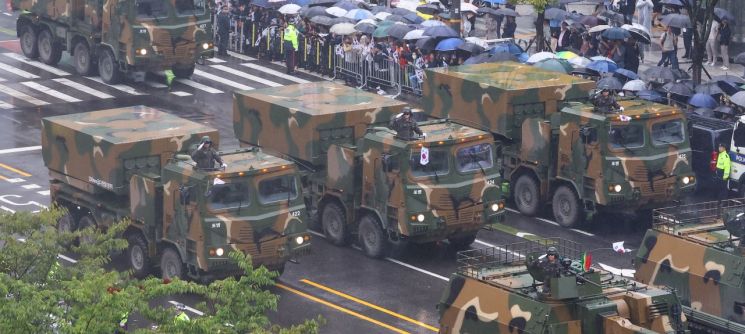
According to industry sources on the 15th, Hanwha Aerospace will sign a Term Sheet agreement to establish a joint venture with WB Group, Poland's largest private defense company, in Warsaw, Poland. A Term Sheet is an agreement outlining the key principles and conditions related to a contract.
The joint venture will be established with Hanwha Aerospace holding a 51% stake and WB Electronics, a subsidiary of WB Group, holding 49%. The plan is to locally produce the 80km-range Cheonmu guided missile (CGR-080), which will be supplied to the Polish military through additional contracts, as well as to promote exports to the European market in the future.
Hanwha Aerospace aims to quickly respond to Europe's defense bloc strategy, which seeks to exclude non-European companies, by adopting a 'Buy European' strategy. The company plans to significantly expand its recognition and market share in the global market. Starting with the establishment of this joint venture, Hanwha Aerospace intends to secure additional production bases in Europe using funds raised through a paid-in capital increase.
Since 2022, Hanwha Aerospace has signed contracts worth a total of 7.2 trillion KRW by exporting 80km-range guided missiles (CGR-080) and 290km-range guided missiles (CTM-290) to the Polish military procurement agency in two phases.
Meanwhile, Cheonmu uses 239mm guided missiles and 230mm unguided rockets. Unguided rockets contain multiple smaller projectiles inside a large shell, capable of completely devastating an area equivalent to three soccer fields. This is why Cheonmu is referred to as ‘Steel Rain’.
Unguided rockets were produced under a Manufacturing License Agreement (MLA) in the United States by Hanwha Aerospace (formerly Hanwha Corporation) from 2002 to 2011. However, issues arose regarding license approval in the U.S., and exports also became problematic. Unguided rockets are also known as cluster bombs, which have a high potential for civilian casualties and are considered one of the most unethical weapons by the international community. European NGOs have campaigned against investing in cluster bomb manufacturers, which has hindered the export of ‘K-Defense’ products. In fact, five countries?Belgium, Ireland, Italy, Luxembourg, and New Zealand?have legally banned investments in cluster bomb manufacturers. European pension funds such as the French pension reserve fund, Norwegian government pension fund, Swedish pension fund, Dutch civil servant pension fund, and Danish public pension fund also avoid investing in cluster bomb manufacturers.
Hanwha Aerospace spun off its unguided rocket business into a newly established company called Korea Defense Industry (KDI). This was done because if businesses like unguided rockets become obstacles when Hanwha Group seeks investment in Europe, attracting investment could become difficult. KDI has independently developed unguided rockets and passed accuracy tests in October. The failure rate of unguided rockets developed by KDI is 0.1%, lower than the U.S. rate of 0.3%, thereby reducing civilian casualties.
If Cheonmu is exported, it also raises hopes for the export of unguided rockets. Ukraine is reportedly in immediate need of unguided rockets. Cheonmu’s compatibility is also a strength. While the main missile caliber is 239mm, it can fire up to 40 rounds of 130mm ballistic rockets like the ‘Guryong’ multiple rocket launcher, which was previously the mainstay of the South Korean military. When exporting to Poland, it is being modified to use 122mm rockets, which are widely used in Europe.
© The Asia Business Daily(www.asiae.co.kr). All rights reserved.
![Clutching a Stolen Dior Bag, Saying "I Hate Being Poor but Real"... The Grotesque Con of a "Human Knockoff" [Slate]](https://cwcontent.asiae.co.kr/asiaresize/183/2026021902243444107_1771435474.jpg)















