Indonesian Government and State-Owned Enterprises Join Forces
Introducing 'Circular Resource Hydrogen Solution'
Establishing Clean Hydrogen Production and Hydrogen Refueling Stations
Hyundai Motor Group will produce hydrogen using biogas generated from a landfill site in Indonesia. The group has concretized multilateral cooperation to establish a hydrogen ecosystem within Indonesia.
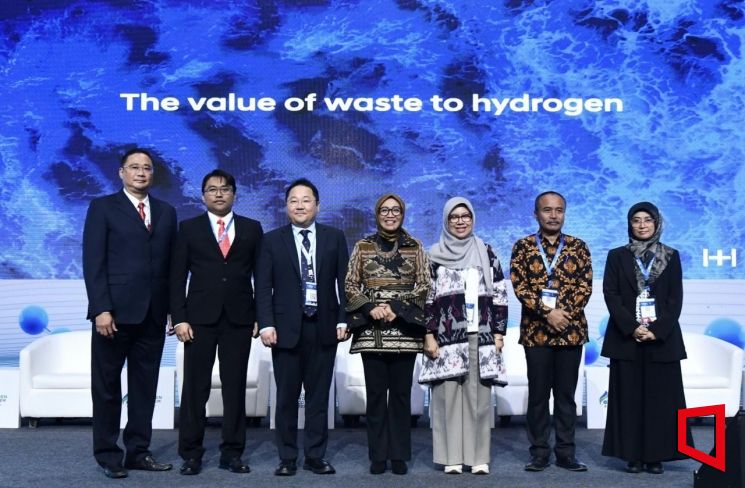 On the 15th (local time), Hyundai Motor Group announced the 'W2H Hydrogen Ecosystem Development Project' with the Indonesian government and state-owned energy company Pertamina Holdings at the 'Global Hydrogen Ecosystem Summit 2025' held in Jakarta, Indonesia. Jaeha Park, Executive Director and Head of Hyundai Motor Global Hydrogen Business Division (third from the left), is taking a commemorative photo with Indonesian government and corporate officials. Hyundai Motor Group
On the 15th (local time), Hyundai Motor Group announced the 'Indonesia Circular Resource Hydrogen Solution (W2H) Hydrogen Ecosystem Establishment Project,' which is being promoted with the Indonesian government and the state-owned energy company Pertamina Holdings, at the 'Global Hydrogen Ecosystem Summit 2025' held in Jakarta, Indonesia. This is Hyundai Motor Group's first demonstration project producing hydrogen from organic waste overseas.
Last year, at the Consumer Electronics Show (CES), Hyundai Motor Group announced plans to introduce the 'W2H' system in West Java Province, Indonesia, which converts organic waste into hydrogen. The method involves refining methane generated from organic waste such as food waste, sewage sludge, and livestock manure to produce biogas, which is then converted into hydrogen. Establishing a local production base can reduce costs associated with transportation and storage.
Initially, hydrogen will be produced using biogas extracted from the Sarimukti landfill near Bandung City in West Java Province, Indonesia. The Sarimukti landfill processes about 80% of the approximately 1,500 tons of waste generated daily in Bandung City. Recently, due to abnormal climate caused by global warming, the area has frequently experienced natural disasters such as large fires, floods, and landslides.
Hyundai Motor Group plans to collaborate with Sejin G&E, a landfill development specialist company, to cover the Sarimukti landfill to prevent natural disasters. The biogas extracted from the covered landfill will be converted into clean hydrogen using Hyundai Rotem's hydrogen reformer. The technical feasibility study for landfill development has been completed, and discussions with West Java Province are underway to start related facility construction within this year.
In the future, Hyundai Motor Group intends to form a consortium with JAENG, Korea Testing Laboratory, and the Korea Institute of Industrial Technology to apply related technologies for hydrogen production, operation, and refueling. Additionally, by 2027, they plan to complete the installation of hydrogen reformers and hydrogen refueling stations on land provided by Pertamina Holdings, and maintain close cooperation with Pertamina Holdings throughout the entire hydrogen value chain, including hydrogen transportation and hydrogen mobility utilization.
This project not only establishes a hydrogen production hub but also contributes to solving Indonesia's waste problem. It is cited as a key case related to Indonesia's national hydrogen roadmap and is receiving full support and backing from the local government.
A Hyundai Motor Group official stated, "This is significant as the first case of expanding the resource-circulating hydrogen production demonstration project, which is successfully underway domestically, overseas. Through our hydrogen business brand 'HTWO,' we hope to expand hydrogen production in cooperation with the Indonesian government and companies and accelerate the hydrogen society."
Meanwhile, Hyundai Motor Group is implementing the W2H model domestically through projects such as the hydrogen production demonstration project at the food waste bio-center in Chungju City, the establishment of a clean hydrogen production facility using biogas generated from organic waste at the public sewage treatment plant in Cheongju City, and a resource circulation project for creating a mini hydrogen city in collaboration with Paju City and the Korea Institute of Industrial Technology.
© The Asia Business Daily(www.asiae.co.kr). All rights reserved.
![Clutching a Stolen Dior Bag, Saying "I Hate Being Poor but Real"... The Grotesque Con of a "Human Knockoff" [Slate]](https://cwcontent.asiae.co.kr/asiaresize/183/2026021902243444107_1771435474.jpg)















