New York Fed Consumer Expectations Survey Results
44% Expect Higher Unemployment in One Year
Highest Level Since April 2020
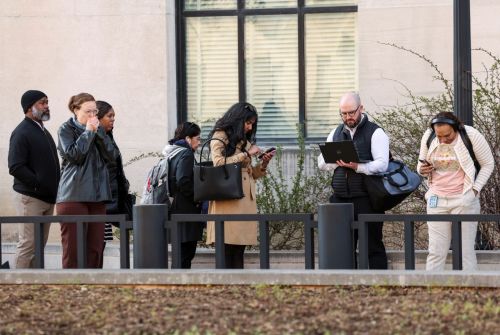 Employees of the U.S. Department of Health and Human Services (HHS), which recently announced a plan to cut 10,000 jobs, lined up outside the Mary E. Switzer Memorial Building on the 1st (local time). Recent concerns about rising unemployment among Americans have grown to the highest level since the early days of the COVID-19 pandemic. Photo by Reuters Yonhap News
Concerns about rising unemployment among U.S. consumers have reached their highest level since the early days of the COVID-19 pandemic.
According to the March Survey of Consumer Expectations (SCE) released on the 14th (local time) by the Federal Reserve Bank of New York, the average unemployment rate expectation ? that is, the average probability that the unemployment rate will be higher one year from now than it is currently ? surged by 4.6 percentage points to 44.0%. This is the highest figure since April 2020.
The New York Fed explained that this upward trend was widespread across age groups, education levels, and income brackets.
The median inflation expectation rose by 0.5 percentage points to 3.6% for the one-year outlook. The average perceived probability that U.S. stock prices will rise in one year fell by 3.2 percentage points to 33.8%, marking the lowest level since June 2022.
The survey is compiled from responses of over 1,300 household heads nationwide. The March survey was conducted before U.S. President Donald Trump announced reciprocal tariffs against countries worldwide on the 2nd.
Earlier, the University of Michigan’s Consumer Sentiment Index released on the 11th also showed a sharp deterioration in U.S. consumer sentiment. The preliminary April Consumer Sentiment Index fell 6.2 points from the previous month’s final figure to 50.8, significantly below market expectations of 54.5. The Consumer Sentiment Index has declined for four consecutive months. The preliminary one-year inflation expectation rose sharply by 1.7 percentage points to 6.7%, the highest level in 44 years since 1981.
These two surveys indicate that among U.S. consumers, President Trump’s tariff policies are intensifying expectations of stagflation (economic stagnation accompanied by rising prices). The University of Michigan’s expected inflation, announced on the 11th (local time), jumped from 5.0% in March to 6.7% in April, the highest since 1981. Moreover, the Consumer Sentiment Index also plunged by 6.2 percentage points to 50.8 compared to the previous month. Current and expected conditions regarding personal finances, employment, and prices all appeared pessimistic.
© The Asia Business Daily(www.asiae.co.kr). All rights reserved.
![Clutching a Stolen Dior Bag, Saying "I Hate Being Poor but Real"... The Grotesque Con of a "Human Knockoff" [Slate]](https://cwcontent.asiae.co.kr/asiaresize/183/2026021902243444107_1771435474.jpg)















