AI G3, $40,000 National Income, and Expanding the Middle Class to 70%
200 Trillion Won Investment in the AI Ecosystem
Welfare Prioritized Through 'Lifetime Welfare Account' Using Investment Returns
Earned Income Tax Reduction and Inheritance Tax Reform
Expansion of Basic Deduction for Dependent Family Members
Former People Power Party leader Han Dong-hoon announced on the 15th that through the '3·4·7' future growth vision?AI G3, $40,000 national income, and expanding the middle class to 70%?he aims to "open an era of a growing middle class."
At the 'Policy Vision Presentation Part 1, Growing Middle Class' event held at the National Assembly Communication Office that morning, Han said, "The middle class must feel that they are truly middle class, and the lower class should be able to leap into the middle class with will and effort." The intention is that, having reached the ranks of advanced countries, the middle class must be nurtured to foster the future and hope.
Han pointed out, "Conservative governments and conservative parties have rarely made the 'middle class' a core policy or slogan. But now that we have become an advanced country, we must further expand the middle class. We must not just hand out money with fake economics like Lee Jae-myung’s Democratic Party. We must not cut off the sprouts of achievement and challenge with welfare populism like the basic series." He added, "I will change the social atmosphere where extreme voices are overrepresented and the views of the middle class are often ignored. I will open an era of a growing middle class that values moderation and the middle way."
To expand the middle class, he proposed four strategies: national income growth, excessive tax cuts, strengthening welfare for essential costs such as healthcare, education, care, and housing, and increasing real income through price stabilization in energy and other sectors. First, for the first part of the 3·4·7 vision?to become one of the world’s top three AI powers?he proposed investing 150 trillion won in AI infrastructure and a total of 200 trillion won in creating an innovation ecosystem. He emphasized the government's role in investing industrial growth funds in areas where private sectors find it difficult to bear risks, sacrificing some returns, as well as securing joint public-private funds, matching funds, and proactive financial policy support. Regarding ecosystem creation such as AI infrastructure and talent development, he pledged strategic investments in applied fields like medical AI, robotics, defense AI, drones, and autonomous driving, training 10,000 AI specialists through a complete overhaul of elementary, middle, high school, and university education, and establishing a future strategy department (tentative name) to oversee AI policy.
Referring to the U.S. AI joint investment project Stargate with an 800 trillion won investment and Tesla’s 200,000 GPUs, Han said, "If we aim for AI G3, investing 150 trillion won over five years in data centers, computing hardware, and semiconductors is by no means excessive." He stressed, "Our people’s high digital literacy is a strong asset. I believe that 'Korea’s Palantir' can definitely be born." He continued, "AI will create jobs, contribute to childcare, education, and care, and I will prioritize welfare policies through a 'Lifetime Welfare Account' so that the returns on national AI investments reach every citizen."
To enjoy the era of $40,000 national income, he introduced plans to reform the tax system by reducing the burden of earned income tax, expanding the basic deduction for dependents, and converting inheritance tax into an estate acquisition tax. Han said, "Adjusting corporate tax is necessary to revive corporate vitality, but to realize a 'growing middle class,' we must first reduce the earned income tax burden on hardworking citizens."
He also argued that tax relief is essential to support marriage and childbirth. The basic deduction for dependents would be increased from the current 1.5 million won to 2 million won, and the child basic deduction expanded to 2.5 million won for the first child, 3 million won for the second, and 4 million won for the third and beyond. Additionally, a corporate tax credit for parental leave takers would be implemented to encourage taking parental leave. He emphasized converting inheritance tax from the current whole estate basis to an individual receipt basis (estate acquisition tax) and fully exempting spousal inheritance. He also highlighted plans to expand child deductions and lower tax rates in lower brackets to effectively reduce the tax burden for most citizens.
Regarding welfare, he promised service welfare through job creation and guaranteed customized welfare benefits throughout the life cycle by introducing a Lifetime Welfare Account. This account would include not only a cash account but also individual care service accounts, removing program silos and extending voucher validity periods so that citizens can autonomously use the welfare they need. Han said, "I plan to actively promote demand-centered welfare restructuring, which previous governments failed to do, by establishing a deputy prime minister-level Social Security Department with budget adjustment authority."
He also pledged to expand elementary school childcare through the second season of Neulbom School, provide breakfast and lunch during vacations, introduce family care insurance to practically guarantee parental leave, and offer paid family sick leave to workers with elderly, sick, or accident-affected family members needing care. For the elderly, he introduced plans to expand housing and care services currently provided to low-income seniors to all seniors above the middle class, and to expand integrated services for senior housing support and community medical care.
Furthermore, he explained plans to stabilize energy prices through building a nuclear power ecosystem and power infrastructure, and stabilize agricultural product prices by easing farmland sales regulations and establishing large-scale smart farms. After mentioning new nuclear power plant construction and existing plant operation plans, Han said, "At least 100 trillion won will be needed by 2038 for energy infrastructure such as transmission and distribution networks. We will utilize the Power Industry Infrastructure Fund and cut energy subsidies with uncertain effects to convert them into resources to lower electricity bills."
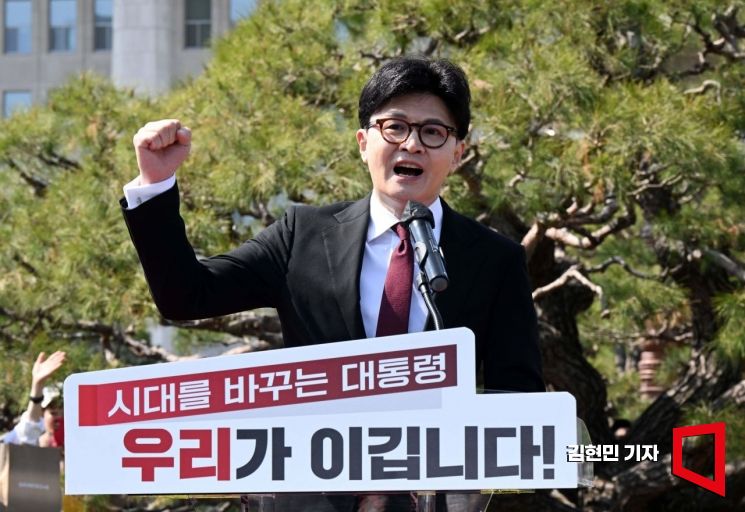 Handonghun, former leader of the People Power Party, is declaring his candidacy for the presidential election in front of the National Assembly fountain on April 10, 2025. Photo by Kim Hyunmin
© The Asia Business Daily(www.asiae.co.kr). All rights reserved.

















