First Clinical Trial of CAR-T Cell Therapy for Refractory Lupus Begins in Korea
Led by Professors Jihyun Joo and Jaeho Yoon at Seoul St. Mary’s Hospital
Seoul St. Mary’s Hospital has begun a clinical study administering CAR-T cell therapy, one of the immune checkpoint inhibitors, to a patient with systemic lupus erythematosus (SLE) for the first time in Korea.
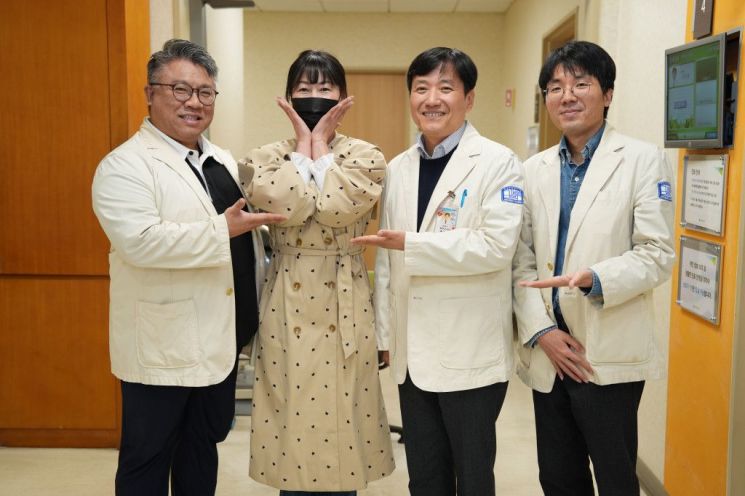 (From left) Professor Yoon Jae-ho, Department of Hematology, lupus patient, Professor Joo Ji-hyun, Department of Rheumatology, Professor Lee Bong-woo, Department of Rheumatology. Seoul St. Mary's Hospital
According to Seoul St. Mary’s Hospital on the 15th, a team led by Professors Jihyun Joo and Bongwoo Lee (Rheumatology) from the Rheumatology Center and Professor Jaeho Yoon (Hematology) from the Blood Disease Hospital administered CAR-T therapy in March this year to a woman in her 40s with lupus who had no other treatment options. This study is also a result of collaboration in the hospital’s key research areas, 'refractory autoimmune diseases' and 'cell therapy,' following Seoul St. Mary’s Hospital’s selection as a Phase 1 certified research-oriented hospital by the Ministry of Health and Welfare.
The patient was diagnosed with systemic lupus erythematosus in 2009 after experiencing generalized edema and proteinuria during pregnancy. Despite high-dose steroid and multiple immunosuppressant treatments after childbirth, lupus nephritis did not reach remission (a state where symptoms decrease or disappear), and avascular necrosis occurred as a side effect of long-term high-dose steroid use. Proteinuria and kidney function continued to worsen despite various immunosuppressive therapies, and if left untreated, the lupus-induced kidney damage was expected to accelerate, posing a high risk of progressing to end-stage renal failure requiring dialysis.
Accordingly, Professor Jihyun Joo, the patient’s attending rheumatologist, obtained approval from the Ministry of Food and Drug Safety to conduct a clinical trial of an investigational drug for lupus patients and proceeded with the treatment.
Notably, close multidisciplinary cooperation with Seoul St. Mary’s Hospital Blood Disease Hospital, known as a quaternary care center for hematologic diseases, played a significant role. Although rheumatic and hematologic diseases share some immunological intersections, they involve different disease groups, so collaborative treatment cases have been relatively rare. However, the extensive experience of the Blood Disease Hospital in CAR-T cell therapy accumulated through treating patients with relapsed/refractory diffuse large B-cell lymphoma and B-cell acute lymphoblastic leukemia greatly contributed to the CAR-T treatment process for the lupus patient.
At the outpatient follow-up on April 14 to assess the patient’s condition after the March administration, the patient was able to maintain daily life without acute side effects, and lupus-related indicators improved even after discontinuing immunosuppressants.
Lupus is a representative chronic autoimmune disease. It occurs when the immune system, which protects the body from invading pathogens, mistakenly attacks the body itself. The exact cause of onset is unknown, and symptoms vary widely, earning it the nickname “the disease with a thousand faces.”
When major organs such as the kidneys are damaged, strong treatment is required. Based on research showing that combination therapy is more effective for patient prognosis than monotherapy, active use of immunosuppressants has begun. CAR-T cell therapy is an immuno-oncology treatment that collects T cells (immune cells) from the patient’s blood, genetically engineers them to express chimeric antigen receptors (CARs) that recognize specific antigens on cancer cells, and then reinfuses them into the patient. To date, CAR-T cell therapy has been applied to treat hematologic cancers such as leukemia and lymphoma.
Applying this mechanism, B cells, which play an important role in the pathogenesis of lupus, are also suppressed by CAR-T cell therapy, suggesting its potential use as a treatment for lupus. Recently, overseas studies have reported that CAR-T therapy administered to lupus patients unresponsive to conventional treatments led to symptom improvement and achievement of lupus disease activity remission.
Professor Jaeho Yoon stated, “It is significant that CAR-T cell therapy, whose safety and efficacy have been confirmed in hematologic diseases, was able to treat a refractory lupus patient who might have progressed to chronic renal failure. We will continue to do our best for the treatment of refractory patients through multidisciplinary care.”
Professor Jihyun Joo said, “Although recent immunosuppressant use has increased the 10-year survival rate of lupus patients to 90-95%, some patients face life-threatening involvement of major organs such as the lungs, heart, kidneys, and brain. Starting with this clinical trial, we will expand research to enable refractory lupus patients who do not respond to existing drugs and have no other treatment options to achieve complete remission.”
© The Asia Business Daily(www.asiae.co.kr). All rights reserved.

















