"Trump to Participate Directly in Key Negotiations"
WSJ: "South Korea, UK, Australia, India, and Japan Prioritized"
"Talks with China Also Underway... No Evidence of Foreign Governments Dumping U.S. Treasury Bonds"
Scott Vestent, the U.S. Treasury Secretary leading trade negotiations under the Donald Trump administration, has announced upcoming trade talks with South Korea next week. He urged allied countries to engage in negotiations quickly, stating that those who negotiate first will have an advantage.
On the 14th (local time), Secretary Vestent said in an interview with Bloomberg TV in Buenos Aires, Argentina, "Last week, we had negotiations with Vietnam; on Wednesday (the 16th), with Japan; and next week, with South Korea," adding, "(The negotiations) will proceed quickly."
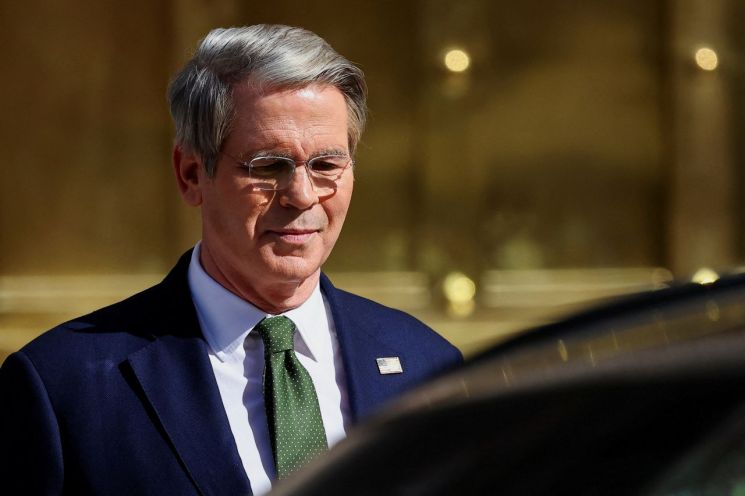
Regarding Japanese Prime Minister Shigeru Ishiba's stance not to rush tariff negotiations with the U.S. ahead of the talks on the 16th, Secretary Vestent said, "I think this will be advantageous for our allies." He continued, "The first mover will have an advantage," and "Usually, the party that makes a deal first achieves the best agreement." When asked who would reach an agreement first, he replied, "That is their choice."
On the same day, The Wall Street Journal (WSJ) reported, citing sources, that the Trump administration is prioritizing trade negotiations with South Korea, the United Kingdom, Australia, India, and Japan. Sources said Secretary Vestent told close aides that these allied countries are his top priorities and that he is in contact with officials from each country. WSJ reported that since Vestent became a key trade advisor to President Donald Trump and took the lead in negotiations, he has been actively communicating with countries subject to reciprocal tariffs.
Although Secretary Vestent had been considered to be overshadowed by economic advisors in the Trump administration such as Commerce Secretary Howard Lutnick and White House advisor Peter Navarro, he has taken a leading role since the announcement of the 90-day suspension of reciprocal tariffs on the 9th.
Kevin Hassett, Chairman of the White House National Economic Council (NEC), said in a CNBC interview that more than ten countries have proposed surprising trade negotiations to the U.S. following President Trump's imposition of reciprocal tariffs.
President Trump initially planned to impose reciprocal tariffs globally starting on the 9th but announced a 90-day suspension and began negotiations with various countries. When asked if there are countries expected to reach agreements before the suspension period ends, Secretary Vestent said, "There may be several countries, and while it may not be an actual trade agreement, we could reach a principled agreement that allows us to move forward on that basis." He added, "It depends on the situation, but we will act as cautiously and quickly as possible." He also mentioned that the negotiations will be based on a vast amount of data collected over years by the U.S. Trade Representative (USTR).
Foreign media predict that, given the time constraints and the fact that negotiations involve over 70 countries, simplified agreements containing commitments to improve trade balances and reduce trade barriers will be made. Since even limited-scope trade negotiations during Trump's first term took several months, it is physically impossible to conclude traditional trade agreements with all countries within 90 days. In particular, for South Korea, where President Trump mentioned a trade and security-linked "one-stop shopping" approach that could include tariffs and defense cost-sharing discussions, time is even more pressing.
When asked if reciprocal tariffs could be completely eliminated through negotiations, Secretary Vestent said, "I say, 'Do your best. I'll judge after seeing what you have prepared,'" adding, "I don't know how the negotiations will unfold." He continued, "There are many issues to resolve, including tariffs, non-tariff barriers, trade barriers, currency manipulation, and subsidies." He also stated that President Trump will personally participate in negotiations with the most important trading partners.
Regarding China, which has imposed a cumulative tariff rate of 145% through retaliatory tariffs, Secretary Vestent left room for negotiations. He said, "This is no joke," but added, "This is a large number, and no one thinks this is sustainable or will continue." He further stated, "There will be a big deal with China someday," noting, "China is our largest economic competitor and military rival, so negotiations with China will be more difficult than with other countries."
In response to questions about whether foreign governments or other forces are dumping U.S. Treasury bonds amid the recent sharp rise in U.S. Treasury yields, he said, "There is no evidence that (the dumping forces) are foreign governments." This was a rejection of analyses suggesting that China has been dumping U.S. Treasury bonds to exert pressure.
© The Asia Business Daily(www.asiae.co.kr). All rights reserved.
![Clutching a Stolen Dior Bag, Saying "I Hate Being Poor but Real"... The Grotesque Con of a "Human Knockoff" [Slate]](https://cwcontent.asiae.co.kr/asiaresize/183/2026021902243444107_1771435474.jpg)
















