Section 232 Investigation Begins on the 1st
Comprehensive Review of Semiconductor Supply Chain
Inevitable Impact on South Korea, Taiwan, and Others
"Supply Chain Disruptions Expected"
The Donald Trump administration in the United States announced that it has begun an investigation to assess the impact of semiconductors and pharmaceuticals on national security. As President Trump has repeatedly indicated, this is a step toward imposing tariffs on semiconductors and pharmaceuticals. Following key South Korean export items to the U.S. such as automobiles, steel, and aluminum, semiconductors are also expected to be affected.
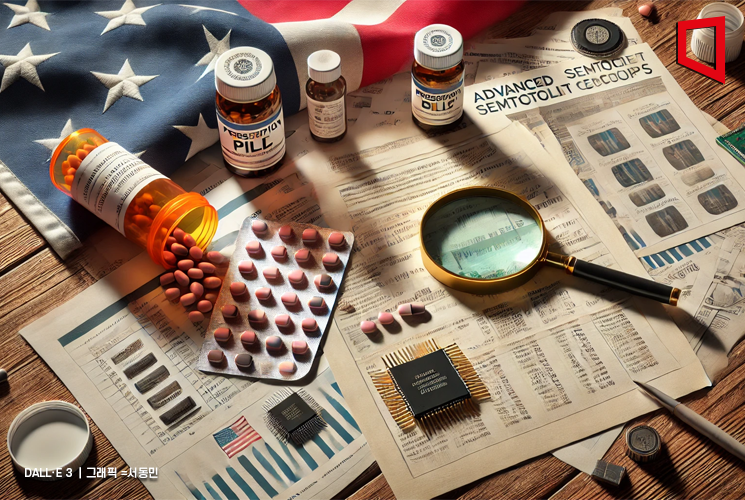
On the 14th (local time), the U.S. Department of Commerce announced in the Federal Register that it has initiated an investigation to determine the impact of imports of semiconductors, semiconductor manufacturing equipment, and derivative products on national security. It also stated that an investigation into pharmaceuticals and their raw materials has begun.
This investigation is based on Section 232 of the Trade Expansion Act. This law grants the President the authority to restrict imports through appropriate measures such as tariffs if imports of certain items are deemed a threat to national security.
Since 25% tariffs were previously imposed on steel, aluminum, and automobiles using Section 232, there is a high possibility that trade measures will also be taken against semiconductors and pharmaceuticals. Although semiconductors and pharmaceuticals were excluded from the reciprocal tariff imposition that began on the 9th, President Trump had previously announced plans to impose item-specific tariffs on semiconductors and pharmaceuticals similar to those on steel, aluminum, and automobiles.
On the previous day, Commerce Secretary Wilbur Ross stated in an interview with ABC News that semiconductor tariffs would likely be announced "within a month or two." President Trump said the day before that semiconductor tariffs would be "implemented in the very near future" and that tariff rates would be announced next week.
According to the Federal Register, the investigation into semiconductors and pharmaceuticals began on the 1st. The Department of Commerce plans to officially publish the investigation in the Federal Register on the 16th and collect public comments for 21 days. The Secretary of Commerce must announce the results within 270 days of the investigation's start, but actual tariff imposition is expected to begin as early as next month.
The semiconductor-related investigation covers semiconductor substrates and wafers, general-purpose semiconductors (legacy semiconductors), cutting-edge semiconductors, microelectronics, and semiconductor manufacturing equipment parts. The Department of Commerce also requested opinions on the overall supply chain, including U.S. demand and production capacity, potential for expanding domestic production, foreign government subsidies, predatory trade practices, and whether measures such as tariffs or import quotas are necessary. The pharmaceutical-related investigation targets finished drugs, key raw materials such as active pharmaceutical ingredients (APIs), vaccines, antibiotics, and medical responses to public health emergencies.
Foreign media have predicted that if semiconductor tariffs are fully implemented, overseas advanced semiconductor manufacturers such as South Korea's Samsung Electronics and SK Hynix, and Taiwan's TSMC may have to raise prices or accept reduced margins. However, President Trump said the day before that "there will be flexibility for some companies," and since cooperation among allies is essential to block China's semiconductor capability enhancement, there may be some room for negotiation.
There is also interest in whether tariffs will apply to semiconductors imported as components embedded in other products. Most semiconductors imported into the U.S. are assembled into electronic products, toys, and automobile parts in Asia or Mexico. Although there is no system to impose tariffs on semiconductors included within products, the U.S. Trade Representative (USTR) began investigating this issue during the previous Joe Biden administration.
Bloomberg News stated, "The new tariffs are feared to deal a significant blow to the essential semiconductor industry, from automobiles to aircraft and mobile phones," adding, "These tariffs could cause major disruptions in the supply chain and increase costs for Americans."
President Trump has criticized the semiconductor law enacted during the previous Joe Biden administration to expand domestic semiconductor production since his last presidential campaign. He argues that subsidies are a waste of budget and that tariffs alone can promote semiconductor production within the U.S. Therefore, the imposition of semiconductor tariffs is seen as a predictable step.
However, some argue that since countries including South Korea, China, Japan, and Taiwan support semiconductor manufacturing through massive subsidies and tax breaks, tariffs are unlikely to help revitalize the domestic industry in the U.S. According to the Semiconductor Equipment and Materials International (SEMI), 105 new semiconductor factories worldwide are scheduled to be operational by 2028, but only 15 of these will be built in the U.S.
Meanwhile, major global pharmaceutical companies such as Eli Lilly and Merck are expected to be inevitably affected as they operate manufacturing facilities worldwide. Pharmaceutical companies are accelerating investment in the U.S. ahead of tariffs, with Novartis recently announcing plans to invest $23 billion in the U.S. over the next five years.
© The Asia Business Daily(www.asiae.co.kr). All rights reserved.

















