Semiconductor Support Fund Expanded by 7 Trillion Won
500 Billion Won to Be Secured Through Supplementary Budget
70% of Underground Power Transmission Line Costs Covered by National Funds
New Investment Subsidies for Advanced Materials, Parts, and Equipment Companies
The government will invest an additional 7 trillion won in the semiconductor industry, which is facing intensified global competition. The state will cover up to 70% of the construction costs for power transmission lines needed for semiconductor clusters and provide investment subsidies to small and medium-sized enterprises producing core components. Of the funds, 500 billion won will be secured through this year's supplementary budget.

Semiconductor support fund expanded by 7 trillion won... 500 billion won secured through supplementary budget
On the 15th, Choi Sang-mok, Deputy Prime Minister for Economy and Minister of Strategy and Finance, chaired the 'Economic Ministers' Meeting and the 'Industrial Competitiveness Enhancement Ministers' Meeting' at the Government Seoul Office in Sejong-ro, Seoul, and announced the 'Plan to Strengthen Fiscal Investment to Secure Global Semiconductor Competitiveness.'
An official from the Ministry of Strategy and Finance said, "With the inauguration of the new U.S. administration, uncertainties have increased and industry demands for government support have grown, but the Semiconductor Special Act is still pending in the National Assembly," adding, "Judging that the golden time could be missed, we have prepared an active fiscal investment plan."
This plan is a follow-up measure to the comprehensive semiconductor ecosystem support plan announced in June last year. At that time, the government announced an investment of 26 trillion won in the semiconductor industry, which has now been expanded by 7 trillion won to 33 trillion won. The support sectors include materials, parts, and equipment (+3.5 trillion won), infrastructure (+2.1 trillion won), and next-generation semiconductor development and talent acquisition (+1.2 trillion won).
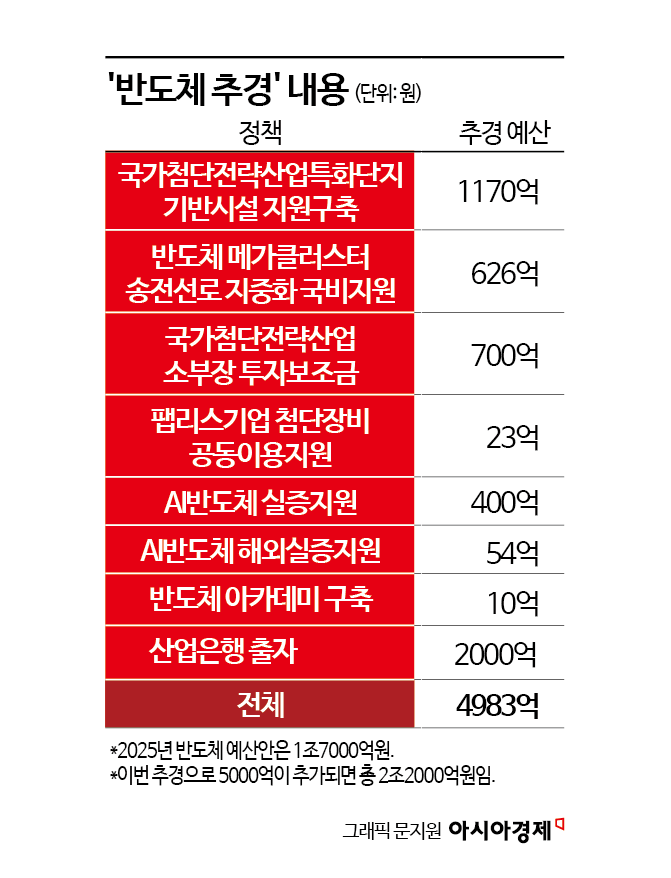
About 500 billion won of the support amount will be secured through the supplementary budget. 298.3 billion won will be allocated by creating new projects or expanding existing budgets, and an additional 200 billion won will be added to the capital of Korea Development Bank. Including the supplementary budget, the total additional fiscal investment by the government amounts to 2.5 trillion won. However, considering the upcoming supplementary budget for the artificial intelligence (AI) sector, the semiconductor-related budget may increase further.
70% support for underground power transmission lines... New subsidies for materials, parts, and equipment
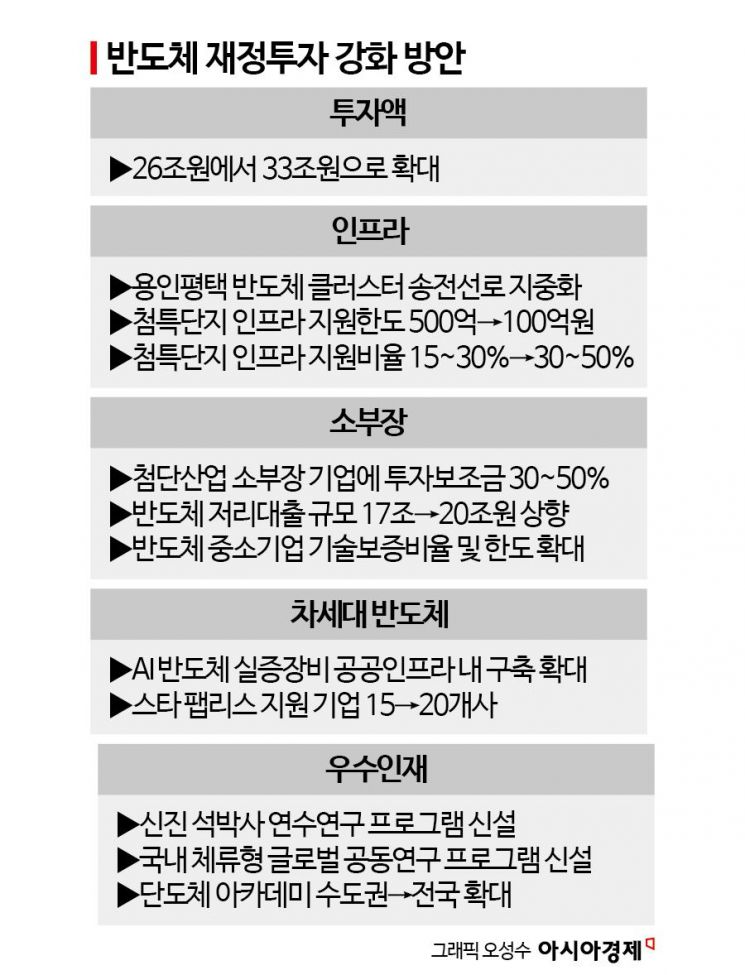
The detailed measures include a plan to support the underground installation of power transmission lines in semiconductor clusters with national funds. In the semiconductor clusters being developed in Yongin and Pyeongtaek, work is underway to bury power transmission lines underground. The total cost is 2.4 trillion won, and excluding Korea Electric Power Corporation's investment (400 billion won) and expenses already incurred (200 billion won), an additional 1.8 trillion won is needed. The government plans to support 70% of this amount, equivalent to 1.2 trillion won, with national funds. The support rate was raised by 20 percentage points from 50% at the time of the Semiconductor Special Act enactment in November last year.
Support for advanced complex infrastructure will also be doubled, not only for semiconductor clusters. For large-scale clusters with investments exceeding 100 trillion won, the national funding limit for infrastructure such as power and water supply will increase from 50 billion won to 100 billion won. The support ratio will also be raised from the current 15-30% to 30-50%. This measure aims to reduce excessive burdens on companies, such as the nearly 4 trillion won cost for wastewater treatment facilities construction in the Yongin industrial complex.
Additionally, 100 billion won will be invested to create subsidies for small and medium-sized enterprises and mid-sized companies in advanced materials, parts, and equipment (SoBuJang). This strategy aims to nurture domestic SoBuJang companies to resolve the serious overseas dependency, as 41% of semiconductor parts are imported from the United States. Small and mid-sized companies producing supply chain stabilization items or strategic materials designated as national advanced strategic industries will receive subsidies covering 30-50% of new investments in location and facilities. Subsidies can be up to 15 billion won per investment and up to 20 billion won per company.
Alongside this, low-interest loans for semiconductors will be supplied up to 20.4 trillion won. On the 5th of last month, the government announced the establishment of an advanced strategic industry fund worth about 50 trillion won and an investment of 17 trillion won in semiconductors, so this represents an increase of over 3 trillion won in about a month. The technology guarantee limit for the semiconductor sector will be raised from 10 billion won to 20 billion won, and the technology guarantee ratio for general semiconductor companies will be expanded from 85% to 95%.
High-priced AI equipment to be installed in public infrastructure
The plan also includes measures for next-generation semiconductor development. Fabless companies (semiconductor design firms) will be able to use expensive AI semiconductor equipment through the establishment of public infrastructure, and a mini fab for demonstrating advanced semiconductors will be built in the Yongin semiconductor cluster. The number of 'Star Fabless' companies, which have technological capabilities and growth potential, will be increased by five from the current 20 and supported.
In addition, to secure talent, training and research programs targeting domestic young master's and doctoral degree holders will be planned, and programs to attract high-level overseas talent will be launched.
© The Asia Business Daily(www.asiae.co.kr). All rights reserved.



















