When Asked About Additional Tariff Exemptions:
"We Are Looking for Ways to Help Auto Companies"
On Smartphone Tariff Exemptions:
"I Am a Very Flexible Person"
Uncertainty Grows Amid Fluctuating Tariff Policies
U.S. President Donald Trump has now hinted at the possibility of tariff exemptions on automobiles and auto parts. Regarding the exemption of tariffs on smartphones, he indicated that there could be flexibility, reversing his previous day's statement that showed a firm intention to impose tariffs on electronic products. Cornered by financial market panic caused by his ultra-hardline tariff policies against the world and domestic criticism, President Trump’s inconsistent tariff moves are causing ongoing uncertainty, making it difficult for companies to conduct business activities.
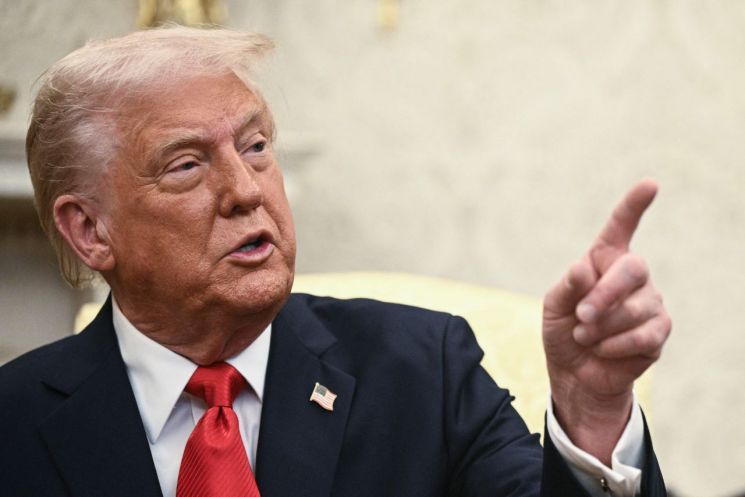
On the 14th (local time), during a meeting with Nayib Bukele, President of El Salvador, in the White House Oval Office, President Trump was asked if there were specific items under consideration for temporary tariff exemptions. He replied, "We are looking for ways to help automobile companies." He explained, "They are transitioning to produce parts here that were previously made in Canada, Mexico, and other regions," adding, "They need a little more time."
Earlier, President Trump imposed a 25% tariff on imported automobiles starting from the 2nd of this month. From the 3rd of next month, tariffs on key auto parts such as engines, transmissions, and powertrains are scheduled to take effect. Although he emphasized the tariffs on automobiles as "permanent" when announcing them last month, about two weeks after the tariff enforcement, he hinted at the possibility of partially exempting tariffs in the automobile sector in the future. He did not specify which items might be exempted.
He also suggested that smartphones could be exempt from tariffs. This was a reversal from the previous day when he personally clarified that no tariff exemptions had been announced regarding mutual tariff exemptions on electronic products.
When asked whether Apple products or smartphones could be exempt from tariffs, he said, "I haven't changed my mind, but I am a very flexible person," adding, "I have helped Tim Cook (Apple CEO) and the entire company." He continued, "I don't want to hurt anyone," and said, "Maybe something might come out of this. But the final outcome will be that America will be in a great position."
Earlier, the U.S. Customs and Border Protection (CBP) excluded 20 electronic products, including smartphones, PCs, and hard disk drives, from the mutual tariff application imposed by the U.S. on various countries on the 11th. Although President Trump and his aides tried to downplay the tariff suspension as a temporary measure the previous day, their inconsistent statements and actions, including mentioning flexibility just a day later, have been criticized for causing market confusion.
Additionally, he reaffirmed the plan to impose item-specific tariffs on pharmaceuticals, stating that it would be implemented in the "near future."
As President Trump frequently changes tariff policies, markets, companies, and U.S. trading partners are all plunged into great confusion due to tariff uncertainty. The continuous policy changes?imposing tariff bombs, then suspending or exempting them, and suggesting re-imposition?have made it virtually impossible for companies to establish long-term business plans. Karl Tannenbaum, Chief Economist at global financial firm Northern Trust, pointed out, "The damage to consumer, corporate, and market confidence is already irreversible."
President Trump has been retreating from his tariff policies as financial markets react violently with stock and bond sell-offs and Wall Street heavyweights repeatedly warn of a recession. In the process of recklessly imposing and then withdrawing tariff attacks, even President Trump is said to have lost direction in tariff policy. The U.S.'s biggest competitor, China, has not budged under tariff pressure, retaliating with counter-tariffs and rare earth export bans, leaving President Trump appearing desperate. Coupled with inflation and economic slowdown concerns, public opinion in the U.S. is worsening, making it increasingly difficult to sustain a long-term tariff war.
AP News criticized, "As President Trump tries to minimize the economic and political backlash caused by his policies, his hardline stance on trade is becoming increasingly ambiguous."
© The Asia Business Daily(www.asiae.co.kr). All rights reserved.
![Clutching a Stolen Dior Bag, Saying "I Hate Being Poor but Real"... The Grotesque Con of a "Human Knockoff" [Slate]](https://cwcontent.asiae.co.kr/asiaresize/183/2026021902243444107_1771435474.jpg)















