Funeral Mass for Bishop Dubong Renado on the 14th
Passed Away on the 10th
"Thank You" Until His Final Moments
"'Thank you. Thank you very much' were the words Bishop Dubong Renado used most frequently during his lifetime. The last words he left behind were also 'Thank you. Truly, thank you.'
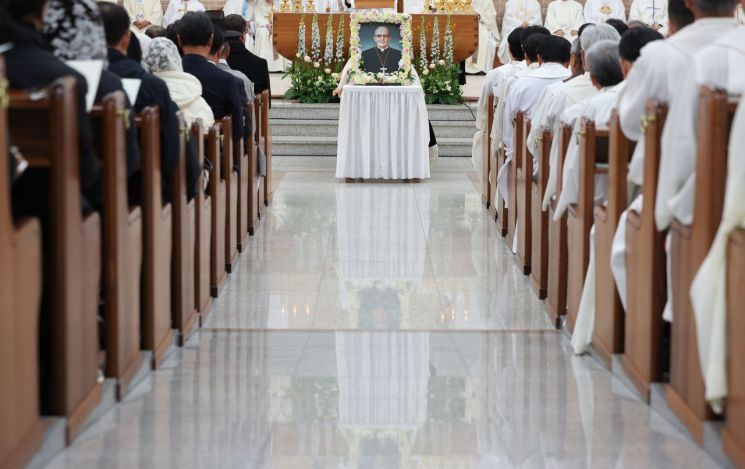 On the 14th, the funeral mass for Bishop Dubong Renado (French name Ren? Dupont) is being held at Moksung-dong Cathedral in Andong-si, Gyeongbuk. Photo by Yonhap News
Bishop Dubong Renado, originally from France, who set foot on Korean soil shortly after the Korean War and served for 71 years, never forgot gratitude until his final moments. On the morning of the 14th, at the funeral Mass held at Moksongdong Cathedral, the cathedral of the Catholic Diocese of Andong in Andong City, Gyeongbuk Province, Bishop Kwon Hyuk-joo, the head of the Andong Diocese, shared the last moments of Bishop Dubong as described above.
Bishop Dubong underwent emergency treatment at Andong Hospital on the 7th due to a stroke and regained consciousness, but passed away on the 10th after receiving his final confession. He wished to have confession on the morning of the day he passed, and although he was too weak to say much, he reportedly said "Thank you" after completing the confession. Later, around 4 p.m., his breathing became rapidly unstable, and after his final prayer around 7 p.m., he passed away.
At the funeral Mass, Bishop Kwon said of Bishop Dubong, "He lived a life of poverty both in heart and body, sharing and giving unconditionally with the poor," and added, "He sought to convey the Kingdom of God and the Gospel as they are, the truth and values themselves, to both believers and non-believers alike."
The Pope also sent a message of condolence. Archbishop Giovanni Gaspari, the Apostolic Nuncio to Korea, said, "His Holiness Pope Francis was deeply saddened to hear of Bishop Dubong’s passing and extends his heartfelt condolences and comfort to the bishop, clergy, religious, laity, and the entire Diocese of Andong."
During the funeral Mass, when the voice recording of Bishop Dubong from April 10 last year was played, the faithful laughed and cried along with his distinctive laughter. "This year marks 70 years since I came to Korea. For 70 years, I have loved and been happy. I have truly been blessed."
The funeral Mass was attended by prominent figures of the Catholic Church in Korea, including Bishop Lee Yong-hoon, Chairman of the Catholic Bishops' Conference of Korea, Cardinal Yeom Soo-jung, Archbishop Jung Soon-taek, Archbishop of Seoul, as well as representatives of the Catholic Farmers' Association and the faithful.
Bishop Dubong was born in 1929 as the second son among three sons and two daughters in a Catholic family in Orl?ans, France. He joined the Paris Foreign Missions Society in 1950, was ordained a priest in 1953, and was dispatched to Korea in December of the following year. He served as assistant priest at Daehung-dong Cathedral in the Diocese of Daejeon, director of the Secretariat of the Diocese of Daejeon, and head of the Korea branch of the Paris Foreign Missions Society before being appointed the first Bishop of the Diocese of Andong in 1969 and receiving episcopal ordination.
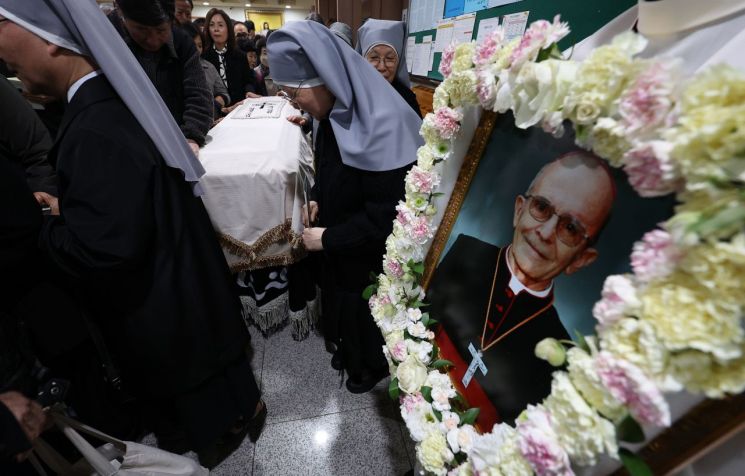 At the farewell funeral mass for Bishop Dubong Renado (French name Ren? Dupont), held on the 14th at Moksung-dong Cathedral in Andong-si, Gyeongbuk, the faithful are saying their goodbyes to Bishop Dubong. Photo by Yonhap News
During the Park Chung-hee regime, he faced the threat of expulsion due to his dedication to the poor and farmers. When Mr. Oh Won-chun, a Catholic and head of the Cheonggi branch of the Farmers' Association in Yeongyang County, protested against the county’s suggestion to cultivate potatoes by saying "The seeds are poor quality and do not sprout," he was kidnapped. Bishop Dubong and other priests stood against the Park Chung-hee regime and faced the risk of expulsion.
In December 1990, while serving as Bishop of Andong, he resigned 14 years before the mandatory retirement age based on his conviction that "a Korean should serve as the diocesan bishop." Until recently, he lived in Uiseong, Gyeongbuk Province, meeting and socializing with faithful who came from afar.
His published works include essay collections "Saram-ui Ilgam" (The Work of People) (Muneumsa, 1989) and "Gajang Meotjin Saenghwal" (The Most Wonderful Life) (Pauline Daughter, 2011). He was awarded the French Napol?on Medal in 1892 and received the Immigrant of the Year Award (Presidential Citation) from the Ministry of Justice in 2019. He also acquired special nationality of the Republic of Korea.
© The Asia Business Daily(www.asiae.co.kr). All rights reserved.
![Clutching a Stolen Dior Bag, Saying "I Hate Being Poor but Real"... The Grotesque Con of a "Human Knockoff" [Slate]](https://cwcontent.asiae.co.kr/asiaresize/183/2026021902243444107_1771435474.jpg)

















