KOSPI Drops 1.02% Compared to End of Last Month in April
"Shipbuilding and Defense ETFs Exceed 10% Returns"
"Low Impact from U.S. Tariff Policies, Growth Potential Remains"
In the stock market, which showed extreme volatility due to U.S. President Donald Trump's tariff policies, shipbuilding and defense exchange-traded funds (ETFs) recorded high returns. In the case of defense, it is relatively free from the U.S. administration's tariff policies, and there is an expectation that shipbuilding could actually benefit.
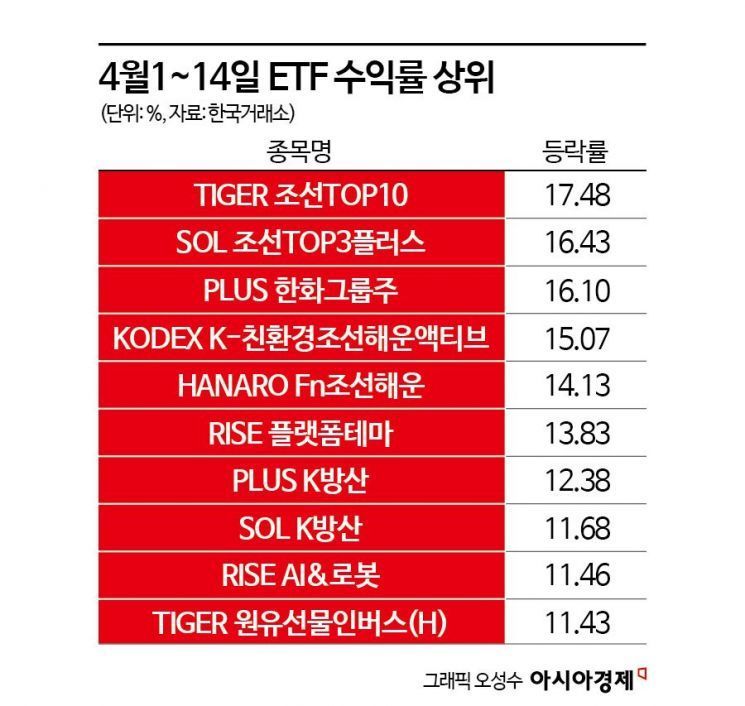
According to the Korea Exchange on the 15th, the top-performing ETF in the domestic stock market from the 1st to the 14th of this month was TIGER JoseonTOP10, with a return of 17.48%. Following were SOL JoseonTOP3Plus (16.43%), PLUS Hanwha Group Stocks (16.10%), KODEX K-Green Shipbuilding & Shipping Active (15.07%), and HANARO Fn Shipbuilding & Shipping (14.13%). Additionally, PLUS K Defense (12.38%) and SOL Defense (11.68%) also recorded returns exceeding 10%.
The domestic stock market showed extreme volatility this month. After the announcement of U.S. reciprocal tariffs, the U.S. stock market plunged, triggering a sell-sidecar (program trading suspension) on the KOSPI on the 7th. On the 10th, news that President Trump would grant a 90-day exemption to all reciprocal tariff countries except China led to a buy-sidecar.
Despite this volatility, the KOSPI fell by 1.02% compared to the end of last month, but shipbuilding and defense ETFs posted excellent returns.
The reason for the strong performance of shipbuilding and defense ETFs is interpreted as these sectors being relatively free from U.S. tariff policies. In the case of defense, major export regions include Europe, the Middle East, and Asia, making it less affected by U.S. tariff policies. Additionally, the 'REARM Europe Plan' announced last month by the European Union (EU) is a positive factor. The plan aims to mobilize funds amounting to at least 800 billion euros (approximately 1,229 trillion KRW) to promote increased defense spending among member countries.
Yang Seung-yoon, a researcher at Eugene Investment & Securities, said, "The defense industry benefits from a trickle-down effect due to increased weapons demand from Europe and new opportunities in the Middle East and Asia-Pacific markets," adding, "The multiples of Korean defense stocks have followed U.S. defense stocks and have now started to chase European defense multiples."
Expectations for shipbuilding ETFs are rising rather than concerns. This is because President Trump signed an executive order to rebuild the shipbuilding industry, which is expected to accelerate domestic shipbuilders' participation in maintenance, repair, and overhaul (MRO) businesses.
The carbon tax to be introduced by the International Maritime Organization (IMO) from 2027 is also a positive factor. Large vessels over 5,000 tons engaged in international voyages must meet strengthened greenhouse gas intensity standards for ship fuel oil starting in the first half of 2027. Failure to comply will result in costs proportional to greenhouse gas emissions for operation.
The securities industry expects that these regulations will further increase orders for merchant ships. Kang Kyung-tae, a researcher at Korea Investment & Securities, explained, "The global shipbuilding merchant ship order cycle will be prolonged," adding, "This is because the pricing of emissions creates the strongest incentive to replace aging vessels."
© The Asia Business Daily(www.asiae.co.kr). All rights reserved.
![Clutching a Stolen Dior Bag, Saying "I Hate Being Poor but Real"... The Grotesque Con of a "Human Knockoff" [Slate]](https://cwcontent.asiae.co.kr/asiaresize/183/2026021902243444107_1771435474.jpg)

















