Ramen and Konjac Noodles Lead the Way
Noodle Market Grows on Convenience and Health Food Trends
Manufacturers Like Myeon Sarang See Strong Performance
Amid a contraction in the domestic economy and rising cost burdens worsening the overall sentiment in the food industry, the noodle sector has continued its growth trend. This is attributed to the combined effect of a preference for healthy foods and increased demand for convenience foods, resulting in expanded consumption both domestically and in exports.
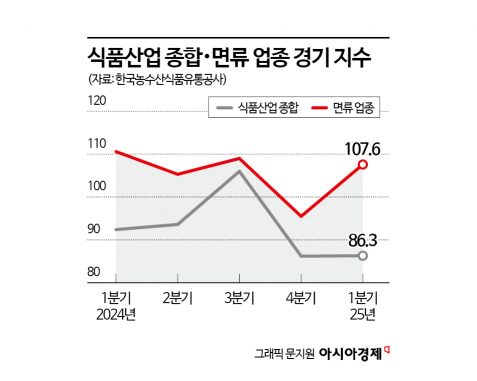
According to the "2025 Q1 Food Industry Business Trend Survey" released on the 15th by the Korea Rural Economic Institute and the Korea Agro-Fisheries & Food Trade Corporation, the business condition index for the noodle sector in the first quarter stood at 107.6, exceeding the baseline (100). The outlook index for the second quarter was also recorded at 100.7.
In this survey, sectors such as grain processing (59.8), meat processing (77.6), fruits and vegetables (79.2), and rice cakes, bread, and confectionery (90.4) were classified as deteriorating industries. The overall food industry business condition index was 86.3, below the baseline. Major causes identified included decreased consumer spending (56.6%), economic instability due to high interest rates and high exchange rates (21.5%), and poor raw material crop yields caused by climate change (10.5%).
The survey was conducted from the 17th to the 28th of last month targeting 1,519 food and beverage manufacturers nationwide. An index below 100 indicates that more companies perceive the business conditions as worsening compared to the previous quarter, while an index above 100 indicates the opposite.
Domestic Market Worth 3.5 Trillion KRW... Growth Driven by Health and Convenience Food Trends
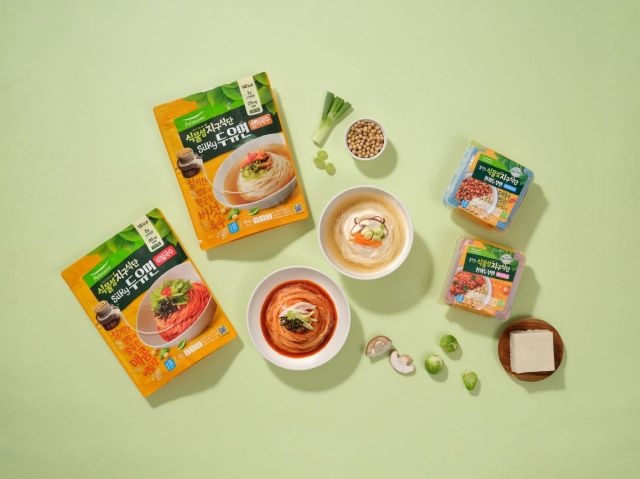
The domestic noodle market grew from 2.445 trillion KRW in 2020 to 3.546 trillion KRW in 2023. Noodles refer to products made primarily from grain flour and starch, shaped, heat-treated, and dried. Types include fresh noodles, cooked noodles, dried noodles, and fried noodles. By market share, fried noodles such as ramen accounted for the largest portion at 65.7%, followed by cooked noodles at 16.4%, dried noodles at 13.0%, and fresh noodles at 4.8%. A representative from the Korea Agro-Fisheries & Food Trade Corporation explained, "With the spread of health and wellness trends, there is increasing caution against excessive carbohydrate intake, leading to growing demand for alternative noodles," citing seaweed noodles, konjac noodles, and tofu noodles as examples.
Noodle exports are also on the rise. Last year, noodle export value reached 1.362 billion USD, a 22.1% increase from the previous year’s 1.115 billion USD. Among all exports, ramen showed the steepest growth at 31%, but exports of other noodles such as wheat noodles (13%), cold noodles (10%), glass noodles (10%), and alternative noodles (9%) also showed an increasing trend. The popularity of products labeled in Hangul and K-Food certified products has contributed to export growth to the U.S., Southeast Asia, and Europe.
Corporate Performance Also on the Rise... Strengthening Convenience Food Lines Proves Effective
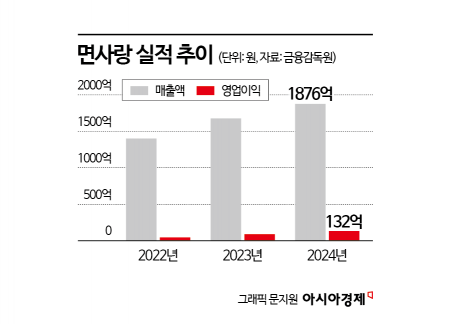
The popularity of noodles is also reflected in the performance of food companies. Myeon Sarang, a noodle-specialized manufacturer, recorded sales of 187.6 billion KRW and operating profit of 13.2 billion KRW last year, marking increases of 12% and 46% respectively compared to the previous year. The company focuses on frozen noodles, fresh noodles, udon, and cold noodles primarily for B2B transactions, with expanded school meal and dining-out channels and investments in factory automation driving performance improvements.
Myeon Sarang was established in 1991 as Janghak Food and changed its name in 1998. CEO Jeong Se-jang of Myeon Sarang is the son-in-law of the late Ham Tae-ho, honorary chairman and founder of Ottogi, and the brother-in-law of Ham Young-jun, chairman of Ottogi. Production is handled at the headquarters in Jincheon, Chungbuk, and recently the company has also been strengthening its B2C convenience food lines. From January to March, 'Meatball Bologna Spaghetti' recorded a sales increase of 270% compared to the same period last year, and 'Bacon Cream Spaghetti' saw a 233% increase.
Pulmuone is solidifying its position in the premium fresh noodle and cold noodle market with its 'Saeng Gadeuk' series and is expanding its range of healthy alternative noodles such as tofu noodles, soy milk noodles, and konjac noodles. It is also simultaneously expanding exports to overseas markets including the U.S., China, and Japan. Ottogi maintains its market share in packaged noodles such as frozen udon and old-fashioned noodles by leveraging its home meal replacement distribution network. In particular, it is accelerating distribution expansion in convenience stores and e-commerce with easy-to-cook pouch-type products.
An industry insider stated, "Health-oriented consumption and the spread of convenience food demand are becoming stable growth foundations for the noodle industry," adding, "Product innovation and diversification of distribution strategies will be key factors determining corporate performance in the future."
© The Asia Business Daily(www.asiae.co.kr). All rights reserved.
![Clutching a Stolen Dior Bag, Saying "I Hate Being Poor but Real"... The Grotesque Con of a "Human Knockoff" [Slate]](https://cwcontent.asiae.co.kr/asiaresize/183/2026021902243444107_1771435474.jpg)

















