Kim Kyungsoo Pursues a 'Good Second Place,' Minimizes Confrontation with Lee
Kim Dongyeon Focuses on Differentiation; Kim Dookwan Considers Withdrawing from the Race
The Democratic Party of Korea has effectively finalized the presidential primary rules through a 'National Participation Primary,' causing significant ripples among the non-Lee Jae-myung (Bi-Lee Jae-myung) faction presidential candidates. Former Gyeongnam Governor Kim Kyung-soo accepted the party leadership's decision and officially confirmed his presidential candidacy. On the other hand, Gyeonggi Governor Kim Dong-yeon and former lawmaker Kim Doo-kwan have criticized the unfair primary rules and have even raised the possibility of withdrawing midway.
The Democratic Party's Special Committee for Preparing Presidential Primary Rules plans to officially enact the so-called 'National Participation Primary,' which selects the presidential candidate through 50% party members' votes and 50% general public opinion polls, as the 'Special Party Rules on the Selection of Candidates for the 21st Presidential Election' on the afternoon of the 14th. Special Rules Committee Chair Lee Chun-seok said, "After intense discussions, we decided to change the primary rules from a national primary to a national participation primary."
The National Participation Primary is widely regarded in political circles as a primary system favorable to the leading presidential candidate, former party leader Lee Jae-myung. Since Lee, who already controls the party leadership, has a significant advantage in the party members' vote, which accounts for 50%, and the other 50%?the public opinion poll?can minimize the 'reverse selection' concerns that were feared in the 'national primary' system. Conversely, for non-Lee faction candidates with weaker party leadership control, this primary rule is the most disadvantageous compared to the 'complete national primary (open primary)' and 'national primary' systems.
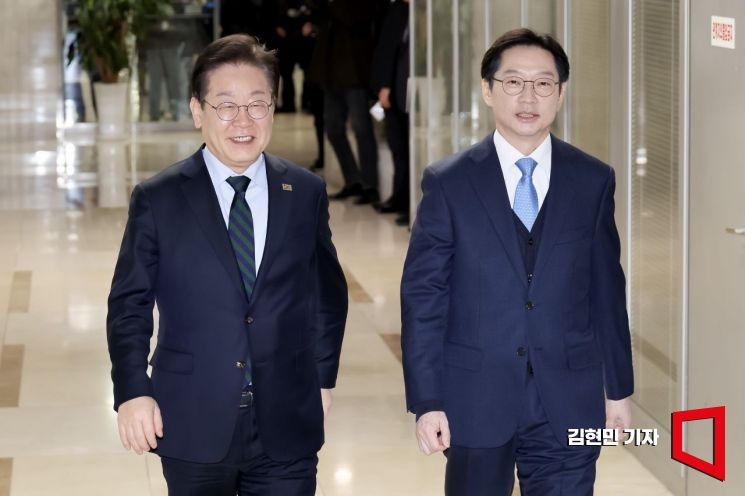 Lee Jae-myung, leader of the Democratic Party of Korea, and Kim Kyung-soo, former governor of Gyeongnam, are entering the meeting room at the National Assembly on the 13th. 2025.2.13 Photo by Kim Hyun-min
Attention is focused on the actions of former Gyeongnam Governor Kim Kyung-soo. He officially declared his presidential candidacy in Sejong the day before, immediately after the party leadership virtually finalized the primary rules. This effectively acknowledges the primary rules. A change is also detected in his initial statements. In February, he pressured former leader Lee by putting constitutional amendment at the forefront. However, in his candidacy announcement, he said, "The completion of ending internal strife is the constitutional amendment," but added, "After 400 days of social public discussion and deliberation following the presidential election, the constitutional amendment will be carried out in the next (next year's) local elections." Rather than confronting Lee, who is lukewarm about immediate constitutional amendment, he emphasized unity and coalition, aligning his pace accordingly.
The political circles interpret that former Governor Kim has embarked on a 'good second place' strategy aiming for the next party leadership in this primary. The 'good second place' strategy was first mentioned by former Roh Moo-hyun Foundation Director Yoo Si-min on the 5th. Yoo advised Kim to "use a strategy of becoming a good second place," suggesting that he should refrain from confrontation with the party and criticism of the one-pole system centered on former leader Lee. The advice implies that Kim should secure a meaningful vote share in this primary to establish his position as a future party leader and a leading presidential candidate. Political commentator Choi Soo-young said in a phone interview, "Former Governor Kim will adopt a strategy advocating inclusion and unity without provoking former leader Lee for the next step," and predicted, "If he secures 20-25% of the primary vote, he can solidify his position as the next leading candidate."
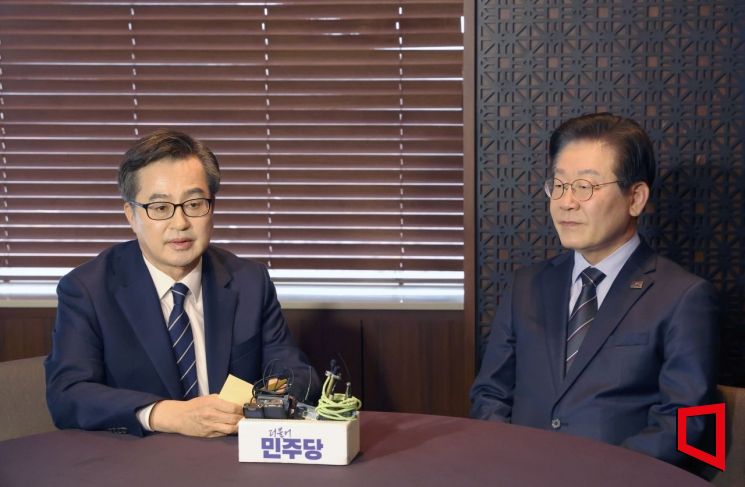 On the afternoon of the 28th, Lee Jae-myung, leader of the Democratic Party of Korea, and Kim Dong-yeon, governor of Gyeonggi Province, met at a Chinese restaurant in Yeouido, Seoul. Lee has been continuing his unification efforts through consecutive meetings with prominent non-Lee Jae-myung faction figures. He has already met with former Gyeongnam Governor Kim Kyung-soo, former Prime Minister Kim Boo-kyum, former lawmaker Park Yong-jin, and former Presidential Chief of Staff Im Jong-seok. 2025.2.28. Photo by the National Assembly Press Photographers Group
On the other hand, Gyeonggi Governor Kim Dong-yeon is focusing on differentiation by confronting former leader Lee on major issues. A representative example is his criticism of Lee's 'one-pole system' and his advocacy for a decentralized four-year renewable term system. Emphasizing his expertise as an economic specialist, he immediately went on a business trip to Michigan after announcing his presidential candidacy to respond to Trump-originated tariff policies, which is interpreted as a strategy to maximize differentiation from former leader Lee. Governor Kim immediately reacted to the primary rules, saying, "I regret that it seems to be a meaningless primary, a mere formality."
Former lawmaker Kim Doo-kwan is reportedly discussing whether to withdraw from the race in protest against the Democratic Party's primary rules. If the party finalizes the National Participation Primary on the afternoon of the day, he may decide his position through a statement. Prior to this, Kim canceled all his scheduled events for the day.
© The Asia Business Daily(www.asiae.co.kr). All rights reserved.
![Clutching a Stolen Dior Bag, Saying "I Hate Being Poor but Real"... The Grotesque Con of a "Human Knockoff" [Slate]](https://cwcontent.asiae.co.kr/asiaresize/183/2026021902243444107_1771435474.jpg)

















