World Quantum Day Established to Commemorate the 'Planck Constant'
Quantum-Related Events Held Worldwide
Korea Remains 'Quiet'... Still Lacking Investment and Interest
Government's Pledge to Foster Three Major Game-Changing Technologies Seen as Empty Slogan
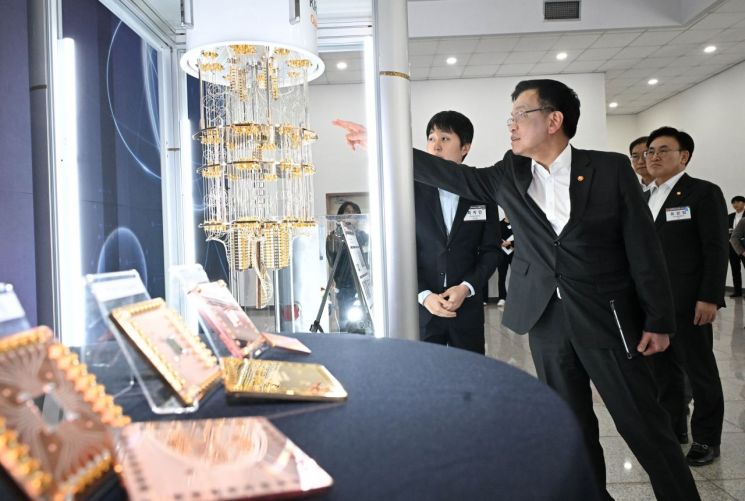 Choi Sang-mok, Acting President and Deputy Prime Minister as well as Minister of Economy and Finance, is listening to an explanation about a quantum computer and its core component, the Quantum Processor Unit (QPU), before attending the first meeting of the Quantum Strategy Committee held on the 12th of last month at the Korea Research Institute of Standards and Science in Daejeon. Photo by Yonhap News.
On the 14th, in celebration of 'World Quantum Day,' quantum-related events are being held worldwide in succession. As it is known that synergy effects are significant when combined with artificial intelligence (AI), there is growing attention on the industrialization of quantum technology. However, unlike the global atmosphere, Korea's 'Quantum Day' remains quiet. Although the government emphasizes fostering quantum technology as one of the three major game-changing technologies, concerns are emerging that interest and investment are still insufficient, making it seem like mere slogans.
According to the scientific community, around this day, quantum-related events are scheduled one after another in countries around the world. In Washington D.C., the center of quantum technology in the United States, the 'Quantum Tech USA 2025 Conference' is being held over three days starting today. Experts from various fields such as quantum computing, quantum communication, and quantum sensing, along with research institutions and companies, gather to discuss the approaching quantum era, covering areas including machine learning, new drug research, financial modeling, cybersecurity, environment, energy, and defense industries. Quantum computing company IonQ will ring the closing bell at the New York Stock Exchange (NYSE) on this day.
Saudi Arabia, attempting to transform from an oil-producing country to a technology nation, is also preparing quantum events. In its capital Riyadh, a 'Discovering Quantum Possibilities' forum is being held with the support of the World Economic Forum (WEF). Saudi Arabia’s oil company Aramco, the country’s financial backbone, is cooperating in this event. WEF plans to announce the winners of the UpLink Quantum for Society Challenge, a competition awarding quantum technologies aimed at solving social issues such as climate, equitable healthcare, food, and freshwater, in conjunction with this event.
Various events aimed at popularizing quantum technology, rather than technical presentations, are also taking place. In the Netherlands, the University of Twente is hosting an ecosystem celebration event sharing the innovation achievements of five major quantum hubs. In Canada, which is emerging as a quantum hub, the University of Waterloo has scheduled a quantum-themed film screening and panel discussion. Taiwan is holding a 100th-anniversary quantum science fair. The African Institute for Mathematical Sciences is also announcing an online event inviting experts.
World Quantum Day is held annually on April 14th to commemorate 4.14, the first digits of the Planck constant. Since 2022, it has been mainly conducted as an academic event centered on European scientists, but this year it is particularly prominent. This is because it marks the 100th anniversary of the development of quantum mechanics and the United Nations (UN) has designated it as the 'International Year of Quantum Science and Technology.'
In Korea, the 'Quantum Korea' event is held every June by the Ministry of Science and ICT. Former President Yoon Seok-yeol attended the 2023 Quantum Korea event and promised support, but the scale of the event has been continuously shrinking since then. Also, the National Quantum Strategy Committee, chaired by the Prime Minister, held its first meeting last month amid controversy over its delayed launch.
The government has promised investment in quantum technology by exempting preliminary feasibility studies, but the gap with major advanced countries such as the United States, China, and Europe remains significant. Advanced countries have identified quantum technology as a key technology that will determine their national future and have been implementing national-level strategies and investments for several years.
As a result, Korea has not achieved significant results in the quantum-related field. Compared to the internet and mobile innovations over 20 years ago, Korea has repeatedly failed to make a presence in AI and quantum fields. Concerns are growing that Korea may fall behind in future science, technology, and applied industries. It is also evaluated that Korea’s quantum technology is only about 2% of that of the United States. Although the country’s first quantum computer was installed at Yonsei University, even this cannot be freely utilized. An industry insider said, "This computer cannot be accessed without the permission of the United States."
On the other hand, the United States is investing billions of dollars in quantum information science through the 'National Quantum Initiative,' China has built the world’s largest national quantum research institute, and the European Union (EU) is investing over 1 billion euros over ten years through the 'Quantum Technology Flagship' program. As a result, since the end of last year, American companies such as Google, IBM, and AWS have successively announced breakthroughs in quantum-related technologies, and China has also been showcasing the achievements of its domestic quantum technology one after another.
Han Sang-wook, president of the Korean Quantum Information Society, explained, "Since the government mainly invests in quantum technology in Korea, it has not been able to actively respond to the World Quantum Day events led by the private sector worldwide."
▲ Max Planck = A German physicist who contributed to the establishment of quantum mechanics. In 1899, he discovered a new fundamental constant, the Planck constant, and was the first in the physics community to introduce the concept and term 'Quantum.' He received the Nobel Prize in Physics in 1918. His name remains in the Max Planck Society, a world-renowned scientific research institution that has produced multiple Nobel laureates.
© The Asia Business Daily(www.asiae.co.kr). All rights reserved.

















