Probability of Identical Patterns
10³² Times Lower Than Human Fingerprints
Electronic Skin with Unique, Inimitable Patterns Developed
Published in Nature Communications
'One in 64 billion'?this is the probability that two people have identical fingerprints.
Even identical twins, who share the same genetic information, have different fingerprints. Now, a technology has emerged that can engrave such fingerprints onto electronic skin. The probability that two of these artificial fingerprints are identical is 10³² times lower than that of human fingerprints matching.
A research team led by Professor Shim Kyoseung from the Department of Chemistry at UNIST has developed a fingertip electronic skin engraved with wrinkle patterns even more unique than human fingerprints. This development is expected to usher in an era where physical AI robots can be equipped with electronic skin that enables unique identification, just like fingerprints.
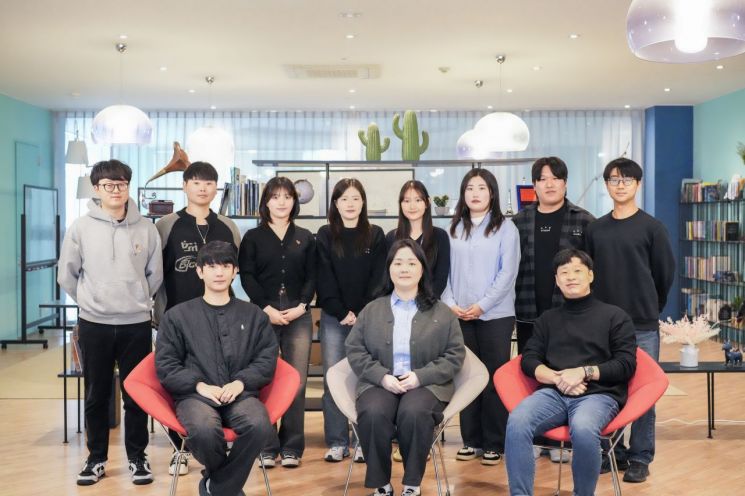 Research team. (From the bottom left) Researcher Haechan Park, Researcher Jooyoung Lee, Professor Kyoseung Shim. Provided by UNIST
Electronic skin needs to incorporate sensors for sensation and mimic the flexibility of natural skin, making flexible organic materials more suitable than rigid inorganic ones. In particular, fingertip electronic skin must also be able to distinguish between objects, so it has been challenging to create skin that is both highly functional and features unique patterns like fingerprints.
Professor Shim’s team developed a fabrication technique that easily imprints random wrinkle patterns onto flexible polymer (SEBS) electronic skin. After chemically treating the flexible polymer to produce a base skin, they simply drop toluene solvent onto it and spin it at high speed, causing random wrinkles to form on the surface. The principle is that the surface, swollen by the toluene solvent, contracts into wrinkles as the solvent evaporates.
The probability of these artificial fingerprints being recreated in exactly the same pattern is only 1 in 10⁴³ per 1㎟. This is 10³² times lower than the probability of identical human fingerprints, and when scaled to the size of a human fingerprint, the chance of the same pattern forming is virtually zero. The artificial fingerprints are also highly resistant to physical shock, heat, and humidity, allowing the patterns to be maintained for a long time.
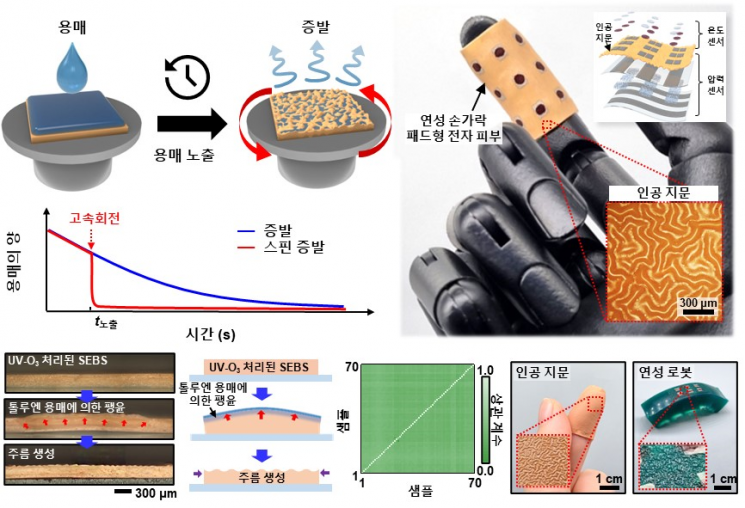 Artificial fingerprint pattern generation process and technology applied to artificial fingerprint electronic skin.
When this developed electronic skin is transplanted onto a robot hand, the robot can grasp objects like a human, recognize surface textures, and even distinguish living beings. The research team also demonstrated a robot equipped with electronic skin and an embedded temperature sensor that physically reacts by avoiding hot objects, just like a person would.
Professor Shim Kyoseung, who led the research, stated, "By utilizing a simple process, we have achieved a probability of identical pattern formation even lower than that of real fingerprints. This technology can be widely applied to future technologies where security and unique identification are crucial, such as personal electronic skin, full-lifecycle managed soft robots, and next-generation human-machine interfaces."
This research was conducted with Lee Jooyoung and Park Haechang from the Department of Chemistry at UNIST as co-first authors, in collaboration with Professor Zhengwei Li's team from the Department of Biomedical Engineering at the University of Houston in the United States.
The study was supported by the Institute for Basic Science at Ulsan National Institute of Science and Technology and the Young Researcher Program of the National Research Foundation of Korea under the Ministry of Science and ICT. The research results were published in the renowned international journal Nature Communications on March 5.
© The Asia Business Daily(www.asiae.co.kr). All rights reserved.
![Clutching a Stolen Dior Bag, Saying "I Hate Being Poor but Real"... The Grotesque Con of a "Human Knockoff" [Slate]](https://cwcontent.asiae.co.kr/asiaresize/183/2026021902243444107_1771435474.jpg)
















