Startups, Investors, and Support Organizations Gather in One Place
Dedicated Fund Established... IR and Meetups to Attract Investment
32 Companies and Organizations Move In, Inquiries Continue
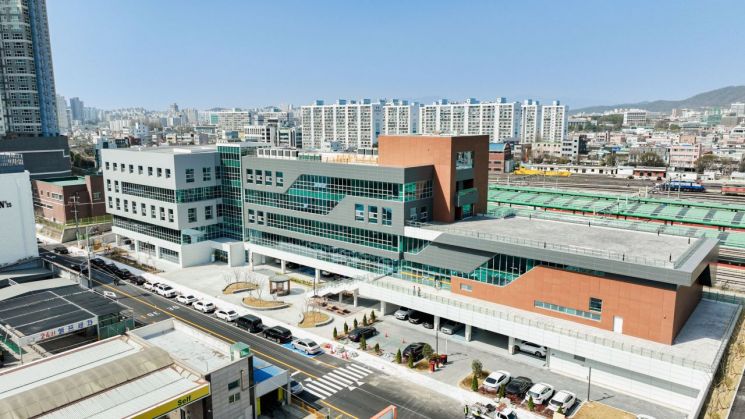
The "Gwangju Station Startup Valley," the largest of its kind in the Honam region, is emerging as a glocal innovative startup hub, with its first core facility and early-stage startup support center, "Bitgoeul Startup Station (STA·G, hereafter referred to as Stage)," drawing significant attention from entrepreneurs.
Not only are there numerous inquiries from startups and investment institutions seeking to move in, but leading domestic partners are also applying to join the startup nurturing program, creating a vibrant startup ecosystem from the very beginning.
The city of Gwangju invested a total of 35 billion won in a site near Gwangju Station to construct "Stage," a five-story building (with a total floor area of 8,950㎡) as part of the Ministry of Land, Infrastructure and Transport's Urban Regeneration New Deal Project, which was completed in December last year.
Stage stands for "STARTUP STATION GWANGJU," symbolizing a "stage where startups can pursue their big dreams." The goal is for startups to successfully settle and thrive in Gwangju.
Stage consists of 41 dedicated office spaces for startups and 5 exclusive spaces for investment institutions such as venture capital (VC) and accelerators (AC). The dedicated area for each space ranges from 45 to 102㎡, offering various options according to each company's needs. Additionally, there are shared office support spaces, large and small conference rooms, a multipurpose hall, cafeteria, open lounge, and rooftop garden to support startups.
Stage goes beyond simply providing space, operating systematic startup support programs such as IR (Investor Relations), meetups, and global expansion. In particular, with investment institutions like VCs and ACs stationed onsite, Stage serves as a hub for attracting investment and facilitating networking among companies.
In February, the city recruited startups and support organizations for Stage, resulting in 29 startups and 1 support organization moving into 32 spaces. It is expected that more than 30 investment firms will be regularly present in the shared office spaces, further raising interest among startups, investors, and support organizations.
The city plans to cluster startups, startup planners, investors, and related organizations here. Through support for startup programs such as investment activation, open innovation, global expansion, and acceleration, the goal is to nurture unicorn companies.
Specifically, to boost investment, a dedicated fund will be created and operated, and monthly investment challenges will be held to help resident companies secure real investments.
For resident companies, direct and follow-up investment attraction will be promoted, and promising startups will be encouraged to move into Stage. For non-resident companies, annual survival-style IR demo days will be held, with the final selected companies receiving commercialization funding and the opportunity to move into Stage the following year. Startup support programs related to open innovation, global expansion, and acceleration will be operated in cooperation with partner companies possessing specialized capabilities in each field.
Gwangju City will select three partner companies with expertise in operating open innovation programs, providing opportunities for collaboration models and technology proof-of-concept (PoC) between large/mid-sized enterprises and startups. This is expected to lead to direct and indirect follow-up investments.
For startups aiming for global expansion, a partner company with expertise in global localization will be selected to provide a global competency enhancement program. The city will analyze startup needs and offer customized mentoring by matching experts. Not only will participation in overseas exhibitions be supported, but efforts will also be made to connect to global commercialization and investment opportunities.
For the acceleration support program, five outstanding private incubators will be selected as partners to operate autonomous programs leveraging their strengths in HR, labor, tax, market development, intellectual property, and more. This is expected to contribute not only to the activation of Stage but also to strengthening the business capabilities and increasing the value of startups.
In fact, when Gwangju City recruited partners to operate open innovation, global expansion, and acceleration support programs, 14 of the nation's top startup support organizations applied. Expectations are rising for the growth and scale-up of startups. Furthermore, more than 30 startup-related events are scheduled to be held at Stage this year, raising expectations among local entrepreneurs.
Joo Jaehee, Director of Economic and Startup Affairs, said on the 13th, "We are truly feeling the passionate interest of local entrepreneurs in Stage," and added, "Gwangju City will become a strong supporter for entrepreneurs and will actively help innovative ideas become successful businesses."
Meanwhile, the "Gwangju Station Startup Valley Development Project," which Gwangju City is focusing on, is an urban regeneration project aimed at revitalizing the declining city center by establishing high-impact startup support infrastructure and improving social and economic infrastructure on idle land at Gwangju Station. By 2027, the city plans to sequentially establish a Complex Hub Center, Corporate Innovation Growth Center, and Social Economy Innovation Town. Through this, a one-stop integrated platform enabling everything from startup to global expansion will be built.
© The Asia Business Daily(www.asiae.co.kr). All rights reserved.
![Clutching a Stolen Dior Bag, Saying "I Hate Being Poor but Real"... The Grotesque Con of a "Human Knockoff" [Slate]](https://cwcontent.asiae.co.kr/asiaresize/183/2026021902243444107_1771435474.jpg)















