KIC Releases Report on Structural Characteristics of the Construction Industry and Solutions for Smart Construction
"Need to Shift Toward Technology Dissemination and Generalization"
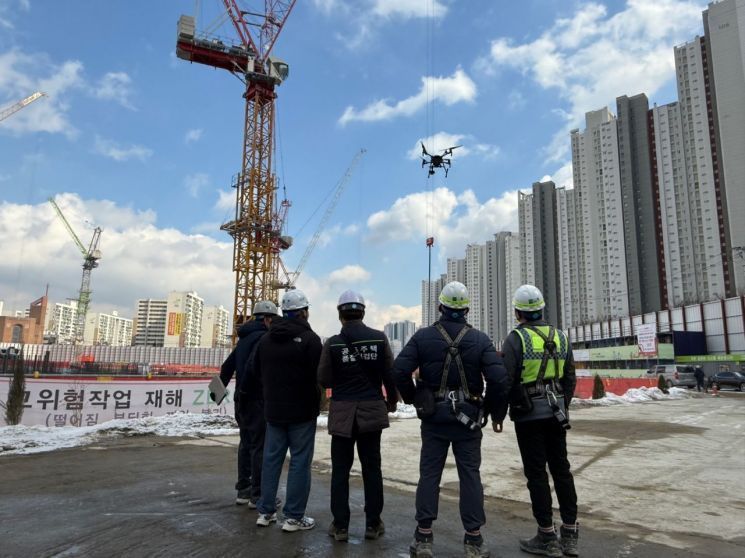 A drone is being used to conduct a safety inspection at a multi-family housing construction site. Gyeonggi-do
There is a claim that in order to improve productivity using smart construction technology, conditions should be created that allow universal utilization rather than monopolization.
Kim Wooyoung, a research fellow at the Korea Construction Industry Research Institute (KIC), stated this on the 12th in a report titled "Structural Characteristics of the Construction Industry and Solutions for Smart Construction."
Researcher Kim explained, "Current new technology policies support specialized companies with new technologies to secure new projects through those technologies," adding, "This is a system that encourages monopolistic situations, which hinders market stability and technological advancement, and is not a desirable direction from the perspective of the construction market."
He further said, "It is desirable to shift to a method where a certain license fee is paid to disseminate and generalize the technology."
According to the report, the productivity of the construction industry is lower compared to manufacturing or finance. The labor productivity index of the construction industry in 2024 has actually decreased by 21.5% compared to 2011. Causes include a labor-intensive industrial structure, slow adoption of digital and automation technologies, rising material costs due to supply chain management issues, and inefficient project management.
Additionally, it has been established that investment in smart construction technology does not necessarily lead to improved efficiency. Smart construction technology can be divided into management and production uses. Management technologies include drones, robots, and sensors developed by general construction companies to monitor and manage site conditions, but these do not directly contribute to productivity improvement. While safety and quality can be enhanced, productivity factors such as processes and costs are not significantly affected.
On the other hand, production technologies such as bricklaying robots or plastering robots used by specialized construction companies related to certain facilities or specialized fields are evaluated to directly impact productivity improvement.
Researcher Kim said, "When investing in smart construction technology development, strategic approaches are necessary because new technologies do not necessarily have utility in construction projects," adding, "Construction projects involve numerous trades intricately linked, so improving processes in only some trades makes it difficult to achieve overall project performance."
He continued, "The entire construction process should be analyzed by detailed trades, and the development level of applicable smart technologies may vary depending on the degree of impact on productivity," emphasizing, "Each detailed trade is performed by specialized construction companies in different fields, so a system must be established to disseminate and share newly developed smart technologies so that they can be utilized by specialized construction companies."
Researcher Kim also added, "An approach is needed to analyze the construction production process and appropriately invest in areas where advanced smart technologies are required among the technologies that directly influence the productivity of detailed trades."
© The Asia Business Daily(www.asiae.co.kr). All rights reserved.