Koryoin Korean Literature Exhibition Held in Gwangju
"If We Do Not Record It in Writing, Life Itself Disappears"
"I have been recording the lives of those who have been forgotten. In my mother tongue, I wanted to leave a mark of a person's life that cannot be erased."
On the 11th, Gwangju Koryoin Village held the 'Koryoin Korean Literature Exhibition' and the 'Special Exhibition on Sakhalin Koreans Who Moved to Central Asia' at Hong Beomdo Park in Wolgok-dong, Gwangsan-gu. At the opening ceremony, Lee Jeonghee, a Korean-language writer from Sakhalin, took the stage for a storytelling performance and shared her life and literary journey.
The event opened with a congratulatory performance by the Arirang Song and Dance Troupe, composed of Koryoin elders, and was attended by Koryoin Village residents, domestic and international visitors, and guides from the Koryoin Village Tourism Office. The opening ceremony and cultural events that followed were filled with moments to reflect on the migration history, identity, and present-day lives of the Koryoin community.
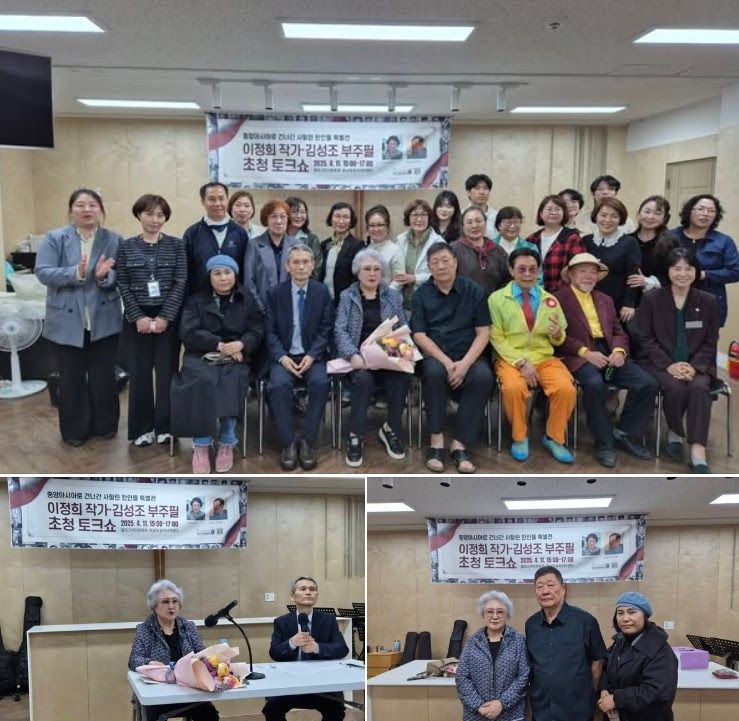 On the 11th, Gwangju Koryoin Village held the opening ceremony of the "Koryoin Hangul Literature Exhibition" and the "Sakhalin Korean Special Exhibition" at Hong Beomdo Park, the center of the village, followed by a storytelling performance featuring Lee Jeonghee, a Hangul writer from Sakhalin. Provided by Gwangju Koryoin Village
During the storytelling performance hosted by Kim Byunghak, director of the Koryoin Cultural Center, writer Lee Jeonghee candidly shared her journey from growing up as a second-generation Koryoin born in Sakhalin to working as a journalist for a Korean-language newspaper and pursuing literary creation and activities.
She spoke about the background of her parents' migration to Sakhalin, how she came to learn the Korean language, and memories from her days at the Sakhalin Korean School, saying, "Holding onto my mother tongue even amid discrimination was the strength that protected me." She also vividly recounted her experiences studying abroad and migrating to Central Asia, as well as her time working as a journalist.
Lee began her literary and journalistic career at the Koryoin newspaper Lenin Kichi (now Koryo Ilbo). In 1971, she became the first female writer to have her work published in the book 'October Sunlight,' and later created over 30 short stories and the play 'Gyewolhyang,' which was staged at the Koryo Theater. Notably, in 2002, she won the Overseas Korean Literature Award in Los Angeles for her short story 'That Night,' and in 2005, she received the 'Golden Crown Medal' from the International Academy of Literature and Arts in Berlin (Moscow branch).
She said, "'That Night' is the work I am most attached to. I wanted to capture the wounds of the era and the inner world of women within it. I still remember the resonance it had."
She also spoke about the sense of fulfillment she felt working as a journalist for a Korean-language newspaper and the issue of language inheritance among the second generation of Koryoin. She emphasized, "The mother tongue is not just a language but the root of our identity and spirit. If we lose that, the memory of our people will also be erased."
She went on to honestly share the difficulties of settling in Korea and the lack of institutional support during her permanent return. "Practical efforts are needed to address the cultural alienation and policy blind spots experienced by Koryoin compatriots in Korea," she said. She concluded, "The greatest fulfillment in my life has been writing in Korean and recording the lives of those who have been forgotten."
A representative of Koryoin Village stated, "Lee Jeonghee's story fully captured the history, pain, and resilient spirit of the Koryoin people," and added, "We will continue to provide opportunities to share the vivid voices of the Koryoin community."
Meanwhile, the 'Koryoin Korean Literature Exhibition' and the 'Special Exhibition on Sakhalin Koreans Who Moved to Central Asia,' currently being held at the Koryoin Cultural Center, are open to the public free of charge. The exhibitions will continue until next month.
© The Asia Business Daily(www.asiae.co.kr). All rights reserved.