Seok Jae-eun of Hallym University Proposes Three-Step Adjustment Plan
"Flexible Policy Design Considering Individual Differences Is Also Needed"
As the proportion of the population aged 65 and over exceeds 20%, entering a super-aged society, there is a claim that the adjustment of the elderly age criteria should proceed at different speeds depending on the system and approach step by step.
Seok Jae-eun, a professor in the Department of Social Welfare at Hallym University, suggested a three-step adjustment of the elderly age at the 4th Expert Meeting on Elderly Age hosted by the Ministry of Health and Welfare on the morning of the 11th, stating, "The current elderly age regulation shows 'institutional lag' that does not follow physical changes, so there is sufficient need for upward adjustment."
First, in step 1, symbolic policy changes such as preferential treatment for the elderly will signal to society the raising of the elderly standard by 2030. For example, starting this year, the eligibility age for benefits such as free subway rides and railway discounts for seniors would be raised by one year annually, adjusting from 65 to 70 years old. Additionally, through amendments to local government ordinances, the criteria for free admission to parks, museums, etc., would be sequentially raised, and the Elderly Welfare Act would be revised to officially declare "elderly are those aged 70 and above."
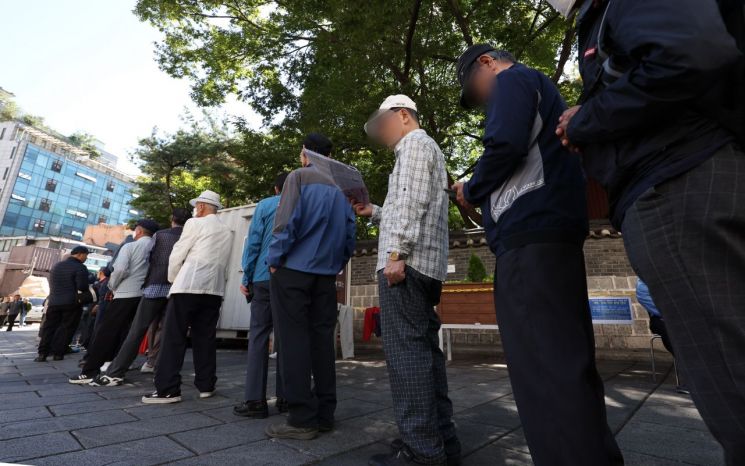 Elderly people are lined up for lunch in front of the free meal service center for seniors at Wongaksa Temple in Tapgol Park, Jongno-gu, Seoul. Photo by Yonhap News
In step 2, the age criteria for public pension and basic pension, which are old-age income security systems, will be raised. The starting age for National Pension benefits will be extended to 68 by 2048, and the new eligibility age for the basic pension will be raised from the current 65 to 66 by 2030, eventually matching 70 by 2040.
Finally, in step 3, the establishment of the system, population projections, and social conditions will be re-evaluated. If the aging trend continues and healthy life expectancy further increases, raising the elderly standard to 75 years old can be considered in the mid to long term. Professor Seok emphasized, "It is necessary to design flexible policies that consider differences in individual health and income, as well as adjusting the speed differently for each system," adding, "The important thing is that the age-raising measures are designed so as not to degrade the quality of life of the elderly."
© The Asia Business Daily(www.asiae.co.kr). All rights reserved.

















