Busan Port Authority Forms On-site Response Team
to Address US Reciprocal Tariff Measures
Preemptive Strategies to Minimize Export-Import Disruptions
and Maintain Port Stability
Busan Port Authority (BPA, President Song Sangkeun) has announced the activation of the "US Reciprocal Tariff On-site Response Team" to review Busan Port's logistics response system and minimize disruptions to exports and imports, following the recent announcement by the US government of an executive order imposing Reciprocal Tariffs.
On April 2, the United States announced the Reciprocal Tariff executive order, imposing a basic tariff of 10% on all countries starting from the 5th, and planned to impose a country-specific reciprocal tariff of 25% on about 70 countries from the 9th. However, implementation for countries other than China has been postponed for 90 days. As a result, most trading partners, including Korea, have been given a preparation period until early July.
Such changes in the trade environment could have complex impacts, including a decline in the price competitiveness of Korean exporters to the US and increased risks of relocating production bases.
In response, Busan Port Authority has formed an on-site response team with shipping companies and terminal operators using Busan Port, and will take preemptive measures focusing on the following support strategies.
The response team will discuss and review measures such as monitoring changes in US-bound cargo volume and routes, optimizing berth operations to improve unloading efficiency for US-bound vessels, expanding cargo handling flexibility through the operation of temporary storage facilities in the New Port hinterland, and strengthening support for storage and transport for exporting and importing companies through logistics centers operated by Busan Port Authority in the US and Southeast Asia.
Busan Port handles about 2 million TEU, accounting for 87% of Korea's annual export and import cargo volume to and from the US. As the world's second-largest transshipment port, US-bound cargo from China, Japan, Southeast Asia, and other countries is transshipped at Busan Port before being shipped to the US, amounting to 2.05 million TEU annually. Especially, as the "Last Port" on the Asia-US route, Busan Port is a key hub that is highly sensitive to changes in US tariff policy.
Song Sangkeun, President of BPA, stated, "Even amid rapid changes in the global trade environment, we will work closely with the government and industry to develop preemptive and effective measures to ensure that Busan Port's export-import and international transshipment functions remain stable."
Going forward, BPA plans to further strengthen policy proposals and the operation of joint consultative bodies in cooperation with the government, local authorities, shipping companies, and operators.
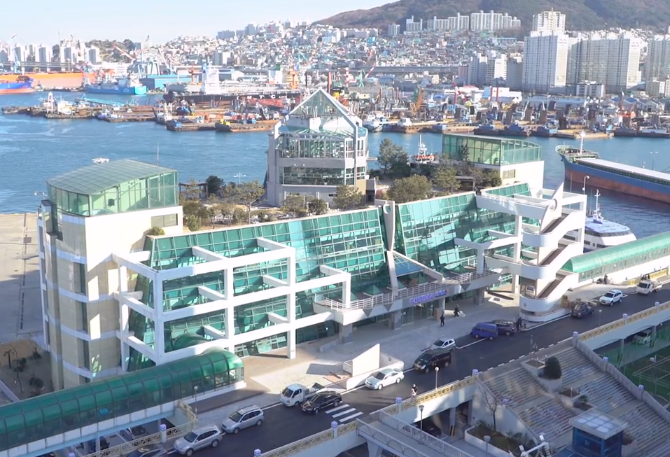 Busan Port Authority
© The Asia Business Daily(www.asiae.co.kr). All rights reserved.
![Clutching a Stolen Dior Bag, Saying "I Hate Being Poor but Real"... The Grotesque Con of a "Human Knockoff" [Slate]](https://cwcontent.asiae.co.kr/asiaresize/183/2026021902243444107_1771435474.jpg)














