Vaccine Antibody Monitoring and Early Detection of Virus Infections
Livestock Farmers Urged to Report Actively and Strictly Follow Quarantine Guidelines
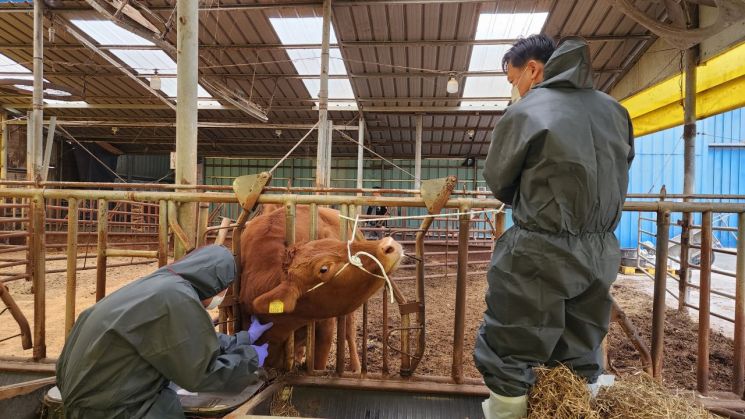 The Jeollanam-do Animal Hygiene Testing Center continuously monitors virus infection status within farms as the season for the activity of insect vectors transmitting bovine lumpy skin disease has arrived. Provided by Jeonnam Province
The Jeollanam-do Animal Hygiene Testing Institute will implement measures starting this month, when vector insects for lumpy skin disease in cattle begin to be active. These measures include vaccine antibody monitoring, early detection of virus-infected individuals in farms, and ongoing surveillance testing to prove the absence of the virus.
Lumpy skin disease is a viral illness in cattle characterized by high fever and skin nodules, and is transmitted by blood-sucking insects such as flies and mosquitoes. Vaccination is also carried out in April, when vector insects become active.
The lumpy skin disease vaccine antibody monitoring test is conducted to check the immune level of cattle farms and verify the effectiveness of the vaccine. Last year, two rounds of tests were conducted on 2,356 cattle from 225 farms, 2-3 months and 6 months after vaccination. This year, the program will be expanded to 6,468 cattle from 616 farms.
Monitoring for lumpy skin disease virus within farms is divided into targeted surveillance and statistical surveillance.
Targeted surveillance is conducted during the vector insect activity period (April to November) on 3,180 cattle from 636 farms in high-risk areas (counties where cases occurred in 2023?2024) and medium-risk areas (adjacent counties to those with cases in 2023?2024, including the west coast and border regions).
Statistical surveillance is carried out year-round on 1,095 cattle from 219 farms in low-risk areas to prove the absence of the virus. Last year, 126 cattle from 12 farms in affected areas (Muan and Shinan) were tested, and all results were negative.
Jung Jiyeong, Director of the Jeollanam-do Animal Hygiene Testing Institute, stated, "To prevent the recurrence of lumpy skin disease, it is most important for livestock farmers to actively report and strictly follow quarantine guidelines. We will do our best to detect the virus early through continuous farm surveillance."
Meanwhile, lumpy skin disease was first reported in Korea on October 19, 2023, in Seosan, Chungnam. Since then, there have been 107 cases nationwide in 2023 and 24 cases in 2024. In Jeollanam-do, there were 2 cases in 2023 (Muan and Shinan) and 3 cases in 2024 (Yeongam, Yeosu, and Goheung), with no additional cases reported since.
© The Asia Business Daily(www.asiae.co.kr). All rights reserved.
![Clutching a Stolen Dior Bag, Saying "I Hate Being Poor but Real"... The Grotesque Con of a "Human Knockoff" [Slate]](https://cwcontent.asiae.co.kr/asiaresize/183/2026021902243444107_1771435474.jpg)















