First Media Interview with CNN After Leaving Office
"Tariffs on China Will Have a Huge Impact on the U.S. and Global Economies"
Former U.S. Treasury Secretary Janet Yellen directly criticized President Donald Trump's tariff policy as "the worst form of self-harm." She pointed to the recent abnormal surge in Treasury yields and the resulting financial market instability as the decisive background for Trump's sudden decision to delay the implementation of reciprocal tariffs.
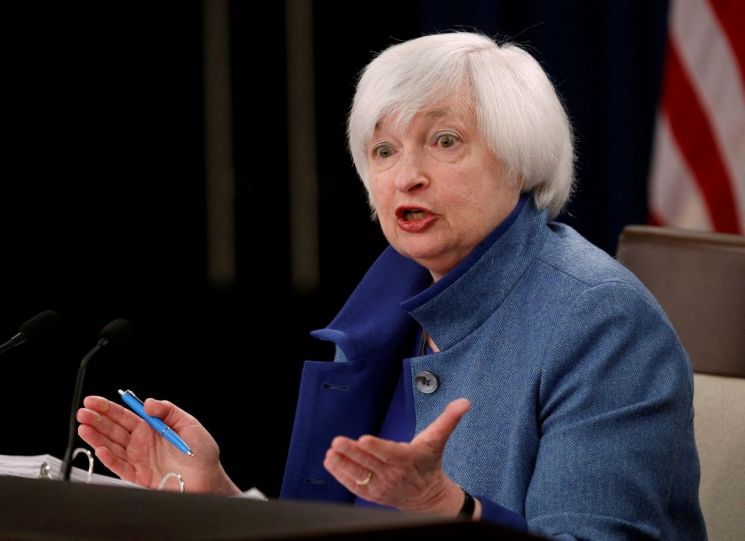
On the 10th (local time), in her first media interview since leaving office, Yellen told CNN, regarding Trump's tariff policy, "I have never seen an administration that has so thoroughly damaged an economy that was doing so well," adding, "This is the worst form of self-harm."
Yellen served as the economic chief under the previous Joe Biden administration and stepped down from her Treasury Secretary position earlier this year following Biden's departure from office.
Regarding Trump's decision to delay reciprocal tariffs, she said it "provided some relief," but also pointed out that "the U.S. and global economies have suffered from the shock of massive protectionism."
Earlier, President Trump, just 13 hours after the full implementation of reciprocal tariffs, decided to impose only a 10% base tariff on countries excluding China and to delay the additional tariff implementation for 90 days. The tariffs on China were raised to a total of 145%, combining the reciprocal tariff rate of 125% with the existing 20% tariff imposed due to inadequate fentanyl (opioid painkiller) control.
Regarding the background of the tariff delay, former Secretary Yellen explained, "Highly leveraged hedge funds holding U.S. Treasury bonds began selling off their assets, and the massive sell-off of U.S. Treasuries is a serious factor that can cause financial instability," adding, "To my knowledge, this issue influenced President Trump's decision to halt reciprocal tariffs." She emphasized, "This is definitely a matter of concern."
As tariff uncertainties have persisted recently, the financial market has seen a sell-off of U.S. Treasuries, the world's safest asset. The large-scale Treasury sell-off caused prices to fall (= Treasury yields to rise), increasing the pressure to liquidate trades that used Treasuries as collateral, raising concerns about liquidity shortages and a potential financial crisis. The rise in Treasury yields also directly increases the U.S. government's interest burden and raises various loan rates, impacting the government, households, and businesses alike. Despite the sudden tariff delay announced the previous day, massive Treasury sell-offs continue, mainly in long-term bonds. The 30-year U.S. Treasury yield is currently moving around 4.87%, up 8 basis points (1bp = 0.01 percentage point) as of this day.
Yellen assessed that Trump's tariff policy has increased the average cost for American households by $4,000 annually (approximately 5.8 million KRW) and raised the likelihood of an economic recession.
She also forecasted that even if reciprocal tariffs are abolished, the average U.S. tariff rate will reach its highest level since 1934. Historically, the U.S. has lowered tariffs through the Reciprocal Trade Agreements Act of 1934. This policy change followed the Smoot-Hawley Tariff Act enacted four years earlier in 1930, which raised average tariffs from 25% to 40% and deepened the Great Depression.
Additionally, Yellen expressed concerns about tariffs on China. She warned that the ultra-high tariffs on China "will have a huge impact on the U.S. and global economies," and cautioned, "No one knows where these policies are headed."
© The Asia Business Daily(www.asiae.co.kr). All rights reserved.
![Clutching a Stolen Dior Bag, Saying "I Hate Being Poor but Real"... The Grotesque Con of a "Human Knockoff" [Slate]](https://cwcontent.asiae.co.kr/asiaresize/183/2026021902243444107_1771435474.jpg)















