All Three Major Indices Fall... Half of Previous Day's Gains Lost
White House: "Tariffs on China at 145%, Not 125%"
U.S.-China Trade War and Economic Slowdown Fears Persist
U.S. Treasury Yields Drop... 10-Year Down by 3bp
The three major indices of the U.S. New York stock market fell around 5% on the 10th (local time). Although U.S. President Donald Trump abruptly suspended reciprocal tariffs on countries other than China for 90 days the day before, the stock market gave back half of the previous day's gains in just one day, showing only a 'flash effect.' Concerns about the U.S.-China trade war and economic slowdown have intensified again due to the 'tariff bomb' on China reaching 145% since Trump's second term began.
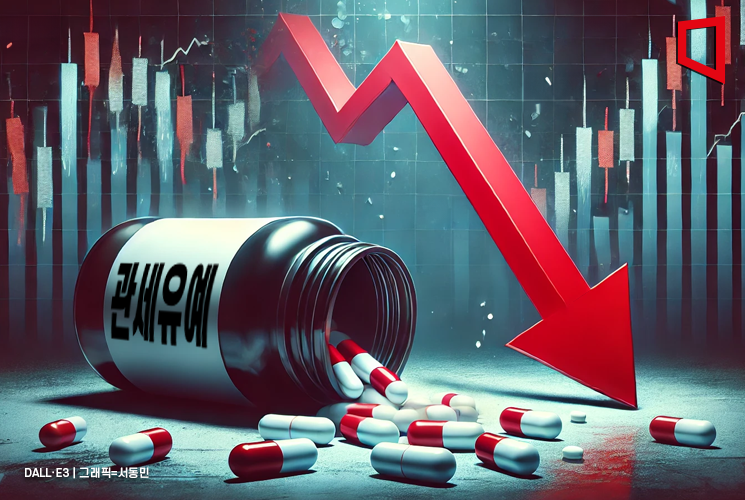
At 12:35 p.m. on the same day in the New York stock market, the Dow Jones Industrial Average (Dow Index), centered on blue-chip stocks, was trading at 38,833.19, down 1,775.26 points (4.37%) from the previous trading day. The S&P 500 Index, focused on large-cap stocks, plunged 279.22 points (5.12%) to 5,177.68, and the Nasdaq Index, centered on tech stocks, slid 1,031.06 points (6.02%) to 16,093.91.
Among individual stocks, large technology stocks are sharply declining. Apple fell 5.85%, Tesla dropped 9.88%, and Nvidia and Meta Platforms, the parent company of Facebook, fell 7.35% and 6.57%, respectively.
The New York stock market had shown a historic rally the previous day. President Trump raised reciprocal tariffs on China to 125%, but only imposed a basic 10% tariff on other countries and abruptly suspended reciprocal tariffs on a country-by-country basis for 90 days, which triggered a buying frenzy. However, as tariff uncertainties persisted, investor sentiment sharply cooled in just one day.
Concerns about escalating U.S.-China trade conflicts are also weighing on the stock market. On this day, the White House confirmed that the total additional tariff rate imposed on China by the U.S. is not 125% but 145%. Previously, President Trump raised tariffs on China, which retaliated with reciprocal tariffs, from the existing 34% to 84% and then to 125% in two steps. The White House explained that this applies only to reciprocal tariffs. Adding the tariffs imposed earlier on China for fentanyl (a narcotic painkiller) control issues?two rounds of 10% tariffs totaling 20%?the total additional tariffs on China during Trump's second term rise to 145%.
Michael Gapen, Chief U.S. Economist at Morgan Stanley, pointed out, "The delay in tariff implementation helps but does not reduce uncertainty," adding, "The effective tariff rate on China is also at an all-time high."
Amy Gong, partner at Coriant, said, "The market is currently moving inside a black box without any clear direction," and added, "This situation is very unstable and volatile. There are many unknown factors, so we advise against making significant changes to asset allocation."
U.S. Treasury yields are declining. The 10-year U.S. Treasury yield, a global bond yield benchmark, fell 3 basis points (1bp = 0.01 percentage points) from the previous trading day to 4.36%, while the 2-year U.S. Treasury yield, sensitive to monetary policy, plunged 15 basis points to 3.79%. The market cites the recent abnormal surge in Treasury yields as the background for President Trump's rollback of reciprocal tariff policies. Due to tariff policy uncertainty, there was a sell-off of U.S. Treasuries, the world's safest asset, causing Treasury prices to fall (= Treasury yields to rise), and the pressure to liquidate trades financed by using Treasuries as collateral increased, raising concerns about a financial crisis.
The dollar is also falling. The Dollar Index, which measures the value of the U.S. dollar against six major currencies, dropped 1.83% from the previous day to 100.74.
The inflation data released that morning suggested progress in slowing inflation. According to the U.S. Department of Labor, the Consumer Price Index (CPI) for March this year rose 2.4% year-on-year. This is the lowest level in 4 years and 1 month since February 2021, falling short of both February's figure (2.8%) and market expectations (2.5%). The core CPI, which excludes volatile energy and food prices, also rose 2.8% year-on-year, marking the lowest increase since March 2021. It was below the previous month (3.1%) and the forecast (3.0%). Although concerns about entrenched high inflation have somewhat eased, since this data was recorded before President Trump's tariff policies were fully implemented, the possibility of future price rebounds remains.
© The Asia Business Daily(www.asiae.co.kr). All rights reserved.

















