1. After Short Selling Resumed on the 31st of Last Month, 1.32 Million Shares Sold Short
2. Average Short Selling Price at 26,775 KRW... Current Price at 29,500 KRW
3. Sales in Europe and the Middle East Expected to Surpass North America
Despite issues with U.S. reciprocal tariffs and the failed investment in the luxury platform 'Balan', Silicon Two's stock price is trending upward. Although short selling has continued since its resumption on the 31st of last month, aggressive 'buy' orders from domestic institutional investors have driven the stock price higher.
According to the financial investment industry on the 11th, Silicon Two's stock price rose 13.5% from the 31st of last month to the day before. During the same period, the KOSDAQ index fell 1.7%. Although market volatility increased due to tariff issues, Silicon Two's stock price growth exceeded the market return by 15.2 percentage points (P). Institutional investors recorded a cumulative net purchase of 1.69 million shares, amounting to over 47.7 billion KRW.
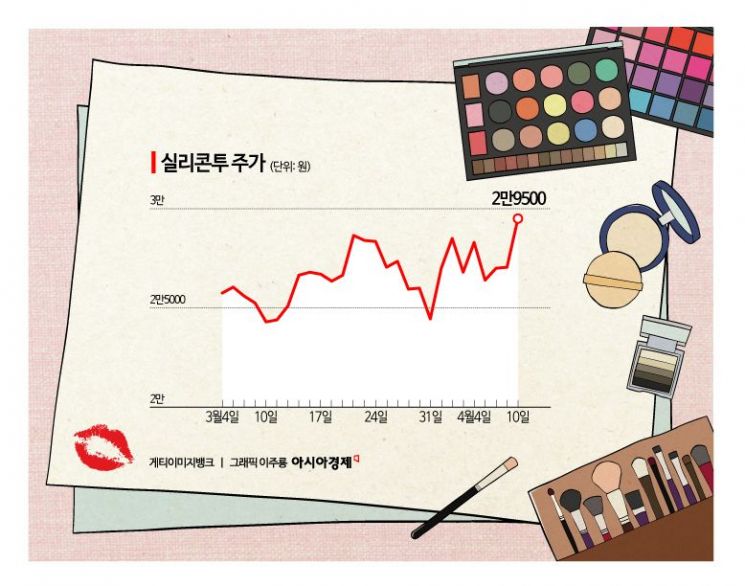
On the 31st of last month, short selling of Silicon Two reached 320,000 shares. This accounted for 32% of the total trading volume of 1 million shares, indicating strong short selling activity. The stock price fell nearly 6% that day. Short selling continued afterward, totaling 1.53 million shares over nine trading days. The average short selling price was 27,148 KRW. Considering the current stock price of 29,500 KRW, short sellers are currently experiencing unrealized losses.
The strong short selling appears to be influenced by concerns over tariff issues. Silicon Two's U.S. business structure involves purchasing cosmetics domestically and sending them to its U.S. branch for sale. The branch is responsible for import customs clearance. Silicon Two has stocked inventory in U.S. warehouses. If tariffs cause product prices to rise, the inventory burden could increase.
Park Eun-jung, a researcher at Hana Securities, analyzed, "Regarding tariff burdens, plans are in place to reduce tariff exposure through negotiations with brand companies and adjustments to branch supply rates," and forecasted that "demand contraction is expected to be minimal."
The confirmed loss issue from the investment in Balan remains. To diversify its business, Silicon Two invested 7.5 billion KRW in Balan. The possibility of recovering this investment will depend on the progress of Balan's rehabilitation procedures.
Yeouido securities firms expect Silicon Two to have growth potential sufficient to overshadow concerns. Last year, Korean cosmetic brands that received favorable reviews in the U.S. market expanded into Europe and the Middle East. Last year, Silicon Two recorded sales of 100 billion KRW in Poland and the Netherlands and 50 billion KRW in the Middle East on a separate basis. Considering the increasing local demand and Silicon Two's expanded sales capabilities, sales in Europe and the Middle East are expected to surpass those in North America this year.
Silicon Two is also discussing collaboration related to Olive Young's entry into the North American market. Although not in the final stages, the possibility of cooperation is considered promising. Synergy effects could arise if Olive Young utilizes Silicon Two's infrastructure during the establishment of local stores.
Hana Securities estimated that Silicon Two achieved consolidated sales of 200 billion KRW and operating profit of 39.1 billion KRW in the first quarter of this year. These figures represent increases of 35% and 33%, respectively, compared to the same period last year. It is expected that the operating profit met the market expectation of 38.9 billion KRW.
© The Asia Business Daily(www.asiae.co.kr). All rights reserved.

















