Constitutional Court Confirms 151-Seat Quorum for Acting President Impeachment
People Power Party Lawmakers Cannot Claim Infringement After Abstaining from Vote
Dissenting Justices: "Ample Opportunity for Debate Was Needed in This Exceptional Situation"
Speaker of the National Assembly Woo Won-sik held a vote on the impeachment motion against Acting President and Prime Minister Han Duck-soo, applying the quorum based on the Prime Minister standard (151 seats) rather than the President standard (200 seats). This was claimed to have infringed on the people's representative rights and the rights to deliberate and vote on the impeachment motion. The Constitutional Court dismissed the jurisdictional dispute case filed by 108 members of the People Power Party.
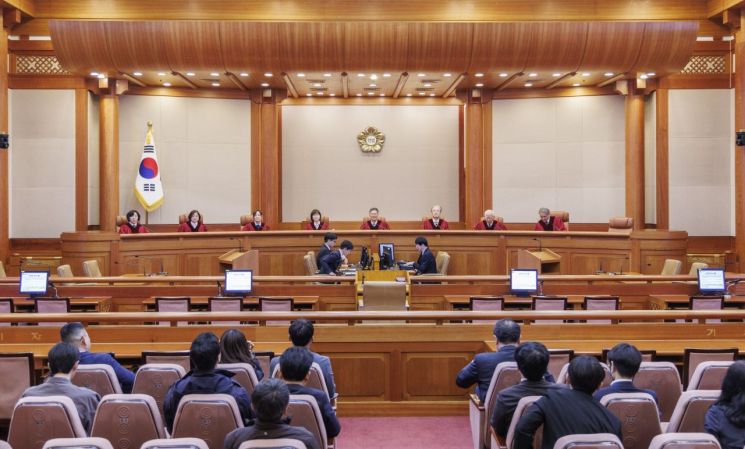
On the afternoon of the 10th, the Constitutional Court announced its decision to dismiss the 'Jurisdictional Dispute Regarding the Resolution of the Impeachment Motion Against the Acting President and Prime Minister' with six justices (Moon Hyung-bae, Lee Mi-sun, Kim Hyung-doo, Jung Jung-mi, Kim Bok-hyung, Jeong Gye-seon) concurring in dismissal and two justices (Jung Hyung-sik, Cho Han-chang) concurring in acceptance. The People Power Party lawmakers argued that the act of declaring the impeachment motion passed at the plenary session of the National Assembly on December 27 last year, when the impeachment motion against Acting President Han was submitted, and the act of delivering a copy of the impeachment resolution to Acting President and Prime Minister Han Duck-soo infringed on the petitioners' people's representative rights and rights to deliberate and vote on the impeachment motion granted by the Constitution and the National Assembly Act, and thus filed a jurisdictional dispute petition.
The Constitutional Court ruled, "There is no recognition that the act of declaring the impeachment motion against Prime Minister Han Duck-soo, submitted to the plenary session of the National Assembly, passed, and the act of delivering a copy of the impeachment resolution to the accused Han Duck-soo infringes on the petitioners' rights to deliberate and vote on the impeachment motion granted by the Constitution and laws." However, justices Jung Hyung-sik and Cho Han-chang dissented, stating that the act of declaring the impeachment motion passed violated the constitutional principle of majority rule and parliamentary democracy, infringing on the petitioners' rights to deliberate and vote.
Regarding the ruling party's claim that there was a problem because the impeachment motion did not go through the Legislative and Judiciary Committee referral procedure, the Constitutional Court first stated, "Simply because the referral procedure to the Legislative and Judiciary Committee, which is a discretionary matter of the National Assembly, was not followed, it cannot be seen that the petitioners' rights to deliberate and vote on the matter were infringed."
In particular, concerning the application of the Prime Minister standard (general quorum standard) rather than the President impeachment quorum standard during the resolution process of the Prime Minister's impeachment motion, the Constitutional Court stated, "In the absence of an established interpretation regarding the quorum for the Acting President's resolution, it is difficult to conclude that the respondent clearly violated the Constitution or laws by applying the 'general quorum' after certain consultations, or that this infringed on the petitioners' rights to deliberate and vote." The Constitution stipulates that the quorum for passing a presidential impeachment motion is two-thirds of the total members (200 seats), while for general public officials such as the Prime Minister, it is a majority of the total members (151 seats).
The Constitutional Court further stated, "Even though the opportunity to freely participate in the plenary session vote was guaranteed, since the petitioners themselves did not exercise their right to vote against, it cannot be seen that the petitioners' rights to deliberate and vote on this impeachment motion were infringed, even if the respondent misjudged and applied the quorum incorrectly, resulting in the declaration of passage." The Court thus rejected the claims of the People Power Party lawmakers. At that time, most of the People Power Party lawmakers did not participate in the actual vote after verbally protesting to Speaker Woo Won-sik.
Justices Jung Hyung-sik and Cho Han-chang, who dissented, argued that Speaker Woo's act of applying the 'general quorum' only after submitting the impeachment motion to the plenary session without separately consulting or discussing the quorum with the lawmakers before the vote violated the neutrality required of the presiding officer by the Constitution and the principle of parliamentary democracy based on it.
These justices explained, "Contrary to the majority opinion, the respondent's act of declaring the passage infringed on the petitioners' rights to deliberate and vote on this impeachment motion," adding, "Because this is a matter with significant national and social impact, it was necessary for the lawmakers participating in the vote to exchange opinions, discuss, and deliberate before deciding which quorum to apply." They also noted, "Despite strong opposition and protests from several lawmakers, the respondent (Speaker Woo) proceeded with the voting process without providing an opportunity for discussion, and the vote was conducted while most petitioners had already left."
© The Asia Business Daily(www.asiae.co.kr). All rights reserved.
![Clutching a Stolen Dior Bag, Saying "I Hate Being Poor but Real"... The Grotesque Con of a "Human Knockoff" [Slate]](https://cwcontent.asiae.co.kr/asiaresize/183/2026021902243444107_1771435474.jpg)















