Announcement of Digital Sex Crime Victim Support Status on the 10th
Victims Increased Ninefold Since Central DiSeong Center Opened in 2018
300,237 Victim Videos Deleted Last Year
Sharp Rise in 'Deepfake' Synthesis and Editing Damage
Notable Increase in Teenage Female Victims... Heightened Exposure to Digital Sex Crimes
Last year, the number of digital sex crime victims exceeded 10,000 for the first time. Among them, victims in their teens and twenties accounted for nearly 80%, with a particularly notable increase among teenage females.
With the advancement of artificial intelligence (AI)-based image synthesis technology, the increase in sex crime materials such as 'deepfakes' is also a distinctive feature. Damage caused by 'synthesis and editing' among victim types increased by more than 200% within a year.
On the 10th, the Ministry of Gender Equality and Family and the Korea Women's Human Rights Institute analyzed and announced the "Status of Support for Digital Sex Crime Victims" supported by the Central Digital Sex Crime Victim Support Center (Central DiSeong Center) last year.
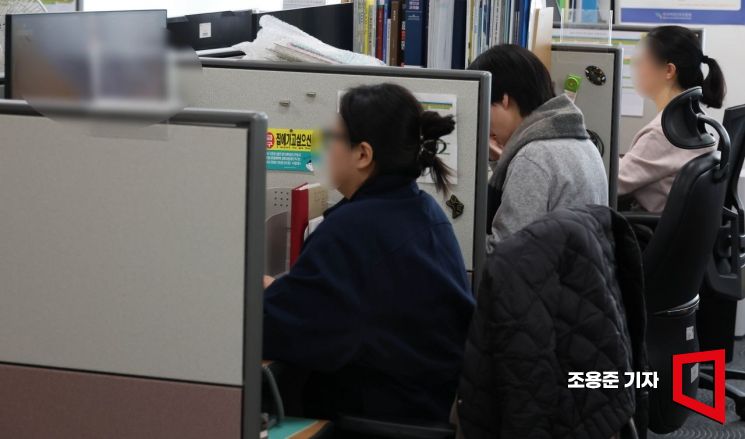 Staff members at the Digital Sexual Crime Victim Support Center of the Korea Women's Human Rights Institute are deleting illegal videos. Photo by Jo Yong-jun
◆Digital Sex Crime Victims, '10,305'... First Time Since Opening in 2018
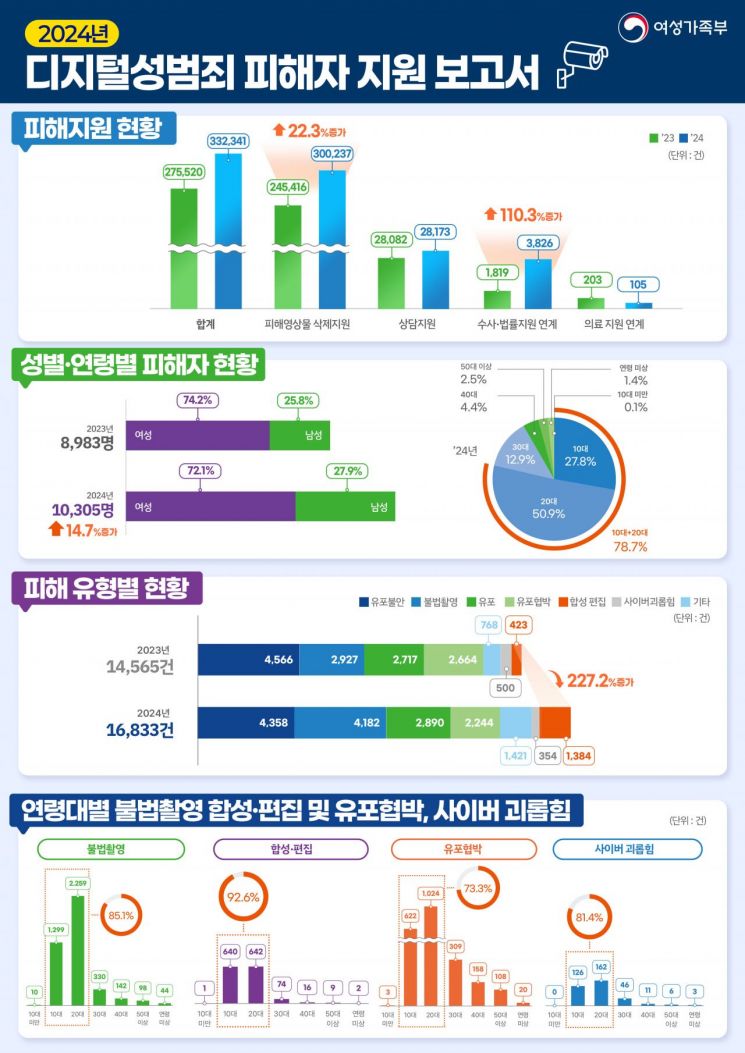
Last year, the number of victims supported by the Central DiSeong Center was 10,305, a 14.7% increase from the previous year (8,983). The number of victims exceeding 10,000 is the first since the Ministry of Gender Equality and Family established the Central DiSeong Center in April 2018 to prevent the spread of digital sex crime victims. The number increased ninefold in six years from 1,315 at the time of opening.
The Central DiSeong Center conducts comprehensive activities such as counseling for digital sex crime victims, support for deleting victim videos, and linking investigations. Among these, deleting various sexual exploitation materials, including illegal deepfake recordings, is a major task. It not only deletes reported videos but also proactively deletes child and adolescent sexual exploitation materials through monitoring. When illegal videos are distributed, it also provides investigation, legal, and medical support in cooperation with victim support organizations.
Looking at last year's support activities by type, support for deleting victim videos was carried out 300,237 times, a 22.3% increase compared to the previous year (245,416). This is interpreted as a result of strengthening urgent deletion support for illegal recordings linked from investigative agencies. Accordingly, the number of cases linked to investigation and legal support also increased by 110.3% from the previous year (1,819), totaling 3,826 cases.
◆Teenage Female Victims Account for 23.9%... Up 3.4 Percentage Points from Previous Year
A notable point is the increase in teenage female victims.
Among the victims supported by the Central DiSeong Center last year, 7,428 (72.1%) were female and 2,877 (27.9%) were male.
By age group, teenagers (2,863, 27.8%) and those in their twenties (5,242, 50.9%) accounted for 7,105 victims, or 78.7% of the total. This means that victims were concentrated in age groups that actively use social media, messengers, and anonymous-based platforms.
In particular, teenage females showed a remarkable increase rate compared to other age groups. In the 2023 survey, teenage females accounted for 20.5% of all victim ages, but last year this rose to 23.9%, an increase of 3.4 percentage points. Other figures were teenage males (4.0% → 3.9%), females in their twenties (34.8% → 32.3%), males in their twenties (15.5% → 18.6%), females in their thirties (8.8% → 10.2%), males in their thirties (3.1% → 2.7%), females in their forties (2.6% → 3.2%), males in their forties (1.4% → 1.2%), females in their fifties (1.0% → 1.1%), and males in their fifties (1.5% → 1.4%).
◆Rapid Increase in 'Synthesis and Editing' Damage Due to Development of 'Deepfake' Technology
Another characteristic is the sharp increase in digital sex crime damage caused by synthesis and editing.
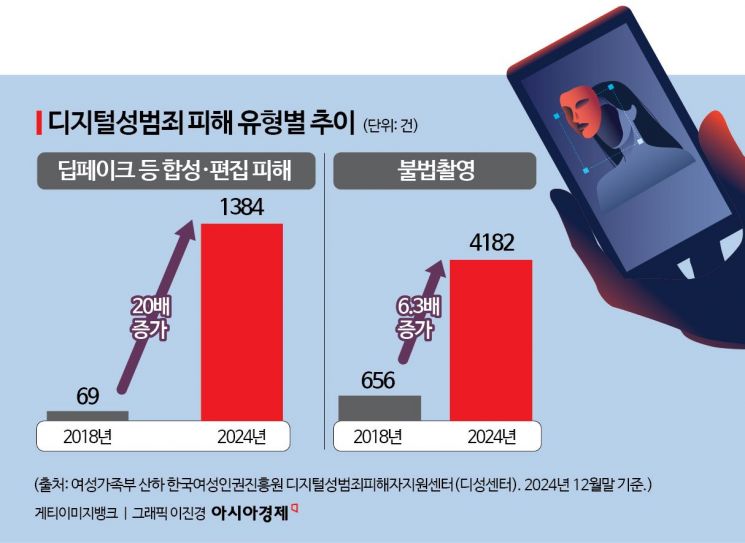
Overall, the types of damage showed similar trends to the previous year, but the number of synthesis and editing damage cases using digital technology was 1,384, an increase of 961 cases (227.2%) compared to the previous year (423), showing the most remarkable growth. Due to changes in the digital environment, the spread of deepfake technology, and the emergence of generative AI, damage is expected to increase in more diverse forms in the future.
In August last year, the Central DiSeong Center formed a "Deepfake Sex Crime Dedicated Response Team" to respond to incidents such as "deepfake on university campuses" and "mass distribution of deepfakes among middle and high school students." They provide urgent counseling and deletion support, and actively collect evidence and request investigations when sexual synthesis and edited materials are distributed, produced, or induced on Telegram.
Among these synthesis and editing cases, those in their teens and twenties accounted for an overwhelmingly high rate of 92.6%. Cyberbullying also showed the highest rates among teenagers and those in their twenties.
The Center analyzed that this age group is the most active in using social media, making personal information and privacy easily exposed online, which leads to frequent occurrences of verbal violence, slander, malicious comments, and personal information leaks due to misuse of personal data.
The Ministry of Gender Equality and Family is preparing to enforce legal grounds for central and regional victim support organizations on the 17th to strengthen protection and support for digital sex crime victims. In addition, in response to the spread of deepfake sex crimes, the ministry announced the "Strengthening Measures to Respond to Deepfake Sex Crimes" jointly with related ministries in November last year and is promoting follow-up measures.
Along with this, the ministry unified the digital sex crime victim counseling reception phone number to 1366 to improve accessibility, and according to the revised law that expanded deletion support targets from illegal recordings to victims' personal information, deletion support will be strengthened to actively prevent secondary damage.
Considering the increasing proportion of teenage victims, prevention education content and educational materials tailored to the perspectives of children and adolescents will be produced and distributed to strengthen response capabilities against digital sex crimes.
Shin Young-sook, Vice Minister of the Ministry of Gender Equality and Family, said, "We will continue to devise response measures to proactively support digital sex crime victims in the future."
© The Asia Business Daily(www.asiae.co.kr). All rights reserved.



















