The South Korean and U.S. navies conducted a joint salvage exercise to prepare for maritime distress situations that may occur during wartime and peacetime.
The Navy announced on the 10th that the Korea-U.S. joint salvage exercise (SALVEX) will be held in the Jinhae Bay area of Gyeongnam Province until the 11th.
The Korea-U.S. joint salvage exercise is a regular training conducted domestically to enhance the joint salvage operation capabilities by practicing joint salvage mission procedures and verifying the interoperability of salvage and diving equipment, in preparation for maritime distress situations that may occur during wartime and peacetime.
This exercise involved the Navy's Maritime Rescue Squadron's Salvage Operations Battalion, the surface ship salvage vessel Gwangyang (ATS-Ⅱ, 3,500 tons), and personnel from the U.S. Navy Mobile Diving and Salvage Unit (MDSU). Additionally, for the first time, personnel from the Korea Coast Guard Central Special Rescue Unit and naval salvage units from the United Kingdom and Australia observed the exercise to share know-how on salvage operations with the Korea-U.S. navies.
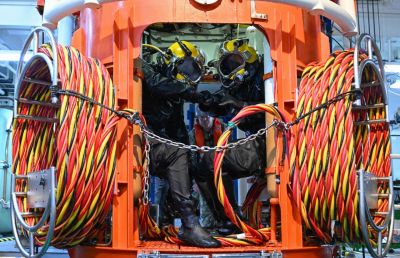 On the 9th, soldiers boarded the diver underwater transport equipment (Wet-Bell) during the Korea-US Navy joint rescue operation training conducted on the Gwangyang salvage ship. Photo by the Navy
During the training period, personnel from the Korea-U.S. salvage units conducted exercises using the Surface Supplied Diving System (SSDS). SSDS refers to equipment that supplies air and communication cables from an onboard or land-based gas source through hoses to the diver's helmet underwater, enabling communication between the surface and the diver. The exercise involved underwater search operations using the Maritime Rescue Squadron’s Underwater Imaging Searcher (UIS) and the U.S. Navy’s Diver Augmented Vision Device (DAVD).
Furthermore, Korea-U.S. personnel deployed near a simulated sunken vessel to conduct joint SCUBA training for searching and rescuing missing persons approximately 15 meters underwater. Onboard the Gwangyang, underwater searches were conducted using a hull-mounted sonar (HMS) and a remotely operated vehicle (ROV). Korea-U.S. salvage personnel also conducted diving training using the Wet-Bell underwater transfer equipment at depths of approximately 40 to 50 meters. The Wet-Bell is a transfer device designed to allow divers to move underwater from the bottom of a surface salvage ship.
Colonel Park Young-nam, commander of the Salvage Operations Battalion, said, "Through this exercise, we were able to significantly strengthen the Korea-U.S. navies’ joint salvage operation capabilities. We will continue to establish a joint salvage operation posture based on ongoing exchanges and realistic training between the two countries’ salvage units."
Major Nicholas Twizelman, operations officer of the U.S. Navy Mobile Diving and Salvage Unit, said, "The Korea-U.S. joint salvage exercise is evidence of the long-standing partnership between the Korea and U.S. navies in the underwater domain. Through this exercise, we will enhance interoperability and develop rapid and systematic response capabilities in the event of maritime distress situations."
© The Asia Business Daily(www.asiae.co.kr). All rights reserved.
![Clutching a Stolen Dior Bag, Saying "I Hate Being Poor but Real"... The Grotesque Con of a "Human Knockoff" [Slate]](https://cwcontent.asiae.co.kr/asiaresize/183/2026021902243444107_1771435474.jpg)
















