Six Organizations, Including KEPCO KDN, Sign Agreement
Pilot Projects for New Industry Model to Be Launched in Dong-gu, Nam-gu, and Buk-gu
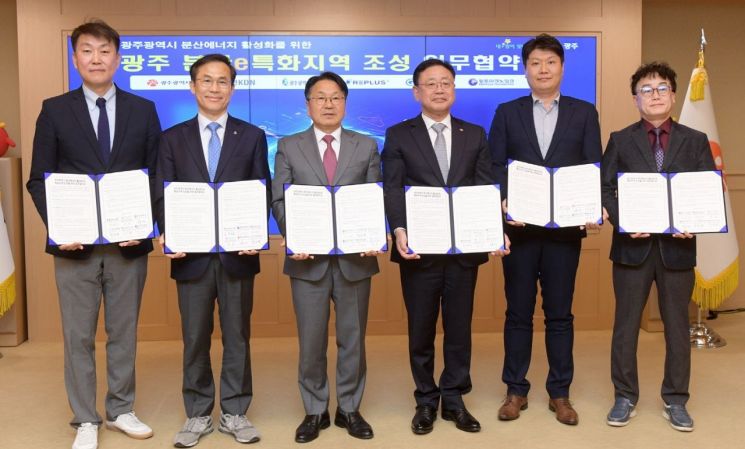 Gwangju Mayor Kang Gijeong is taking a commemorative photo after signing a business agreement for the activation of distributed energy and the creation of specialized areas with Park Sanghyung, President of KEPCO KND Co., Ltd., Kim Seungnam, President of Gwangju Urban Corporation, Yoo Byeongcheon, CEO of Replus Co., Ltd., and Jeon Seok, CEO of Grida Energy Co., Ltd. in the city hall business room on the afternoon of the 9th. Photo by Gwangju City
Gwangju City is establishing a distributed energy model optimized for the region, leading the new era of energy.
On the 9th, Gwangju City signed a "Business Agreement for the Promotion of Distributed Energy and the Creation of Specialized Areas in Gwangju" with energy public corporations, energy companies, and partner organizations at the City Hall Business Room.
The signing ceremony was attended by Mayor Kang Gijung, Park Sanghyeong, President of KEPCO KDN, Kim Seungnam, President of Gwangju Urban Corporation, Yoo Byeongcheon, CEO of Replus Co., Ltd., Jeon Seok, CEO of Grida Energy Co., Ltd., and Kim Chanyeong, Director of Gwangju Technopark, representing six organizations and companies.
The agreement covers: ▲ designation and creation of distributed energy specialized areas ▲ establishment and implementation of distributed energy policies ▲ demonstration and development of new technologies for distributed energy ▲ support for fostering companies in the new energy industry, among others.
Through this agreement, the city expects to promote a distributed energy specialized model based on the energy ICT solutions of Gwangju AI companies and partner organizations, overcoming the limitations of low energy self-sufficiency in inland areas and contributing to stabilizing local electricity demand and the growth of the new energy industry.
According to the agreement, participating organizations will carry out demonstrations of an urban distributed energy marketplace as a new industry activation model in Dong-gu, Nam-gu, and Buk-gu. The new industry activation model links distributed energy sources such as solar power and energy storage systems (ESS) with information and communication technology (ICT), piloting new business models and utilizing specialized areas as testbeds for the new power industry.
In Dong-gu, a 1MW solar power plant will be used to demonstrate power trading with RE100 demand companies, and a distributed energy integrated platform will be operated using the RE100 Megastation.
In Nam-gu, solar power generation in Sinhyocheon Village will be used for electricity trading among residents and to supply power to electric vehicle chargers in nearby apartment complexes. In Buk-gu, a business model will be demonstrated by storing 1MW of solar power in a 10MWh ESS and trading it with nearby companies. The city plans to apply for designation as a distributed energy specialized area by the Ministry of Industry in April, in cooperation with the agreement organizations and companies.
Mayor Kang Gijung said, "We are taking the important first step toward the designation of a distributed special zone. This agreement will serve as a stepping stone for Gwangju to leap forward as an energy self-sufficient city," adding, "Through close cooperation with participating organizations, we will lead the future of a sustainable energy industry."
© The Asia Business Daily(www.asiae.co.kr). All rights reserved.
![Clutching a Stolen Dior Bag, Saying "I Hate Being Poor but Real"... The Grotesque Con of a "Human Knockoff" [Slate]](https://cwcontent.asiae.co.kr/asiaresize/183/2026021902243444107_1771435474.jpg)















