Apartment Pre-Sales in Former Jeonbang and Ilsin Textile Redevelopment Delayed
Originally Expected in April-May, Now Likely Postponed Until October
Gwangju Shinsegae Also Adopts Wait-and-See Approach Amid Economic Downturn
Deliberating Without Submitting Negotiation Proposal to Gwangju City
Adjusting Project Pace Due to Housing Construction Risks
Ongoing Debate Over Issues Such as Public Contribution Amount
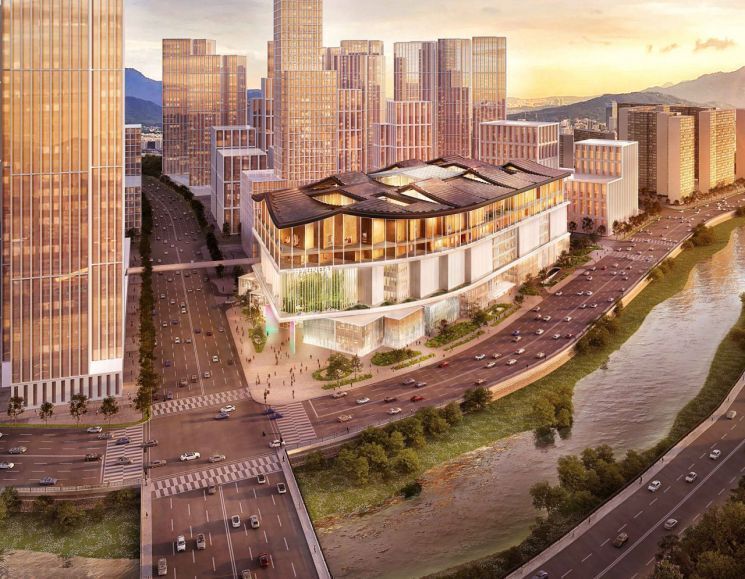
The apartment development projects in Gwangju are freezing up amid a slump in the construction and housing pre-sale markets. Even the housing construction projects within the Gwangju Complex Shopping Mall (The Hyundai Gwangju, Shinsegae Department Store, Eodeungsan Starfield), which were expected to fare better, have come to a standstill, heightening the sense of crisis to its peak.
According to the local construction industry, the sale of residential complexes (apartments) related to the redevelopment of the former Jeonbang and Ilsin Textile sites is expected to be postponed until after August. This means the pre-sale will be delayed at least two to three months compared to previous forecasts that predicted it would start as early as this month or, at the latest, next month, simultaneously with the commencement of construction.
Considering the upcoming summer vacation season and Chuseok holiday, which are typically off-seasons for pre-sales, there is speculation that the pre-sale may not be possible until after October.
The official reason for the postponement is delays in business procedures such as obtaining permits.
In the early stages of the Jeonbang and Ilsin Textile redevelopment project, disagreements arose between the developer and the city during the appraisal process to determine the amount of public contribution, specifically regarding the differential rate for land use change (40-60% of the difference in land value before and after the change).
After more than a year of discussions, on July 30 last year, both sides agreed to pay 589.9 billion won, which is 54.4% of the expected increase in land value of 1.0835 trillion won, in installments over five years. However, this agreement was reached only after considerable time had passed.
On top of this, issues such as the traffic impact assessment and adjustment of commercial space ratios have further slowed the progress of the project.
Although some administrative procedures, such as the district unit plan decision, traffic impact assessment, and landscape and architectural review, were completed around December 30 last year, the "building permit" application submitted by the Jeonbang and Ilsin Textile redevelopment developer (Champions City Complex Development AMC) to Gwangju City in March has yet to be approved, even after more than a month.
Even if the building permit is granted, there is still the process of obtaining pre-sale approval from the Buk-gu District Office. Since the Buk-gu District Office has decided to independently re-verify the traffic impact assessment related to the project, it is difficult to predict how much longer it will take to receive final pre-sale approval.
Despite these delays, The Hyundai Gwangju does not appear to be in any rush. Given the extremely poor market conditions, there is a prevailing sentiment that waiting and observing is not a bad option.
Internally, it is reported that there are serious discussions underway regarding the pre-sale price for the approximately 4,300 apartment units.
Last year, there were rumors that the price would be set at around 28 million won per pyeong, but in just over a year, the cost of materials and labor has increased, and now prices above 30 million won per pyeong are being discussed.
Of course, if the pre-sale price exceeds 30 million won, there is a significant risk of a drop in the pre-sale rate, so simulations are being conducted. However, if the price is set below this level, profit margins will inevitably fall, leaving the developer in a dilemma.
It is a rather anticlimactic situation, considering that major domestic construction companies such as Samsung C&T, Hyundai Engineering & Construction, POSCO E&C, and Daewoo E&C have expressed considerable interest (by submitting letters of intent to build).
Although their positions are somewhat different, Gwangju Shinsegae, which is pursuing another complex shopping mall project, is facing similar concerns.
Gwangju Shinsegae announced a vision to create a "city within a city," expanding the department store and building facilities for culture, commerce, business, education, healthcare, and a luxury hotel, as well as a terminal, in three phases from 2026 to 2037. In particular, the blueprint includes the construction of a 47-story mixed-use complex with 500 residential units. The total project cost amounts to 4.4063 trillion won.
However, as of now, Gwangju Shinsegae has not submitted a negotiation proposal to Gwangju City, even though it was selected as a "pre-negotiation target for urban planning change" in October last year, and five months have passed.
Although the specific reason is unclear, it is speculated that there is an invisible tug-of-war with Gwangju City over the amount of public contribution.
While there is a time buffer of about ten years based on the overall project plan, it is difficult to blindly predict a positive future at this point. The population in the Gwangju region is already declining, and there is no guarantee that the local distribution and construction markets will improve in the future.
For now, Gwangju City is likely to demand a public contribution amount similar to that proposed by The Hyundai Gwangju, and from Gwangju Shinsegae's perspective, submitting a negotiation proposal without thorough consideration could result in significant losses.
This is a kind of aftereffect caused by the downward trend in the regional economy due to the slump in the construction market.
A local construction industry official said, "It is difficult to get a positive signal from the housing construction projects being promoted in the Jeonbang and Ilsin Textile redevelopment or the Shinsegae Department Store expansion, whether considering the present or the future," and emphasized, "That shows just how bad the current industry situation is. In the past, if you wanted to push a project quickly, you needed confidence that it would succeed, but now, with the construction market itself in such a difficult state, it is not easy at all."
© The Asia Business Daily(www.asiae.co.kr). All rights reserved.
![Clutching a Stolen Dior Bag, Saying "I Hate Being Poor but Real"... The Grotesque Con of a "Human Knockoff" [Slate]](https://cwcontent.asiae.co.kr/asiaresize/183/2026021902243444107_1771435474.jpg)















