'Panic Buying' of iPhones in the U.S. Amid Trump's Tariff Bomb
Most iPhones Are Manufactured in China
U.S. Prices Unavoidable to Rise Once Tariffs Are Imposed
Concerns have recently been raised that the price of the iPhone could skyrocket due to the reciprocal tariffs announced by U.S. President Donald Trump, and foreign media reports indicate that American consumers are flocking to stores to purchase iPhones before the tariffs are imposed.
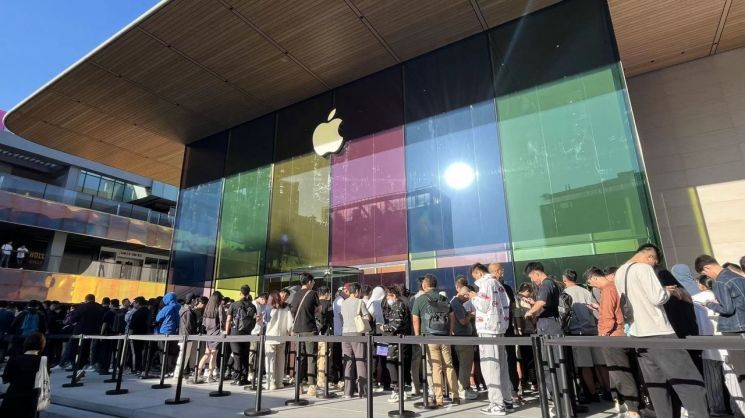 Foreign media reported that American consumers are flocking to stores to purchase iPhones before tariffs are imposed. The photo shows visitors lining up at the Apple flagship store in Sanlitun, Beijing, China. Photo by Kim Hyunjung
On the 8th (local time), Bloomberg News, citing an Apple employee, reported that Apple stores are crowded with people trying to 'panic buy' phones. Bloomberg said, "Stores were packed with customers over the weekend," adding, "Almost every customer asked if the price would rise soon."
The panic buying phenomenon has occurred because there are growing forecasts that the U.S. consumer price of the iPhone will inevitably increase once the country-specific reciprocal tariffs announced by the U.S. government take effect on the 9th. About 90% of iPhones are produced in China, and starting from the 9th, a 54% tariff must be paid when importing Chinese products into the U.S.
If Apple passes this burden on to consumers, some price increase seems unavoidable. Analysts at Swiss bank UBS predicted that the price of the highest-end iPhone model, the iPhone 16 Pro Max, could increase by up to $350 (approximately 510,000 KRW) in the U.S. Since this product starts at $1,199 in the U.S., this means about a 30% increase. Wall Street's Rosenblatt Securities also predicted that U.S. iPhone prices could rise by 30-40%. Since reciprocal tariffs are tariffs imposed on products imported into the U.S., the increased prices will only apply within the U.S.
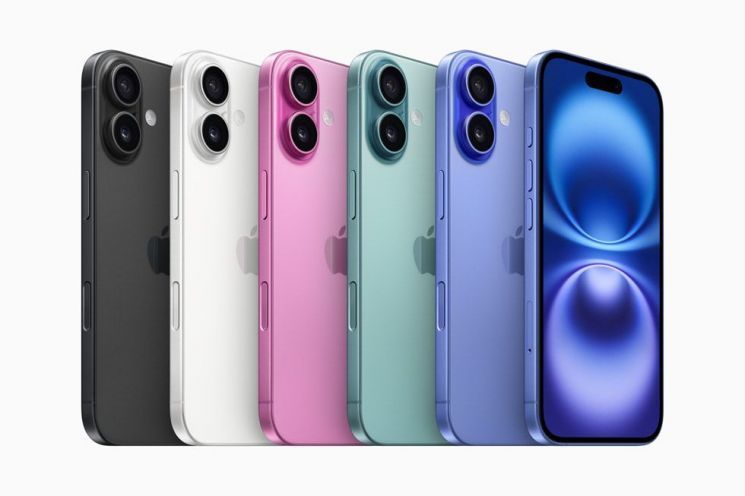
The U.S. Wall Street Journal (WSJ) reported on the 7th that Apple is pursuing a plan to expand iPhone production in India to reduce tariffs. Indian-made products are subject to a lower tariff of 26% compared to China. However, WSJ pointed out that even if Apple imports all iPhones produced in India to the U.S., it would only satisfy about half of the U.S. iPhone demand this year.
There is also a possibility that Apple will not immediately raise iPhone prices. Amid sluggish growth in the smartphone market, it is analyzed that Apple, which already employs a high-price strategy, will find it difficult to raise prices further. If demand stagnates and cost increases due to tariffs materialize, Apple's profitability will face additional pressure. Angelo Zino, a stock analyst at CFRA Research, said, "It will be difficult for Apple to pass on more than a 5-10% price increase to consumers," and predicted, "Apple plans price increases annually in a planned manner, so it is highly likely that major price hikes will be deferred until the release of the iPhone 17 scheduled for this fall."
© The Asia Business Daily(www.asiae.co.kr). All rights reserved.
![Clutching a Stolen Dior Bag, Saying "I Hate Being Poor but Real"... The Grotesque Con of a "Human Knockoff" [Slate]](https://cwcontent.asiae.co.kr/asiaresize/183/2026021902243444107_1771435474.jpg)
















