Brent Neiman, University of Chicago Professor, Contributes Op-Ed to NYT
"Calculation Formula Is Wrong... The Goal Is Also Irrational"
If Joint Research Had Been Followed, Tariff Rate Would Be Less Than a Quarter
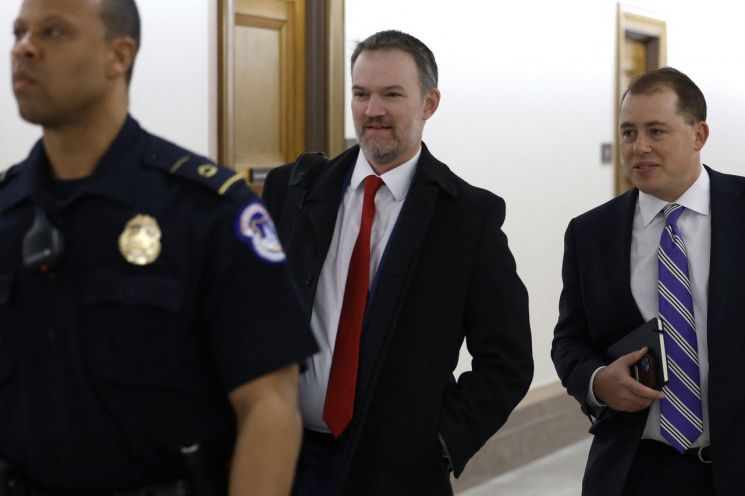 Jamison Greer, the USTR representative of the Donald Trump administration, is passing by the Senate office building in Washington on December 10 last year. Photo by AFP Yonhap News
The author of the paper cited by the U.S. Trade Representative (USTR) under the Donald Trump administration as the basis for calculating reciprocal tariff rates by country on the 2nd (local time) has directly refuted the claim, stating that his research was misinterpreted.
Brent Neiman, a professor at the University of Chicago Booth School of Business (MBA), stated in an op-ed for the New York Times (NYT) on the 7th (local time), "I fundamentally oppose the trade policies and approaches of the Trump administration."
The USTR said that the paper by Professor Neiman and others was used as the basis for calculating reciprocal tariff rates for 57 countries announced by President Trump. They cited the joint research results co-authored by Neiman and Harvard University professor Alberto Cavallo. This study dealt with the impact of tariffs imposed on China between 2018 and 2019 during Trump’s first term.
Professor Neiman introduced that the result of the paper was that the import demand price elasticity, which refers to the impact of tariffs imposed on China on U.S. importers, is close to 0.95. If a 20% tariff is imposed on China, the price elasticity responds proportionally such that the burden on U.S. importers increases by 19%.
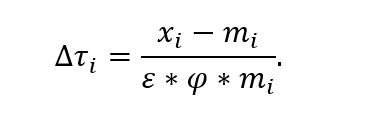
The formula previously disclosed by the USTR is essentially the trade deficit divided by import value. The denominator’s ε (import demand price elasticity) is set to 4, and φ (tariff pass-through rate) is set to 0.25, so multiplying these equals 1. The only variables are total export value (x) and total import value (m).
Professor Neiman pointed out, "The government inserted the figure of 25% into the formula without explaining why," adding, "It is unclear where this 25% figure came from or how it relates to our research." Furthermore, he noted that if the 0.95 figure from the joint research were used for calculation, the tariff rate would decrease by up to a quarter.
In fact, when the think tank American Enterprise Institute (AEI) calculated tariff rates for each country based on Neiman’s paper, the tariff rate for Lesotho, a small country in South Africa that would have received the highest reciprocal tariff rate (50%), decreased to 13.2%. South Korea’s reciprocal tariff rate also dropped from the existing 25% to 10%.
Professor Neiman also criticized the goal of reducing the U.S. trade deficit through tariffs as irrational. He mentioned that Sri Lanka exports clothing to the U.S., while the U.S. exports pharmaceuticals and gas turbines to Sri Lanka, explaining, "Such trade merely reflects differences in resources, comparative advantage, and development levels, and even if there is a deficit in this trade, it does not imply unfair competition."
He then introduced a remark by Nobel laureate and former Harvard professor Robert Solow: "I have a chronic deficit with my barber because the barber buys nothing from me." This means that trade imbalances between countries can arise for reasons unrelated to protectionism. Professor Neiman emphasized, "Reciprocal tariff policies cannot succeed and must be completely abolished."
Meanwhile, Professor Neiman served as Acting Deputy Assistant Secretary of the Treasury during the Joe Biden administration.
© The Asia Business Daily(www.asiae.co.kr). All rights reserved.
![Clutching a Stolen Dior Bag, Saying "I Hate Being Poor but Real"... The Grotesque Con of a "Human Knockoff" [Slate]](https://cwcontent.asiae.co.kr/asiaresize/183/2026021902243444107_1771435474.jpg)
















