KOSPI Drops to 2,300 Level, Giving Up All Gains for the Year
Rebounds on Bargain Hunting After Previous Day's Sharp Decline
Adjustment Unavoidable for Now Due to Tariff Uncertainties
The KOSPI fell to the 2300 level, giving up all the gains made this year. This was due to the global stock markets plummeting together under the shock of China's retaliatory tariffs in response to the U.S. reciprocal tariffs. On the 8th, the stock market initially rebounded due to bargain hunting following the previous day's sharp decline, but it is expected that a fragile market will continue for the time being.
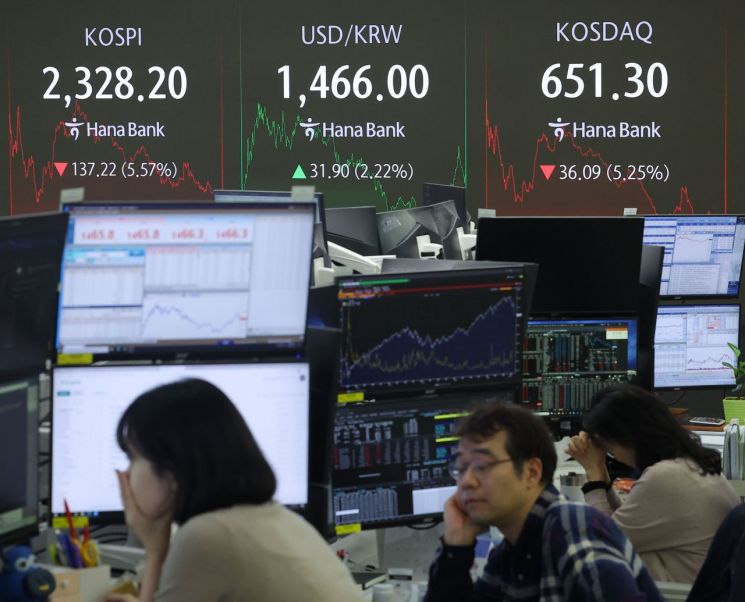
As of 9:15 a.m. on the 8th, the KOSPI was trading at 2371.30, up 43.10 points (1.85%) from the previous day. The KOSDAQ was up 14.12 points (2.17%) at 665.42.
Both the KOSPI and KOSDAQ fell more than 5% the previous day, turning their year-to-date returns negative. The 'Black Monday' that hit global stock markets was caused by China's imposition of retaliatory tariffs in response to the U.S. reciprocal tariffs. So Suhong, head of the NH Investment & Securities Research Center, analyzed, "Negotiations with major countries will proceed, but retaliatory tariffs and counter-tariffs in response are still ongoing, and the possibility of change in the current situation lies solely in the intentions of U.S. President Donald Trump. Also, while the Federal Reserve (Fed) and others have sufficient capacity to respond, it is expected that they will not take preemptive action. This disappointment has spread into the asset market as concerns over a disorderly hard landing, causing major stock markets including Korea's to plunge together."
Since there is still no visible way out of the tariff issue, the stock market adjustment phase is expected to continue for the time being. Kim Dongwon, head of KB Securities Research Division, said, "With the expiration of major tax cut provisions at the end of 2025 and the midterm elections in 2026, it is President Trump who becomes increasingly disadvantaged over time, and the opposing countries are well aware of this. Therefore, there is a possibility of a tough response to tariffs." He added, "President Trump has declared that additional tariffs will be imposed if retaliatory tariffs from opposing countries occur. Of course, as some claim, Trump may extend the grace period further, but circumstantially, there may be adjustments to the period."
Since the adjustment was triggered by tariffs, the momentum for a rebound is also expected to come from tariffs. Park Heechan, head of the Mirae Asset Securities Research Center, explained, "Whether the adjustment continues depends on tariff negotiations, especially the intensity of mutual responses between the U.S. and China." He added, "Regarding the rebound, a positive shift in tariff negotiations, Fed rate cuts, and rapid realization of large-scale economic stimulus efforts by various countries are necessary."
In the case of the domestic stock market, downside rigidity has been secured due to the resolution of political uncertainties, so future economic stimulus measures are expected to act as momentum for a rebound. Cho, the research center head, said, "The Korean stock market has secured a certain level of downside rigidity as domestic political events have passed. However, in the short term, the influence of external factors linked to the global financial market will increase." He added, "As the presidential race progresses, expectations for domestic stimulus policies will expand similarly to regions with momentum for economic stimulus outside the U.S. The key point to watch is the size of the supplementary budget; if it exceeds 20 trillion won, the effect of economic stimulus in Korea is expected to strengthen, expanding expectations for upward momentum in the Korean stock market."
Although the stock market will show a fragile trend for the time being, it is advised not to respond with selling. Park said, "Recession pricing is already underway, but various possibilities remain open depending on the efforts of each country and tariff negotiations, so active stock selling is not necessary." He explained, "It is recommended to strengthen global asset allocation and adopt a strategy focusing on defense industries, shipbuilding, internet software, and entertainment sectors, which are relatively free from tariff impacts in domestic stocks."
© The Asia Business Daily(www.asiae.co.kr). All rights reserved.
![Clutching a Stolen Dior Bag, Saying "I Hate Being Poor but Real"... The Grotesque Con of a "Human Knockoff" [Slate]](https://cwcontent.asiae.co.kr/asiaresize/183/2026021902243444107_1771435474.jpg)















