Reviewing a "Third-Party Allotment Rights Offering"
Hanwha Aerospace is reducing the size of the rights offering it announced last month from 3.6 trillion won to 2.3 trillion won.
Hanwha Aerospace stated that it is considering a "third-party allotment rights offering" involving three companies?Hanwha Energy, Hanwha Impact Partners, and Hanwha Energy Singapore (hereinafter Hanwha Energy). If this method is finalized, Hanwha Energy, whose major shareholders are the three sons of Hanwha Group Chairman Kim Seung-yeon, will participate in the 1.3 trillion won third-party allotment rights offering of Hanwha Aerospace without any discount. This would allow the 1.3 trillion won paid by Hanwha Aerospace from the sale proceeds of Hanwha Ocean to return to Hanwha Aerospace.
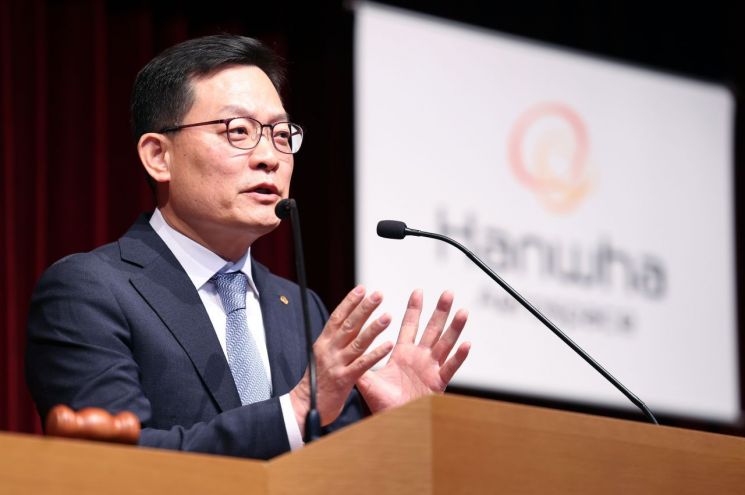
Hanwha said, "This move dispels concerns that the 1.3 trillion won might be used as funds for the succession of management rights by the major shareholders of Hanwha Energy," adding, "It aligns with the principles of 'rightful management' and 'transparent succession' emphasized when Chairman Kim decided last month to gift 11.32% of Hanwha Corporation shares to his three sons, including Vice Chairman Kim Dong-kwan, who pledged to pay taxes faithfully according to the law."
Previously, Hanwha Aerospace and Hanwha Energy reportedly held a preliminary briefing for directors to discuss measures to return the 1.3 trillion won from the sale of Hanwha Ocean shares back to Hanwha Aerospace. The participation in the third-party allotment rights offering emerged as a solution during this process, according to the company. Lee Jae-gyu, CEO of Hanwha Energy, said, "We are considering participation in Hanwha Aerospace's third-party allotment rights offering to avoid unnecessary succession controversies."
Earlier last month, Hanwha Aerospace carried out a rights offering worth 3.6 trillion won, the largest in the history of the domestic capital market. The company explained that the measure was to raise investment funds, but the market criticized it as a decision prioritizing the interests of the controlling family. This criticism stemmed from Hanwha Aerospace acquiring a 7.3% stake in Hanwha Ocean held by Hanwha Energy, whose major shareholders are Chairman Kim's three sons, by spending 1.3 trillion won before the rights offering.
Vice Chairman Kim purchased Hanwha Aerospace shares worth about 3 billion won, emphasizing "responsible management" amid mounting shareholder criticism, but the controversy did not subside. Ultimately, on the 31st of last month, Chairman Kim intervened and gifted his shares in Hanwha Corporation to Vice Chairman Kim Dong-kwan, Hanwha Life President Kim Dong-won, and Hanwha Hotels & Resorts Vice President Kim Dong-sun, distributing 4.86%, 3.23%, and 3.23% respectively, partially ending the succession-related controversy. However, noise surrounding the 1.3 trillion won from the sale of Hanwha Ocean shares has continued since then.
Hanwha Group adopts a parallel structure rather than a legal holding company system. Under Hanwha Corporation, which sits at the top of the governance structure, are subsidiaries in defense, shipbuilding, energy, finance, and distribution sectors. At the time of the rights offering announcement, Chairman Kim Seung-yeon was the largest shareholder of Hanwha Corporation with 22.65%, while his eldest son, Vice Chairman Kim Dong-kwan, held only 4.91%. Simply put, additional share acquisition was necessary to strengthen the control of the "successor" Vice Chairman Kim, and the purchase of Hanwha Ocean shares was seen as securing ammunition in preparation for management succession.
Hanwha Aerospace expects that if the discussed third-party rights offering plan is implemented, it will dispel succession controversies while raising the full 3.6 trillion won. Hanwha Aerospace currently plans mid- to long-term investments totaling 11 trillion won, including securing local production bases in Europe, research and development for new market entry, and investment in ground defense infrastructure. Of this, 3.6 trillion won will be raised through the rights offering, and the remaining 7.4 trillion won will be secured through future operating cash flows and borrowings from financial institutions.
A Hanwha official said, "The third-party allotment rights offering involving three companies including Hanwha Energy is a measure to ensure that minority shareholders receive real benefits through the sacrifice of major shareholders," adding, "Hanwha Aerospace plans to continue bold large-scale investments as a survival strategy for essential business activities."
© The Asia Business Daily(www.asiae.co.kr). All rights reserved.
![Clutching a Stolen Dior Bag, Saying "I Hate Being Poor but Real"... The Grotesque Con of a "Human Knockoff" [Slate]](https://cwcontent.asiae.co.kr/asiaresize/183/2026021902243444107_1771435474.jpg)















