On the 5th, in celebration of Arbor Day, the Korea Tourism Organization announced on the 7th that it had undertaken restoration activities for the Hwanggeun colony on Biyangdo Island in collaboration with the Biyangri Village Association in Jeju.
Hwanggeun is a native Jeju species of hibiscus that was once designated as a second-class endangered wild species but has been successfully restored through 20 years of joint efforts between the public and private sectors. It is a semi-mangrove plant that thrives even in saline coastal areas and has recently gained attention as a "carbon pocket," absorbing three to five times more carbon than terrestrial forests.
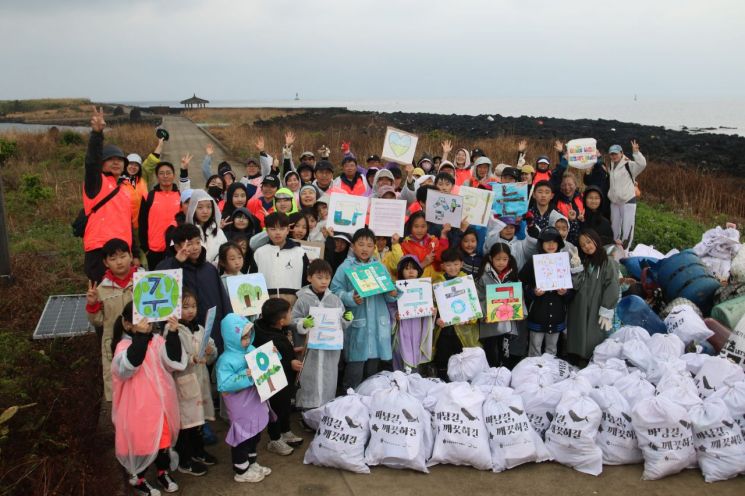 Participants who took part in the restoration activities of the Hwanggeun colony on Biyangdo Island, Jeju, are taking a commemorative photo.
 Photo by Korea Tourism Organization
On that day, participants planted 120 Hwanggeun trees at Peorangmot on Biyangdo and conducted marine litter cleanup activities along the Biyangdo trail. The event was supported by several organizations, including Jeju Theme Yeomiji Botanical Garden and Jeju Olle, with over 150 people participating.
Park Jeong-ung, head of the Jeju branch of the Korea Tourism Organization, said, "Biyangdo is a treasure-like island that holds Jeju’s precious ecological resources and marine environment," adding, "We will continue to discover and promote sustainable marine tourism content utilizing Jeju’s unique ecological environment."
On February 25, the Jeju branch of the Korea Tourism Organization signed a business agreement with the Biyangri Village Association for the "Discovery and Promotion of Jeju Marine Tourism Content by 2025."
© The Asia Business Daily(www.asiae.co.kr). All rights reserved.
![Clutching a Stolen Dior Bag, Saying "I Hate Being Poor but Real"... The Grotesque Con of a "Human Knockoff" [Slate]](https://cwcontent.asiae.co.kr/asiaresize/183/2026021902243444107_1771435474.jpg)















