Southeast Asian Countries Hit by High Tariffs
Korean Companies with Local Factories Affected
Companies "Reviewing Optimal Production Sites"
Considering Relocation to Mexico, the U.S., and Europe
After U.S. President Trump announced reciprocal tariff rates by country, major domestic companies including Samsung Electronics and LG Electronics are reorganizing their supply chains. They are reducing dependence on countries subject to high tariffs such as Vietnam, Thailand, and China, and are reviewing plans to relocate production to regions with relatively lower tariff burdens such as Mexico, the United States, and Europe.
According to the industry on the 9th, Vietnam faces a 46% tariff and China 34% under the reciprocal tariff rates announced by the U.S., increasing the burden on domestic companies. High tariff barriers in Southeast Asian countries, including Cambodia (49%) with the highest tariff rate, Laos (48%), Myanmar (44%), and Thailand (36%), are emerging as risks for companies with production facilities in those locations.
In response, companies are primarily considering price increases, but they have also taken out options such as shifting production volumes to factories in Mexico and the U.S., where tariff impacts are relatively lower, or seeking third-party production sites.
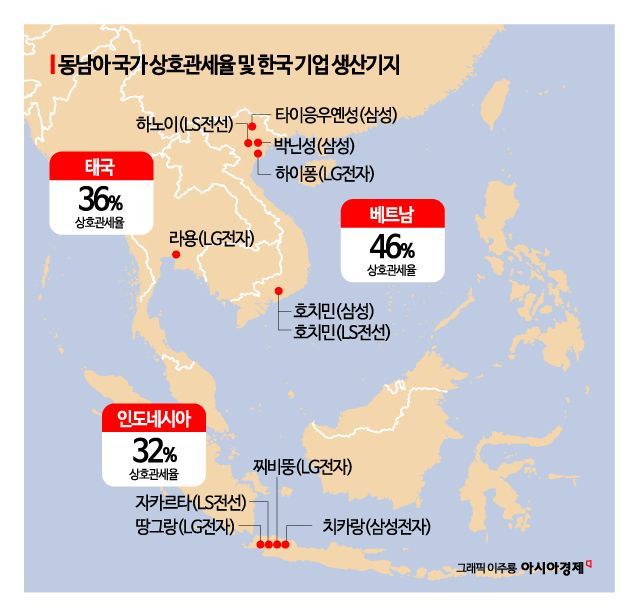
The industry expected to be hit the hardest is the electrical and electronics sector, which has smartphone and home appliance production bases in Vietnam. In particular, Samsung Electronics operates smartphone and home appliance factories in Bac Ninh Province, Thai Nguyen Province, and Ho Chi Minh City in Vietnam. After the announcement of the U.S. reciprocal tariff rates, Samsung Electronics is monitoring negotiations by country and preparing production adjustment plans. Since Vietnam is Samsung’s largest smartphone production base, it is being cautious about production relocation. Samsung plans to mitigate tariff burdens by adjusting volumes between its Mexico factory, which mainly produces home appliances, and its Vietnam factory, which focuses on smartphones.
A Samsung Electronics official said, "Since the largest smartphone factory is in Vietnam, we are watching how the Vietnamese government responds," adding, "Because we have a global supply chain, we will flexibly respond through production volume adjustments between factories."
LG Electronics also operates home appliance factories in Hai Phong City, Vietnam, and Rayong City, Thailand, and is analyzing tariff impacts. It is seeking alternatives to minimize tariff effects, including its North American production base, and the Tennessee plant in the U.S. has available space, making production volume transfers possible if necessary. An LG Electronics official explained, "We are reviewing the optimal production sites considering not only tariffs but also manufacturing costs by location," and added, "The Tennessee plant in the U.S. has available space, so expanded production is possible in the future."
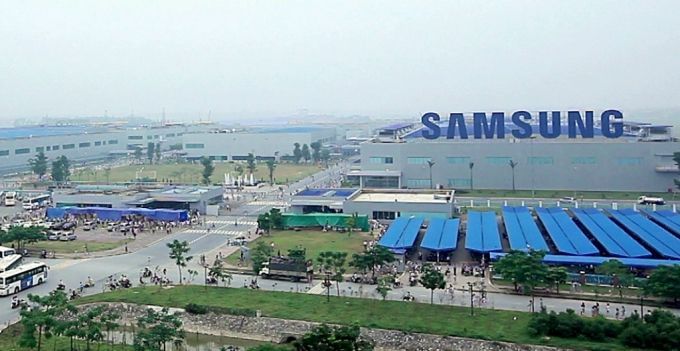 Samsung Electronics smartphone manufacturing plant located in Bac Ninh Province, Vietnam. Photo by Samsung Electronics
Electronic component companies with production bases in Southeast Asia may also be affected. Samsung Electro-Mechanics produces advanced semiconductor substrates and camera modules in Vietnam, and LG Innotek operates a camera module production factory. These component companies have not yet faced direct tariff impacts, but there is a possibility of a chain reaction due to production adjustments by finished product companies and price fluctuations among partners.
An industry official said, "Currently, most volumes can be covered if production is maintained at factories in Mexico or the U.S., but there may be countries with tariffs so high that overcoming them is impossible," and added, "Watching the negotiation process by country, in the long term, companies with many production sites will be competitive in such situations."
© The Asia Business Daily(www.asiae.co.kr). All rights reserved.
![Clutching a Stolen Dior Bag, Saying "I Hate Being Poor but Real"... The Grotesque Con of a "Human Knockoff" [Slate]](https://cwcontent.asiae.co.kr/asiaresize/183/2026021902243444107_1771435474.jpg)
















