Private Universities Trigger Domino Effect in Tuition Hikes
Education Prices Up 2.9%
Kindergarten Fees See Largest Increase in Nine Years
Education prices, one of the major items in household expenditures, have risen the most sharply since the financial crisis (2007-2008). University tuition fees, which increased mainly at private universities, have spread to national/public and vocational universities, and kindergarten fees also rose the most in about nine years. The price of home study materials showed the highest rate of increase since December 1996, just before the International Monetary Fund (IMF) foreign exchange crisis.
On the 7th, Yonhap News cited the National Statistical Portal of Statistics Korea and reported that education prices (classified by expenditure purpose) rose 2.9% compared to a year ago last month. This increase is the largest in 16 years and 1 month since February 2009 (4.8%) during the financial crisis.
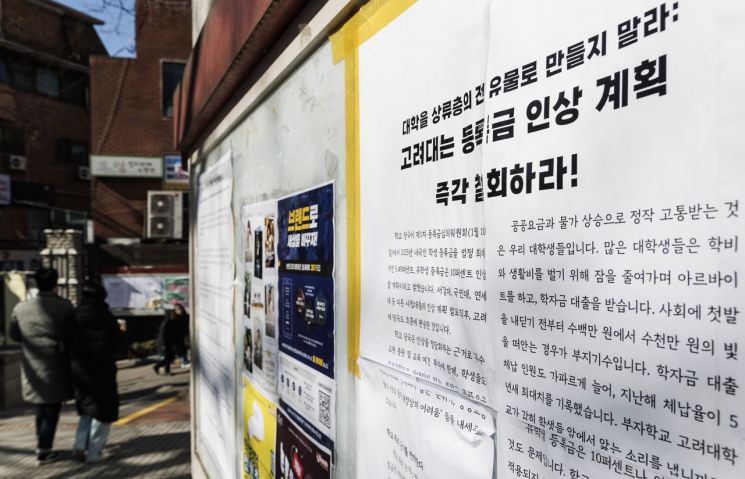 On February 4th, a poster opposing the university's tuition fee increase was posted on a bulletin board at Korea University in Seongbuk-gu, Seoul. The university decided earlier this month to raise undergraduate tuition fees by 5%, which had been frozen for the past 16 years due to rising prices. Yonhap News
The main cause of the rise in education prices is the increase in university tuition fees. This phenomenon was particularly prominent at private universities. According to the Korea Council for University Presidents of Private Universities, as of February 20 this year, 120 out of 151 four-year private universities, accounting for 79.5%, decided to raise tuition fees. Among 39 national/public universities, 11 (28.2%) also decided to increase tuition fees.
In the March consumer price index, private university tuition fees rose 5.2% compared to a year ago. This was the largest increase since February 2009, when it was 7.1%. By region, Busan, Ulsan, and Gyeongnam had the highest increase at 5.6%, followed by Seoul, Incheon, and Gyeonggi (5.5%). Jeju had the lowest increase at 0.1%, followed by Jeonnam, Jeonbuk, and Gwangju (3.7%).
Other private universities that did not raise tuition fees this year and many national/public universities are showing signs of raising them in the first semester of next year. Ultimately, there is considerable analysis that the financial policy direction of the new government, which will be established following the impeachment of former President Yoon Seok-yeol, will be crucial.
Previously, the government had used support from the National Scholarship Type II (university-linked support type) to encourage universities to freeze tuition fees. Since 2012, a condition to receive support from National Scholarship Type II has been to freeze tuition fees, and most universities participated in the government's freeze policy. This was because the support funds from the government through the national scholarship were greater than the amount of tuition fee increases.
The recent change in universities' calculations is due to facing a financial crisis as the government's freeze policy has continued for 17 years. They judged that it was more beneficial to raise tuition fees within the legal ceiling than to freeze tuition fees and receive support from National Scholarship Type II. The legal ceiling for this year was 5.49%.
The problem is that the atmosphere of tuition fee increases at universities may spread to national/public universities next year, becoming the main culprit of continuous price increases. Even within the Ministry of Education, voices are emerging that there is no policy tool to induce tuition fee freezes at national/public universities.
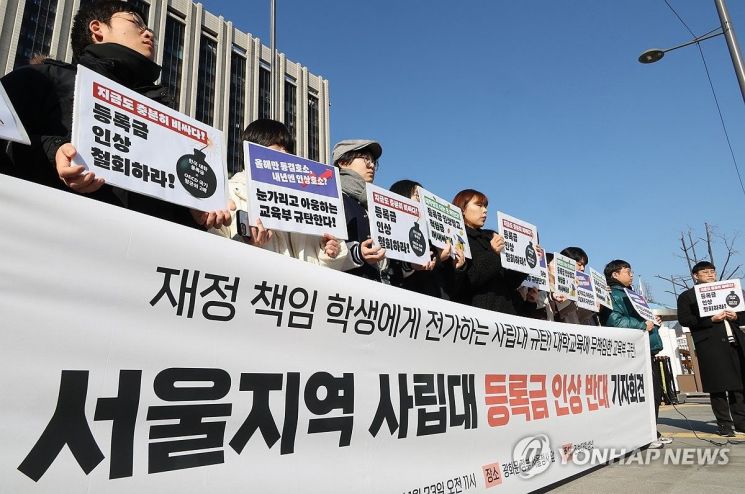 Jinbo University Students Network is holding a press conference opposing the tuition fee increase at private universities in the Seoul area in front of the Government Seoul Office Building on the 23rd. Photo by Yonhap News
Some believe that since it is difficult to find a quick solution to the financial crisis of universities, many of the universities that froze tuition fees this year may raise them all at once next year.
However, there is also a view that the legal ceiling for tuition fee increases may be significantly lowered next year, which could be a variable. It is also expected that the tuition fee increase or freeze strategies of each university will be linked to the university policy direction of the new government, which will be inaugurated around June due to the early presidential election.
Meanwhile, kindergarten fees also surged. Last month, kindergarten tuition fees rose by 4.3%, the largest increase in about nine years since February 2016 (8.4%). Kindergarten tuition fees had been declining year-on-year for 58 consecutive months since May 2020 but turned to an increase last month.
Kindergarten tuition fees are analyzed to have large regional variations due to differences in tuition support policies. They rose significantly in Jeonnam (24.3%), Gangwon (15.7%), Busan (14.7%), Gyeongbuk (12.1%), and Seoul (5.0%).
© The Asia Business Daily(www.asiae.co.kr). All rights reserved.


















