Survey of 1,000 U.S. Hiring Managers
Positive Views: "AI Helps Find Better Talent"
As generative artificial intelligence (AI) is gaining attention as a driving force that enhances corporate efficiency and competitiveness, a survey has revealed that companies find it difficult to assess the true abilities of applicants as job seekers create resumes and portfolios using generative AI tools.
On the 7th, Yonhap News reported the results of a survey conducted by the global career support platform 'ResumeGenius' targeting 1,000 hiring managers in the United States.
Among the hiring managers who responded to the survey, 76% said that "it has become more difficult to evaluate the authenticity of applicants due to AI." The proportion of respondents who said they were "worried that applicants might use AI tools in their application documents" also reached 58%.
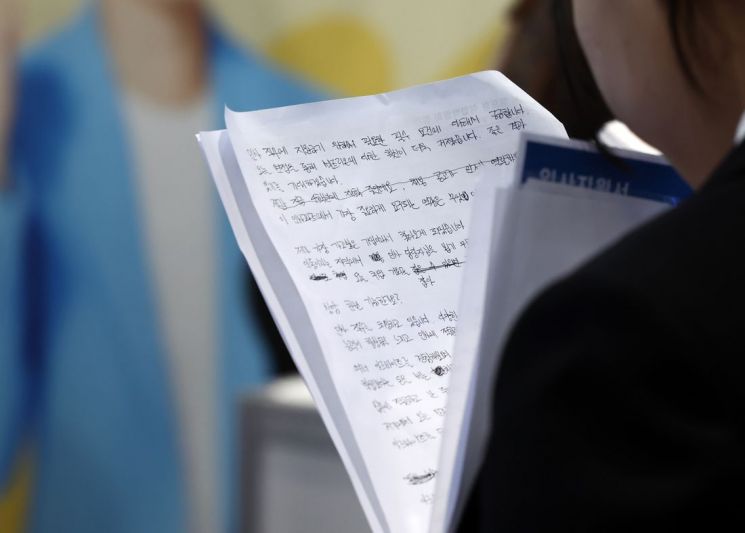 On the 19th of last month, a job seeker is waiting for an interview holding a job application form at the '2025 Korea Job Fair' held at the aT Center in Seocho-gu, Seoul. Photo by Yonhap News
There were many positive evaluations such as "Thanks to AI, the efficiency of the hiring process has improved" (78%) and "We were able to find better candidates through AI" (75%), but it is interpreted that the hiring field is experiencing both the benefits and side effects of new technology.
When asked about the actual problems hiring managers have encountered, the most common response, at 47%, was "cases where applicants submit self-introductions or recommendation letters generated by AI." Other responses included "cases where portfolios or creative works are produced by AI" (35%) and "cases where LinkedIn or other social media profiles used for hiring reference are generated by AI" (33%).
Twenty-nine percent reported experiencing cheating by using AI during online job competency tests, and 17% said they had seen applicants use deepfake (AI-based synthetic video/image) technology during remote video interviews.
The situation is unlikely to be different in South Korea, where AI adoption rates are high. Muhayu, a generative AI plagiarism detection service provider, analyzed 890,000 self-introductions submitted to domestic companies and public institutions last year and found that 48.5% were suspected of using generative AI. It is also known that there are quite a few cases where AI is used to generate answers during online coding tests and to create planning documents submitted for task evaluations. Companies that use AI in the first round of document screening may also be the first to adopt technology to filter out AI-generated documents.
However, some argue that completely banning applicants from using AI during the hiring process is unrealistic. Since AI is already widely used in corporate workplaces for tasks such as translation, proofreading, presentation material preparation, and statistical analysis, it is necessary to evaluate how well applicants utilize AI. In the AI industry and elsewhere, there is also an opinion that rather than whether AI was used, it is important to see if the applicant had "intellectual control" over the output.
Earlier, historian Yuval Harari expressed concern, saying, "If AI continues to develop at the current pace, it will become the first technology in human history that humans cannot control," adding, "AI is not a human tool but an agent of action." He also pointed out that humanity is losing trust faster than ever during this time when people need to come together and cooperate over AI.
© The Asia Business Daily(www.asiae.co.kr). All rights reserved.
![Clutching a Stolen Dior Bag, Saying "I Hate Being Poor but Real"... The Grotesque Con of a "Human Knockoff" [Slate]](https://cwcontent.asiae.co.kr/asiaresize/183/2026021902243444107_1771435474.jpg)
















