KICOX Presents Blueprint for Next-Generation Industrial Complexes
AI and Digital Infrastructure, Energy Innovation, Youth and Cultural Elements
Introducing Infrastructure for Innovation in New-Concept Industrial Complexes
The Korea Industrial Complex Corporation announced on the 6th that it has newly presented a development blueprint for industrial complexes to transform them into next-generation advanced strategic industry hubs.
While existing industrial complexes were established by expanding only the basic infrastructure necessary for simple production activities such as electricity and water supply, future industrial complexes will be developed as next-generation complexes by introducing ▲digital transformation infrastructure (DX) to improve productivity, ▲energy self-sufficiency systems (CX) producing energy from eco-friendly sources, ▲and cultural elements (YX) that attract young people.
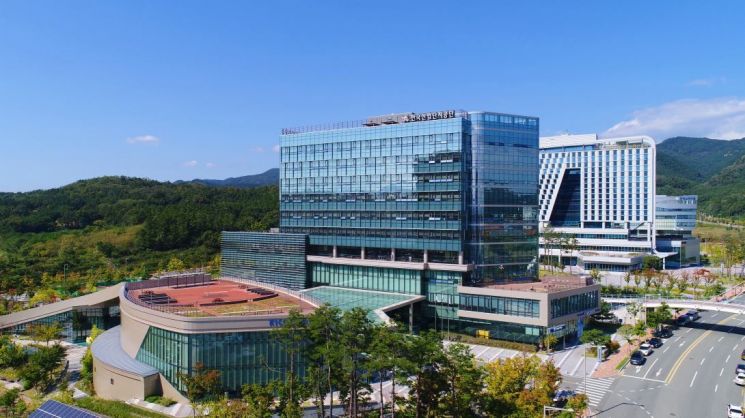
The Incheon Gyeyang General Industrial Complex, where the next-generation industrial complex development blueprint has been applied, attracted great interest during its sale in November last year due to the introduction of future innovation elements, recording a competition rate of 8 to 1. Construction is underway with the goal of completion by December 2026.
The Gyeyang General Industrial Complex plans to establish a 5G specialized network infrastructure, introduce smart safety solutions, install eco-friendly solar power generation, and create urban forests. In particular, by installing solar power generation facilities on factory roofs, it is planned to cover up to 20% of the entire complex’s electricity consumption through self-generation, thereby fundamentally transforming the paradigm of industrial complexes.
The Korea Industrial Complex Corporation also plans to build a 50,000㎡ ‘Autonomous Manufacturing Cluster for Aircraft Parts’ based on artificial intelligence (AI) and 5G communication at the Gyeongnam National Aviation Industrial Complex, aiming to implement a domestic model for digital and low-carbon industrial clusters.
Professor Jang Young-jae of KAIST stated, “To innovate industrial complexes facing difficulties such as labor shortages, supply chain crises, and productivity decline, it is important to establish an AI autonomous manufacturing ecosystem,” and “By proactively introducing future innovation elements for autonomous manufacturing such as 5G communication infrastructure, smart facilities, and AI manufacturing transformation into industrial complexes, the Korea Industrial Complex Corporation is expected to facilitate the spread of AI autonomous manufacturing factories.”
Lee Sang-hoon, President of the Korea Industrial Complex Corporation, said, “Based on the pilot models of introducing future innovation elements in the Gyeyang General Industrial Complex and the autonomous manufacturing cluster for aircraft parts, our corporation will continue to implement next-generation industrial complex models by introducing future innovation elements suitable for the regional industry and location conditions in new industrial complexes in Anseong, Yeosu, and Ulsan,” and “We will create new industrial complexes that integrate digital transformation, decarbonization, and cultural elements, and accelerate changes in existing industrial complexes to establish a foundation where companies, workers, and the regional economy can sustainably grow.”
© The Asia Business Daily(www.asiae.co.kr). All rights reserved.
![Clutching a Stolen Dior Bag, Saying "I Hate Being Poor but Real"... The Grotesque Con of a "Human Knockoff" [Slate]](https://cwcontent.asiae.co.kr/asiaresize/183/2026021902243444107_1771435474.jpg)















