Seoul Continues to Rise After Expansion of Land Transaction Permission Zone
Nationwide Sale Prices Up 0.13%... Sejong Sees 0.25% Increase
In the first week of April, after the expansion of the land transaction permission zone designation, Seoul real estate sale prices rose by 0.21% compared to the previous week. Following the adoption of the impeachment motion against President Yoon Seok-yeol, a period of market pause is expected to continue for the time being.
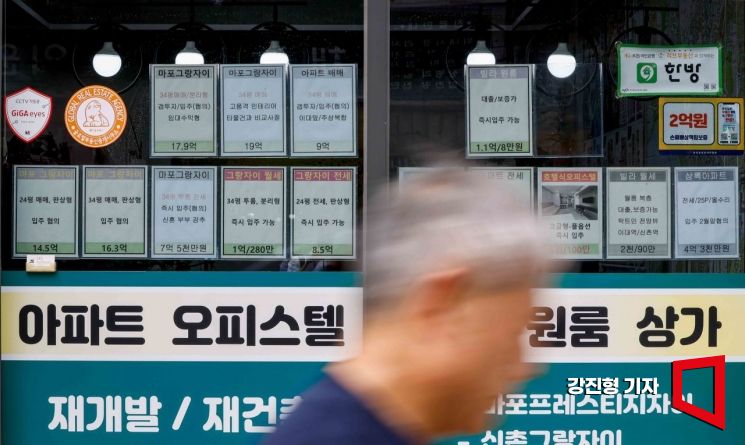 According to the KB Real Estate Weekly KB Apartment Market Trend report, last week Seoul apartment sale prices surged by 0.22% in just one week, with both sale and jeonse prices listed for apartments in Mapo-gu, Seoul on the 5th. Photo by Jinhyung Kang aymsdream@
According to Real Estate R114 on the 5th, the nationwide apartment sale prices in the first week of April increased by 0.13% compared to the previous week. Seoul led the price increase in the metropolitan area with a 0.21% rise, while Gyeonggi and Incheon rose by 0.08%. The five major metropolitan cities increased by 0.04%, and other provinces rose by 0.10%.
Among the 17 cities and provinces nationwide, 16 regions showed price increases, indicating a strong nationwide upward trend. By individual regions, the largest increases were in △Sejong (0.25%) △Seoul (0.21%) △Gyeongbuk (0.17%) △Jeju (0.14%) △Daejeon (0.12%) △Incheon (0.12%) △Daegu (0.12%) △Jeonbuk (0.10%). Busan was the only region to decline, dropping by 0.03%.
On a monthly basis in March, the nationwide fluctuation rate recorded 0.33%. While most regions nationwide either turned downward or continued a declining trend, Seoul saw a significant increase of 0.42 percentage points compared to the previous month (0.76%). Ulsan also recorded an upward trend for two consecutive months.
In the first week of April, nationwide apartment jeonse (long-term lease) prices rose by 0.03%. The increase in jeonse prices was more prominent in provinces than in the metropolitan area (0.00%). Seoul fell by 0.04%, whereas Gyeonggi and Incheon rose by 0.03%. The five major metropolitan cities jumped by 0.11%, and other provinces were adjusted upward by 0.10%.
Among the 17 cities and provinces nationwide, jeonse prices increased in 15 regions. The regions with the largest jeonse price increases were △Jeonnam (0.33%) △Ulsan (0.33%) △Jeonbuk (0.19%) △Busan (0.18%) △Gangwon (0.16%) △Sejong (0.13%) △Chungbuk (0.12%) △Daegu (0.10%). Daejeon fell by 0.11%, and Seoul decreased by 0.04%. The nationwide monthly jeonse price fluctuation rate in March was 0.09%, continuing an upward trend for 20 consecutive months.
Following the adoption of the impeachment motion against President Yoon Seok-yeol on the 4th, key government real estate policy initiatives such as the abolition of the excess profit recovery system for reconstruction, reconsideration of the Lease Protection Act 2, and easing of heavy taxation on multiple homeowners are expected to lose momentum.
Concerns about prolonged housing supply instability have also been raised. The plan to supply 2.7 million housing units over the five-year term, the Special Act on Promotion of Reconstruction and Redevelopment Projects (Reconstruction Promotion Act), and other supply expansion and deregulation of maintenance projects are expected to face obstacles.
Baek Saerom, chief researcher at Real Estate R114, explained, "Ahead of the early presidential election expected at the end of May or early June, both homebuyers and investors will show limited movement until the outlines of real estate-related pledges and policy directions of the ruling and opposition presidential candidates emerge. For the time being, a market pause will continue as major political parties analyze their election pledges."
© The Asia Business Daily(www.asiae.co.kr). All rights reserved.

















