Medical Community Urges Approval of Assisted Reproductive Technologies
Childbirth Should Be a Voluntary Choice
Children from Diverse Family Backgrounds
Must Grow Up Without Discrimination to Boost Birth Rate
There has been a call for assisted reproductive technologies such as sperm donation, frozen egg and embryo storage to be institutionally available even in non-marital situations, so that various family members can give birth and raise children without discrimination. Currently, sperm donation is only allowed in cases of de facto marital relationships according to the ethical guidelines on assisted reproductive technology by the Korean Society of Obstetrics and Gynecology, but there are demands to expand this further.

At the 1st Population 2.1 Seminar hosted by the Korea Future Population Research Institute on the 3rd at the POSCO Center in Seoul, panelists discussed the social acceptance and institutional challenges of non-marital childbirth. Chaired by former Vice Minister of Gender Equality and Family Kim Kyung-sun, the discussion focused on institutional improvements to create an environment where various family members can give birth and raise children without discrimination, moving beyond the existing marriage-centered policies amid the ultra-low birthrate crisis.
Recently, as non-marital childbirth by celebrities has continued, social perceptions have changed. The proportion of people who believe that children can be born without marriage rose to 37.2% (2024), up 2.5 percentage points from two years ago. However, the system has not kept pace. A representative example is the regulations related to assisted reproductive technology. The Anti-Corruption and Civil Rights Commission recommended revising the ethical guidelines of the Korean Society of Obstetrics and Gynecology on assisted reproductive technology, citing that restrictions on in vitro fertilization for unmarried women constitute discrimination. However, the Korean Society of Obstetrics and Gynecology opposed this, stating that childbirth using a third party's reproductive ability is a serious issue that requires social consensus, including the protection of the rights of sperm donors and children born, and thus the guidelines were not revised.
Researcher Byun Soo-jung of the Korea Institute for Health and Social Affairs pointed out, "Non-marital childbirth no longer only means childbirth by unmarried cohabiting couples," adding, "Society has now changed to mean non-marital single, independent childbirth." Byun emphasized, "Despite long-standing social discussions on guaranteeing non-marital cohabiting relationships, they have yet to be realized, and the reality is that issues related to assisted reproductive technology need to be discussed," and stressed, "Furthermore, we must accept that the discussion dimension regarding births through these methods and child welfare is rapidly changing."
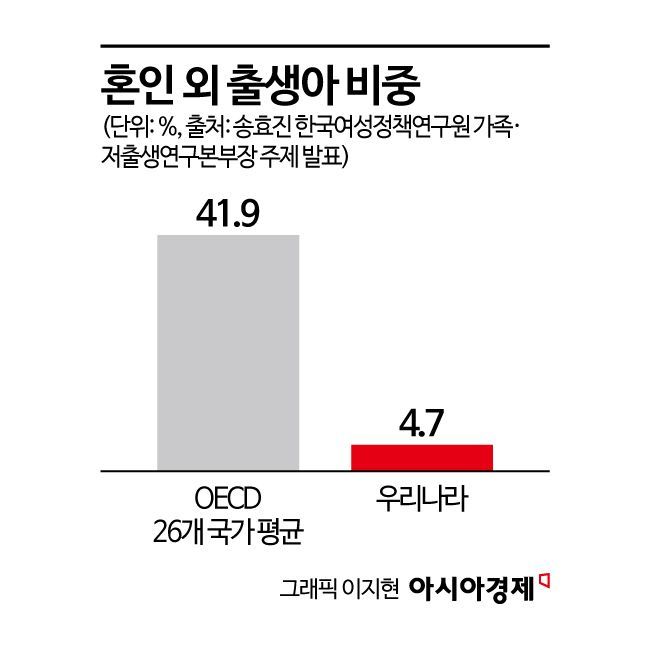
Kang Eun-ae, head of the Women and Family Policy Team at the Seoul Foundation of Women and Family, said, "There is a need to define non-marital childbirth more broadly and discuss support measures and legal and institutional improvements according to the circumstances of non-marital childbirth," adding, "Designing support for childbirth and parenting regardless of the presence of a partner can be a more inclusive approach."
Kang said, "According to the 2021 study 'Seoul Citizens' Perceptions and Policy Tasks on Non-Marital Childbirth,' 73.3% responded that assisted reproductive technology should be available regardless of marital status," and added, "Countries such as Denmark, Australia, Norway, Germany, and some states in the United States allow assisted reproductive technology regardless of marital status, and Denmark even supports assisted reproductive technology through public health insurance costs, considering women's health rights and children's rights."
Social prejudice and discriminatory perceptions toward non-marital childbirth remain a persistent challenge.
Non-marital households also report economic difficulties. Kim Ji-hwan, CEO of Dad’s Embrace at the Korea Single Father Family Support Association, said, "Life with my child is joyful and happy, but life outside the home to protect that life was very difficult," adding, "It was honestly very hard to maintain a regular full-time job, and I always felt self-conscious about constantly receiving accommodations." Park Soo-kyung, CEO of the marriage information company Duo, said, "We need to instill the perception that childbirth can be a merit, not a penalty," and suggested, "Both positive perceptions of non-marital status and willingness to give birth are increasing, so practical support measures are needed to make childbirth a voluntary choice."
The government said it will strive to positively change perceptions of non-marital childbirth. Kim Sang-hee, Director of Population and Child Policy at the Ministry of Health and Welfare, said, "In Korea, non-marriage is more strongly characterized as a preparatory stage before marriage rather than an alternative to marriage rejecting norms, as seen abroad," adding, "Non-marital childbirth was perceived more as negative social views and practical inconveniences such as the absence of a guardian rather than explicit institutional discrimination." He continued, "We will further consider creating policy and institutional foundations so that children born into diverse family backgrounds can grow up without discrimination," and added, "In a society where negative perceptions such as sadness and fear are too prevalent regarding marriage and childbirth, we will work to improve these issues together and continuously prepare institutional improvement measures for non-marital cohabitation and childbirth."
Lee In-sil, director of Hanmiyeon, emphasized, "We will continue to propose concrete policies to create a social environment where non-marital childbirth families can raise children without discrimination," and said, "Embracing diverse family forms and creating an environment where all children can grow up healthily will be a key to overcoming the low birthrate."
© The Asia Business Daily(www.asiae.co.kr). All rights reserved.
![Clutching a Stolen Dior Bag, Saying "I Hate Being Poor but Real"... The Grotesque Con of a "Human Knockoff" [Slate]](https://cwcontent.asiae.co.kr/asiaresize/183/2026021902243444107_1771435474.jpg)















