TSMC Demands 20% Stake
In Exchange for Sharing Some Manufacturing Technologies
Unclear Funding Plan... Final Agreement Needed
U.S. semiconductor company Intel and the world's largest foundry (contract manufacturing) company TSMC have tentatively agreed to establish a joint venture chip manufacturing operator, signaling the formalization of a symbiotic relationship between Intel and TSMC. If the main contract is signed, it is expected to serve as a breakthrough for Intel, which is facing a crisis due to financial difficulties and weakened technological competitiveness, to normalize its management and foundry business.
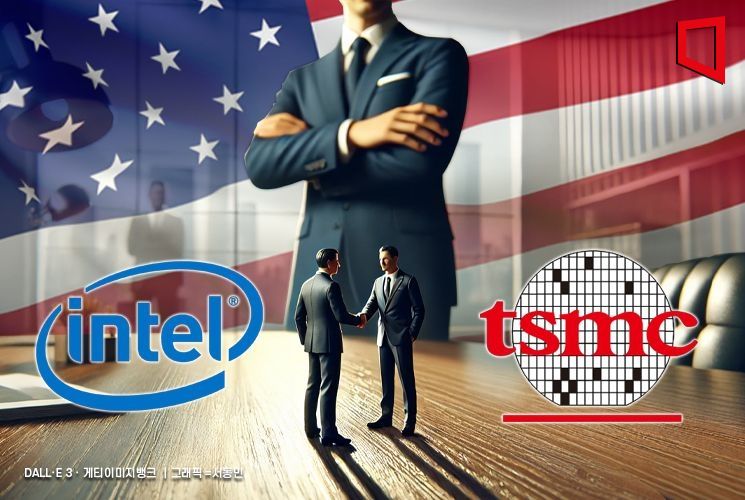
On the 3rd (local time), U.S. IT media outlet The Information cited two sources, reporting that the management teams of Intel and TSMC recently reached a tentative agreement to establish a joint venture company to operate Intel's manufacturing plant foundry division. Intel and other U.S. semiconductor companies will hold most of the shares in the joint venture, while TSMC will acquire a 20% stake in Intel's foundry business.
TSMC is discussing sharing some manufacturing technologies with Intel in exchange for receiving a 20% stake in the joint venture. However, details such as the scale of the production joint venture or the proportion of Intel's semiconductor production accounted for by the joint venture have not been disclosed. The Nihon Keizai Shimbun (Nikkei) interpreted this as reflecting a policy emphasizing domestic production in the U.S., led by American capital and supported by the U.S. administration.
However, it is unclear how this joint investment is connected to TSMC's proposal in March to Nvidia, AMD, and Broadcom for joint investment to operate Intel's fabs. Last month, foreign media including Bloomberg reported that TSMC was considering acquiring a stake in Intel's factories and operating them at the request of the Trump administration. Intel and TSMC have not issued separate statements regarding this.
The joint venture between the two companies is expected to take the form of TSMC supporting Intel, which is struggling with poor management. TSMC plans to transfer semiconductor manufacturing methods to Intel and train personnel to carry them out. From TSMC's perspective, this allows minimizing investment and gaining credit for responding to the Trump administration's cooperation request. Recently, Taiwan's DigiTimes reported that TSMC denied acquiring Intel's foundry.
Within Intel, there is an atmosphere of reluctance toward entering a honeymoon relationship with TSMC. Intel and TSMC have different equipment and manufacturing processes, leading to concerns that TSMC's know-how transfer may be meaningless. Some voices within Intel worry that the joint investment could lead to large-scale layoffs. Specific funding plans remain unclear, and there are concerns that final agreement may not be reached during the review process.
TSMC's investment is also seen as being pushed by the Trump administration. President Trump recently demanded that TSMC acquire Intel's factories or engage in technology joint ventures to rescue Intel, which has fallen into deficit. Considering the threat of withdrawal of subsidies under the CHIPS Act, the 32% reciprocal tariffs imposed on Taiwan, and semiconductor tariffs, TSMC had no choice but to accept the Trump administration's proposal. Facing increasing pressure, TSMC announced last month that it would invest an additional $100 billion (approximately 150 trillion won) in its U.S. factories.
The Information reported, "It appears that the U.S. Trump administration supports negotiations between Intel and TSMC as a measure to revitalize Intel, the largest chip manufacturer in the U.S."
© The Asia Business Daily(www.asiae.co.kr). All rights reserved.
![Clutching a Stolen Dior Bag, Saying "I Hate Being Poor but Real"... The Grotesque Con of a "Human Knockoff" [Slate]](https://cwcontent.asiae.co.kr/asiaresize/183/2026021902243444107_1771435474.jpg)
















