Reciprocal Tariffs Could Raise U.S. Inflation by 1.5%p, Impacting Purchasing Power
$3.1 Trillion Wiped Out from U.S. Stock Market in a Single Day
Further Decline Remains a Possibility
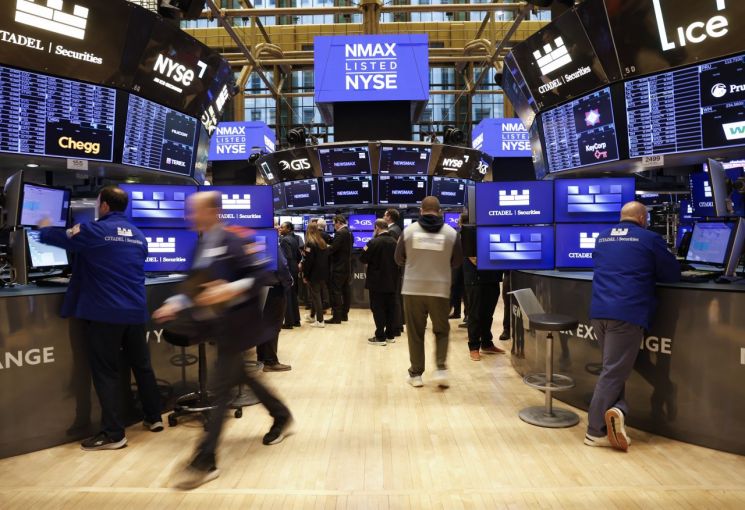 On the 3rd, the day after U.S. President Donald Trump implemented reciprocal tariffs on the 2nd (local time), employees were busy moving around the New York Stock Exchange. On that day, the three major indices of the New York stock market fell by more than 3 to 5%, marking the largest drop in the past five years. Photo by UPI Yonhap News
On the 2nd (local time), U.S. President Donald Trump pushed forward with reciprocal tariff policies, raising warnings on Wall Street about the increased likelihood of the U.S. facing an economic recession. In particular, pessimism emerged that the downward trend in the U.S. stock market would continue for some time after $3.1 trillion (approximately 4,500 trillion won) vanished from the New York stock market just one day after the reciprocal tariffs were announced.
According to reports from Bloomberg and Newsweek on the 3rd, Michael Feroli, Chief Economist at JP Morgan Chase, stated in an investor note the previous day that "we estimate that this measure could raise the Personal Consumption Expenditures (PCE) price index by 1 to 1.5 percentage points." He also mentioned that the impact of reciprocal tariffs on inflation would appear by mid-year (Q2 to Q3).
He added, "If purchasing power is hit by this, real disposable income could turn negative in Q2 to Q3, and real consumption expenditure may contract," emphasizing that "even this effect alone could push the economy into a recession scenario." Real disposable income, one of the key economic indicators, is the income individuals can actually use for consumption or savings after mandatory payments such as taxes, adjusted for inflation.
According to JP Morgan, before the announcement, the average effective tariff rate in the U.S. was about 10%, but after the reciprocal tariffs took effect, it surged to over 23%. This is the highest level since just before the outbreak of World War I, when protectionism was dominant. Economist Feroli noted, "The average effective tariff rate could rise further," highlighting the additional impact expected from tariffs on semiconductors, pharmaceuticals, and critical minerals, which the White House had announced in advance. Indeed, President Trump told reporters on his private plane on the 3rd that tariffs on semiconductors would "start very soon." Regarding pharmaceuticals, he said it was a "separate category," but added, "It will be announced in the near future and is currently under review."
Jonathan Pingel, Chief U.S. Economist at UBS, predicted that the U.S. economy would fall into a technical recession, showing negative growth for two consecutive quarters due to the impact of reciprocal tariffs. He diagnosed that "economic expansion was already slowing, fiscal support was weakening, and consumer strength was diminishing," indicating that confidence in the U.S. economy had already shown signs of weakening before the reciprocal tariffs were announced.
Some also warned that the New York stock market, which recorded an unprecedented plunge the previous day, would continue to decline further. On the 3rd, all three major indices of the New York stock market recorded their largest drop in five years. Among the three indices, the Nasdaq, which has a high proportion of tech stocks, fell more than 5%. The total market capitalization evaporated by $3.1 trillion (approximately 4,500 trillion won) in just one day.
The equity strategy team led by Lori Calvasina at RBC Capital Markets forecasted that the S&P 500 index could fall further to between 4900 and 5300 due to the impact of reciprocal tariffs. This could represent a drop of up to 20% from the peak in February. While she noted as hopeful factors that no additional measures were imposed on Canada and Mexico and that there was room for negotiation, she cited concerns including the absence of exceptions, ongoing uncertainty about the final tariff levels, and negative effects on economic sentiment.
© The Asia Business Daily(www.asiae.co.kr). All rights reserved.
![Clutching a Stolen Dior Bag, Saying "I Hate Being Poor but Real"... The Grotesque Con of a "Human Knockoff" [Slate]](https://cwcontent.asiae.co.kr/asiaresize/183/2026021902243444107_1771435474.jpg)















