Uijeongbu City to Fully Implement 'Elderly Welfare Safety Net' Ahead of Super-Aged Society
Comprehensive Measures for Super-Aged Society: From Jobs to Care
Integrated Support for Health and Care... Advanced Health Management Using AI Robots and ICT
Uijeongbu City in Gyeonggi Province will actively promote elderly welfare policies to proactively respond to social changes caused by aging, as it is expected to enter a super-aged society by the end of this year.
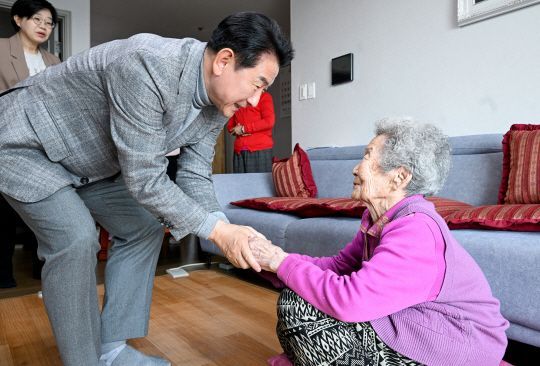 Kim Dong-geun, Mayor of Uijeongbu City, is visiting the home of a centenarian in the area to celebrate their birthday. Photo by Goyang City
According to Uijeongbu City on the 3rd, as of March 2025, 88,711 people, accounting for 19.2% of the total population, are aged 65 or older. Accordingly, the city has set the elderly welfare budget at 328.07 billion KRW, an increase of 9.2% compared to the previous year.
This accounts for 24.8% of the total budget and is the highest proportion of elderly welfare budget among cities in Gyeonggi Province.
Uijeongbu City plans to prepare detailed implementation plans in five major areas?△economic independence △health management △welfare infrastructure △care system △policy foundation?and implement them step-by-step to ensure stable old-age security for the elderly.
First, to strengthen income security for economically vulnerable seniors, the city plans to expand the number of participants in senior job programs to 5,000 in 2025, an increase of 603 from the previous year, supporting more elderly people to secure stable income.
In addition, to promote continuous social participation and employment linkage for seniors with working ability, the city plans to establish and operate an “Integrated Senior Job Support Center” by the end of the year to build a systematic and comprehensive job support system.
Currently, Uijeongbu City provides visiting health management services to about 2,000 seniors to guarantee their health rights and eliminate blind spots in healthcare. Integrated health services such as early dementia screening, cognitive training, and treatment cost support are also being provided through regional dementia relief centers.
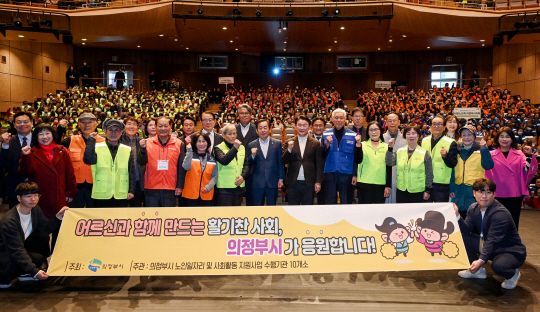 The integrated launch ceremony for senior job participants in 2025 is being held. Photo by Uijeongbu City
In particular, 100 health-vulnerable seniors will receive integrated face-to-face and non-face-to-face health management services using artificial intelligence (AI) care robots, establishing a 24-hour health safety net.
Also, seven senior cafeterias provide balanced meals to 620 people five days a week, and side dish delivery services twice a week are provided to 840 low-income seniors with mobility difficulties, along with regular welfare checks.
Infrastructure for a vibrant old age will also be expanded. Ten additional senior centers will be opened, increasing from 256, and the number of senior centers providing lunch five days a week will be significantly expanded from five to 27.
The “Ttasunbapsang” meal support staff will be operated with a total of 320 people, an increase of 70 from the previous year, to create a stable meal environment.
Customized care for elderly living alone and a safety net based on information and communication technology (ICT) will also be established. The city plans to provide “Customized Senior Care Services” to 3,059 seniors aged 65 or older living alone who require care through four implementing agencies. This is an increase of 236 people from the previous year, and 202 life support workers will strengthen customized care services such as safety checks, social participation support, provision of goods, and housekeeping assistance.
Specialized services to prevent solitary deaths will be provided for 43 high-risk elderly individuals to support more meticulous care. Additionally, ICT will be used to install safety equipment such as activity sensors and fire detectors in 1,032 households of seniors living alone who require real-time monitoring, enabling automatic 119 emergency calls in case of emergencies.
In particular, 100 smart watch-type wearable devices capable of detecting vital signs and emergency calls will be additionally distributed this year to households of elderly living alone with high risk, enabling psychological stability and immediate response.
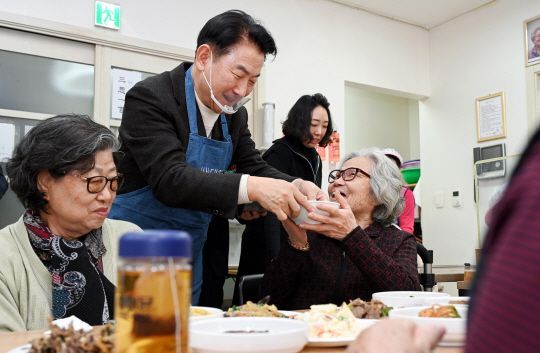 Kim Dong-geun, Mayor of Uijeongbu City, is visiting the Yongam Village 13 Complex Apartment Senior Center and talking with local elders. Photo by Uijeongbu City
Uijeongbu City also plans to prepare policies to respond to the super-aged society. Based on the “Uijeongbu City Elderly Welfare Basic Ordinance” enacted this year, the city will establish and implement a comprehensive elderly welfare plan and a support plan for seniors living alone.
To enhance the practicality of policy formulation, the existing Senior Committee will be divided into three subcommittees: △social participation and jobs △health and care △education, leisure, and culture, and the number of citizen and expert committee members will be expanded from 15 to 22 to contribute to more efficient policy design.
Kim Dong-geun, Mayor of Uijeongbu City, said, “As the entry into a super-aged society accelerates, policy efforts to strengthen welfare and protection for the elderly are more important than ever. We will do our best to establish a meticulous care system so that seniors can enjoy a safer and happier life within the local community and to develop customized elderly policies in preparation for the super-aged society.”
© The Asia Business Daily(www.asiae.co.kr). All rights reserved.
![Clutching a Stolen Dior Bag, Saying "I Hate Being Poor but Real"... The Grotesque Con of a "Human Knockoff" [Slate]](https://cwcontent.asiae.co.kr/asiaresize/183/2026021902243444107_1771435474.jpg)


















