Kim Byung-hwan Proposes Equity-Type Housing Finance (Mortgage)
Aims to Address Household Debt and Support the Homeless
Detailed Roadmap to Be Announced by June
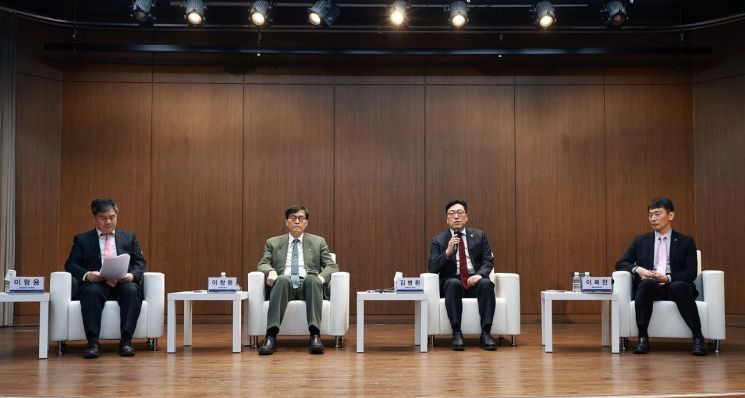 Kim Byung-hwan, Chairman of the Financial Services Commission (second from the right), attended the joint policy conference held by the Bank of Korea and the Korea Institute of Finance at the Bankers' Hall in Jung-gu, Seoul, on the afternoon of the 3rd. Chairman Kim is having a special discussion led by Lee Hang-yong, President of the Korea Institute of Finance (left), with Lee Chang-yong, Governor of the Bank of Korea (second from the left), and Lee Bok-hyun, Governor of the Financial Supervisory Service. Photo by the Financial Services Commission.
Kim Byung-hwan, Chairman of the Financial Services Commission, announced plans to introduce an 'equity-type housing finance (mortgage)' system to address the growing household debt problem and increase support for the homeless. A detailed roadmap is expected to be announced by June.
On the 3rd, at a special discussion held at the Bankers' Hall in Jung-gu, Seoul, during the 'Joint Policy Conference for Improving Real Estate Credit Concentration,' Chairman Kim explained, "So far, support for the homeless in buying homes has been provided by reducing interest rates, but we are considering whether this is desirable from the perspective of household debt and macroprudential management."
He added, "As an alternative, we are preparing measures for an equity-type mortgage," and explained, "The part where funds are insufficient to buy a house is not a loan but a form of equity investment by the public sector, using policy finance in a way that does not create debt." He further stated, "We are considering how to gradually establish this system and plan to announce a concrete roadmap by June."
The equity-type mortgage is a system in which policy financial institutions such as the Korea Housing Finance Corporation (KHFC) participate as equity investors in the housing transaction process to alleviate the borrowing burden of homebuyers. The government's plan is to reduce the proportion of bank loans in housing transactions to lessen the household debt burden.
Chairman Kim emphasized, "The most common criticism we have heard while continuously strengthening loan regulations is whether only those who can inherit from their parents can buy a house, which is a matter of accessibility and inequality. As housing market prices rise, the gap in assets and polarization worsen, inevitably causing economic frustration, which makes it impossible to solve the household debt problem."
In response to these issues, the idea is to help individuals purchase homes jointly with policy financial institutions like KHFC by acquiring equity together. He explained, "For example, if the house price is 100, my money is 10, bank loans are 40, and the remaining 50 is acquired by KHFC as equity." He added, "For the 50 that KHFC holds, the homeowner pays a usage fee slightly lower than interest, and later, when income is generated, the homeowner can buy KHFC's equity." In the event that housing prices fall, KHFC bears the loss first.
He continued, "Since there is an intention to gain profits through leverage, we need to test how much demand there will be even if the structure is changed like this, so we plan to conduct a pilot project." He said, "We will test market demand and identify what needs to be improved, and based on the response, we will consider whether to expand the program."
Lee Chang-yong, Governor of the Bank of Korea, and Lee Bok-hyun, Governor of the Financial Supervisory Service, who attended the special discussion, also agreed with Chairman Kim's views. Governor Lee evaluated, "The REITs method announced by the Bank of Korea can also serve as a starting point for seeking policy changes."
Governor Lee Bok-hyun said, "After considering why there is such excessive concentration in real estate, it is because economic agents have used excessive leverage," and added, "Diversifying non-interest portfolios may legally be equity, but even if it is a loan, if it is to be evaluated without collateral, it must be equitized. There is no disagreement on that direction."
© The Asia Business Daily(www.asiae.co.kr). All rights reserved.
![Clutching a Stolen Dior Bag, Saying "I Hate Being Poor but Real"... The Grotesque Con of a "Human Knockoff" [Slate]](https://cwcontent.asiae.co.kr/asiaresize/183/2026021902243444107_1771435474.jpg)















