Special Committee Policy Forum on "Creating an Elderly Care Society Together" by the Presidential Committee on National Integration
A proposal has been made to reform the current elderly care facility benefit support system, which promotes the use of high-cost nursing facilities. It was diagnosed that increasing support for home care benefits, which provide financial assistance for care services received at home, to ensure fairness could alleviate the excessive demand for nursing facilities in South Korea.
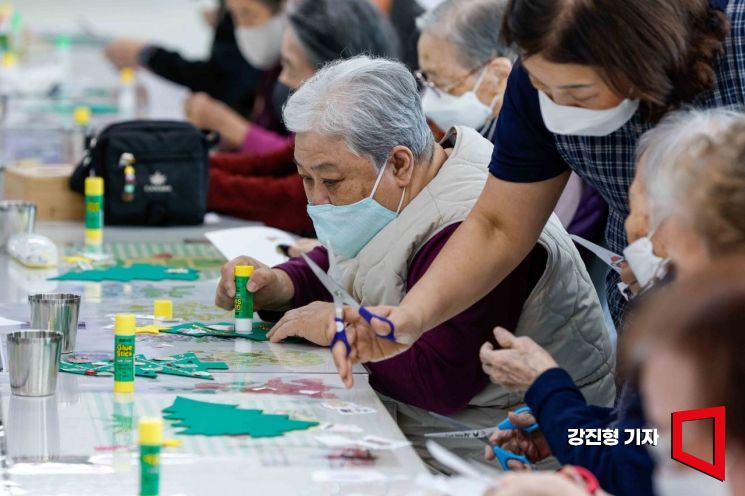 On the 6th, elderly people are engaged in crafting activities at the Gireum Daycare Center in Seongbuk-gu, Seoul. Known as "Nochwon" (a combination of "No-in" meaning elderly and "Yuchiwon" meaning kindergarten), the daycare center is a facility that cares for the elderly who are not yet in need of nursing home care but have difficulty living independently due to early-stage dementia or other age-related illnesses (long-term care levels 1 to 5). Photo by Kang Jin-hyung
On the 4th, the Presidential Committee on National Integration held a policy forum titled "Creating an Elderly Care Society Together" at the Seoul President Hotel with the Korea Senior Citizens Association and the Korean Gerontological Society, where this proposal was made. The special committee was launched last November with the awareness that reforming the elderly care system is an important issue that the state and local communities must solve together.
Following the senior policy forum held in January, this second forum was attended by about 130 people, including Kim Han-gil, Chairperson of the National Integration Committee, Lee Jung-geun, President of the Korea Senior Citizens Association, senior members, elderly care experts, and officials from ministries and local governments. The event proceeded with an opening address by Chairperson Kim Han-gil, congratulatory remarks by President Lee Jung-geun, an outline presentation of the proposal by Special Committee Chairperson Jeong Soon-dul, thematic presentations by Special Committee members Lee Yoon-kyung and Hong Sun-mi, and a comprehensive discussion by four experts.
At the forum, Lee Yoon-kyung, who presented on the theme of "Expanding Care Rights," argued that home care benefits should be increased. Lee explained that the current support structure for facility benefits and home care benefits promotes demand for high-cost nursing care. The support amount for home care benefits, which provide services such as home visit nursing and home visit bathing for elderly people living at home, is relatively low, unnecessarily stimulating demand for nursing facilities. For users assessed with level 4 care needs, who do not necessarily have to use facilities, the monthly limit for home care benefits is 1,341,000 KRW, whereas the monthly compensation for facility benefits is set at 2,240,000 KRW.
Lee said, "Even those assessed with care level 3 or below can use facilities if necessary, but (from the families' perspective) going to a facility is economically advantageous," adding, "There is a need to align the two benefit systems from the perspective of fairness." She explained that compared to the OECD average number of nursing facility beds (3.5 per 1,000 elderly), Korea's number of beds is 32.3, far exceeding the average. Lee emphasized, "Many elderly people want to receive care services at their own homes, but the current system promotes unnecessary facility use."
There was also a proposal to activate family care leave and family care leave systems and to make them paid in the long term. Family care leave, introduced in 2020, is unpaid leave that workers can use when urgent care is needed due to a family member's illness, accident, old age, or child-rearing. It can be used in units of one day up to a maximum of 10 days per year, but the average usage period in public institutions under the Ministry of Employment and Labor was generally 1 to 2 days. Family care leave is derived from family care leave of absence, which has been in effect since 2012. Family care leave of absence can be used for up to 90 days per year for reasons such as family illness, accident, or old age.
Lee said, "Our society provides benefits for child care, but it is difficult to take leave or leave of absence to care for parents," adding, "First, we need to raise awareness of the existing family care systems and find ways to encourage their use without hesitation."
Jeong Soon-dul, who presented the outline of the special committee's proposal, said, "We prepared the policy proposal after discussions since last September," and added, "It is time for the entire society to come forward to build a sustainable elderly care system so that old age does not become a time of suffering."
© The Asia Business Daily(www.asiae.co.kr). All rights reserved.
![Clutching a Stolen Dior Bag, Saying "I Hate Being Poor but Real"... The Grotesque Con of a "Human Knockoff" [Slate]](https://cwcontent.asiae.co.kr/asiaresize/183/2026021902243444107_1771435474.jpg)















