A New Clue for mRNA Therapeutics
IBS RNA Research Group Unveils Intracellular Mechanism for Enhanced Efficacy and Stability
Domestic researchers have uncovered clues to develop the 'messenger ribonucleic acid (mRNA vaccine),' a new therapeutic platform, more effectively and stably.
On the 4th, the Ministry of Science and ICT announced that a research team led by Professor Kim Bitnaeri of the Department of Biological Sciences at Seoul National University and head of the RNA Research Group at the Institute for Basic Science (IBS) identified a group of proteins that control the intracellular delivery and degradation of mRNA vaccines and elucidated their mechanism of action for the first time in the world.
 Kim Bitnaeri, Director of the RNA Research Center at the Institute for Basic Science (IBS) and Professor in the Department of Biological Sciences at Seoul National University, explaining the research results. Photo by IBS
'mRNA (messenger RiboNucleic Acid)' literally means 'messenger ribonucleic acid.' It plays the role of delivering DNA genetic information capable of synthesizing proteins to ribosomes inside the cytoplasm.
mRNA became widely known through its use in COVID-19 vaccines. Unlike traditional viral vaccines that inject weakened viruses into the human body to generate antibodies, mRNA vaccines inject mRNA containing the genetic information of the coronavirus, enabling the body to produce proteins that then create antibodies against COVID-19.
Through this, mRNA-based technology has enormous growth potential, enabling various applications such as infectious disease response, cancer vaccines, immunotherapy, and gene therapy. In particular, mRNA technology has evolved into an innovative therapeutic platform through the development of mRNA synthesis techniques and lipid nanoparticles, substances that protect mRNA and efficiently deliver it to cells.
However, how mRNA vaccines actually operate and are regulated within cells to produce proteins, and how they evade cellular defense mechanisms, have not been sufficiently understood.
Accordingly, the IBS research team conducted detailed 'CRISPR knockout screening' technology, which involves individually removing genes using gene scissors and analyzing genes that affect specific traits or cellular responses, to identify intracellular factors that remove mRNA.
The researchers revealed the roles and regulatory pathways of key protein factors, including the 'heparan sulfate' molecule, an important mediator for mRNA delivery and uptake into cells, and the enzyme 'V-ATPase,' a proton ion pump that acidifies the interior of the endoplasmic reticulum and temporarily disrupts the endoplasmic reticulum membrane.
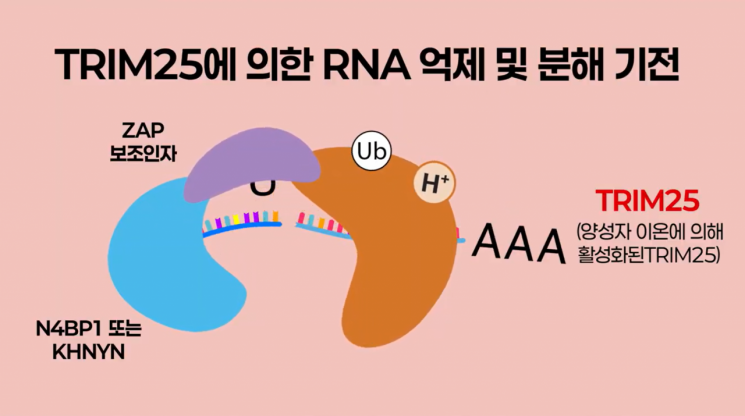
The research team also discovered for the first time the important role of proton ions that alert the cell to the invasion of external RNA, along with major inhibitory factors against RNA therapeutics.
The cytoplasmic 'TRIM25' protein recognizes and removes mRNA as an invader. This protein is activated by proton ions released when the endoplasmic reticulum membrane ruptures and specifically targets and binds to exogenous RNA, rapidly cleaving and degrading it together with other nucleases and auxiliary proteins.
Furthermore, the researchers found that the binding affinity of TRIM25 protein, which binds and removes mRNA, is significantly reduced for the 'N1-methylpseudouridine' modified base, a key component of COVID-19 vaccines that possess properties to evade innate immune responses, preventing the cleavage and degradation of mRNA. This discovery helped understand the factors and principles that enhanced the efficacy and stability of COVID-19 mRNA vaccines.
The research findings were published online on the same day in the world's most prestigious academic journal, Science (IF 44.7). Researcher Kim Myunghwan of the IBS RNA Research Group was listed as the first author, and Professor Kim as the corresponding author. The paper is titled "Exogenous RNA surveillance by proton-sensing TRIM25."
An official from the Ministry of Science and ICT stated, "This research is significant as it revealed for the first time the intracellular mechanism of mRNA vaccines, laying a theoretical foundation to further enhance the efficacy and stability of mRNA therapeutics."
Professor Kim explained the significance, saying, "We discovered for the first time that proton ions act as immune signaling molecules and broadened our understanding of cellular defense mechanisms against external invaders. This will present new research directions not only in RNA but also in immunology and cellular signaling fields."
© The Asia Business Daily(www.asiae.co.kr). All rights reserved.
![Clutching a Stolen Dior Bag, Saying "I Hate Being Poor but Real"... The Grotesque Con of a "Human Knockoff" [Slate]](https://cwcontent.asiae.co.kr/asiaresize/183/2026021902243444107_1771435474.jpg)
















