Gyeonggi Province is launching the ‘Gyeonggi Province Trump Tariff Response Task Force (TF)’ to proactively respond to the U.S. government’s tariff imposition situation. It will also promote emergency special management fund support, logistics cost provision, and extension of local tax payment deadlines for tariff-affected companies. In particular, additional support such as assistance for establishing production bases in the U.S. will be provided to automobile export companies expected to be heavily impacted by the tariffs.
On the 3rd, Gyeonggi Province announced a response plan titled ‘Follow-up Measures of the Gyeonggi Province Emergency Economic Meeting for Trump Tariff Response’ containing these details.
This measure is a follow-up to the ‘Emergency Economic Meeting’ chaired by Governor Kim Dong-yeon at Pyeongtaek Port on the 31st of last month.
Gyeonggi Province will first operate the Trump Tariff Response TF with Economic Office Director Jeong Du-seok as the team leader, involving five offices and bureaus: the International Cooperation Bureau, Future Growth Industry Bureau, Railroad Port Logistics Bureau, and Autonomous Administration Bureau. The TF will prepare practical measures to assist automobile-related export companies in the province, which are expected to suffer the greatest damage from tariff imposition, and monitor the progress of these measures.
To provide prompt consultation and response for export companies facing difficulties due to the U.S. automobile tariff imposition announcement, a dedicated window will be operated within the Gyeonggi Province One-Stop Comprehensive Support Center for Corporate Difficulties. The TF will also monitor U.S. tariff policy trends and provide timely responses by offering HS code and tariff information through newsletters and continuously supporting customized consulting for companies.
Gyeonggi Province will support export companies with an export opportunity voucher worth 8 million KRW per company to help them manage tariff risks. Eligible companies can select and receive support in the fields they need from 14 service areas, including patent and intellectual property rights, legal, tax, and accounting consulting. Additionally, to strengthen export companies’ competitiveness, logistics costs up to 3 million KRW per company and overseas standard certification fees up to 10 million KRW per company will also be supported.
Practical benefits such as extension of local tax payment deadlines, collection deferral, and postponement of tax audits will be provided to tariff-affected companies. Furthermore, the tax reduction for knowledge industry centers and industrial complexes under the Local Tax Special Cases Restriction Act, which is set to expire in 2025, will be extended, and the province plans to propose a legal amendment to the government to increase the reduction rate up to 75% for tariff-affected companies.
For automobile export companies, Gyeonggi Province will support entry into production bases in the U.S. By June, the province will provide one-on-one customized comprehensive consulting by matching 10 automobile parts companies wishing to enter Georgia with state government officials and experts in legal, tax, and accounting fields.
In September, plans to dispatch additional support for electric, electronic, and semiconductor items are also under consideration. Moreover, within this year, Gyeonggi Province will open an additional Gyeonggi Business Center (GBC) in Dallas, U.S., expanding its functions beyond export support activities such as buyer matching and contracts, which are currently operated in New York and LA GBCs, to include comprehensive consulting such as environmental surveys and coordination with related agencies for local market entry.
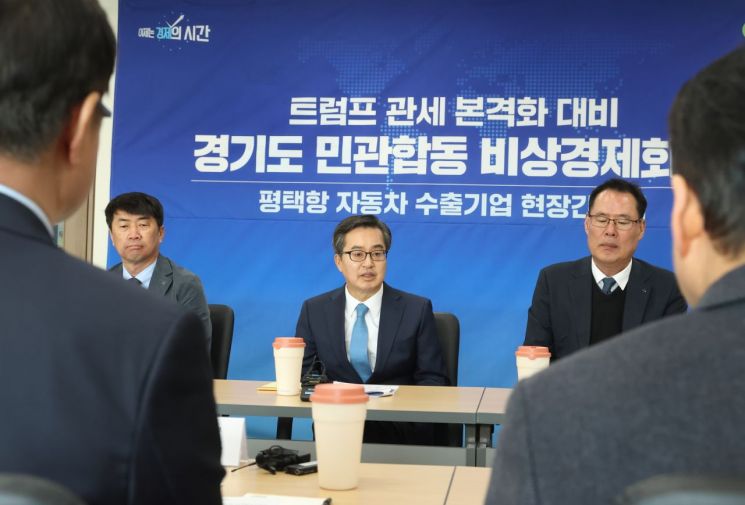 Gyeonggi Province Governor Kim Dong-yeon is presiding over a public-private joint emergency economic meeting at Pyeongtaek Port on the 31st of last month. Photo by Gyeonggi Province
Gyeonggi Province is considering holding a ‘Future Mobility Tech Show’ in the U.S. to build a network between local automobile-related export companies and American automobile manufacturers such as Ford, GM, and Stellantis.
The plan includes setting up promotional booths for local companies and strengthening cooperation systems between local companies and U.S. automobile manufacturers through the Korea-U.S. Future Car Cooperation Forum and business agreements (MOUs) between companies.
In the mid to long term, Gyeonggi Province will also promote industrial structure transformation and regulatory improvements. To respond to the crisis caused by the transition to eco-friendly vehicles, it will support commercialization of eco-friendly vehicles, including prototype production and certification cost support, as individual companies face limitations in business entry and internal workforce retraining.
As a regulatory improvement, considering the difficulties of automobile export companies, Gyeonggi Province plans to actively cooperate with the Korea Shipping Association to extend the allowance period of the ‘Notice on Age Restrictions of Coastal Cargo Ships,’ which temporarily permits domestic cargo transport operators transporting export automobiles to operate vessels aged 15 years or older until June 30, 2025, upon approval from the Ministry of Oceans and Fisheries. Additionally, it will pursue deregulation measures that hinder corporate activities, such as exclusion of additional tax credit benefits for automobile companies within the metropolitan area overconcentration control zone.
Jeong Du-seok, Director of the Gyeonggi Province Economic Office, said, "Supporting export companies, the backbone of South Korea’s economy, under the emergency economic system where high tariffs have become a reality, is one of Gyeonggi Province’s greatest responsibilities. We will listen to voices from the field and closely cooperate with related organizations to prepare and implement the most necessary measures for companies."
© The Asia Business Daily(www.asiae.co.kr). All rights reserved.
![Clutching a Stolen Dior Bag, Saying "I Hate Being Poor but Real"... The Grotesque Con of a "Human Knockoff" [Slate]](https://cwcontent.asiae.co.kr/asiaresize/183/2026021902243444107_1771435474.jpg)















