About 20 Minutes to Reach a Verdict in Previous Two Presidential Impeachment Cases
Dismissal Requires Consent of Six Out of Eight Justices
Tension Peaks... 'Vacuum State' Near Constitutional Court
President Yoon Not Attending... Expected to Watch Live Broadcast from Residence
At 11 a.m. on the 4th, starting with these words, the Constitutional Court's Grand Bench will deliver the impeachment trial decision that will determine President Yoon's fate. Moreover, the future of the Republic of Korea is also at stake. If the Constitutional Court issues a dismissal order, President Yoon will immediately become a former president; conversely, if the impeachment is dismissed, he will promptly return to his duties. It marks the conclusion of a grand journey 111 days after the National Assembly passed the impeachment motion against President Yoon last year and 38 days after the final hearing date.
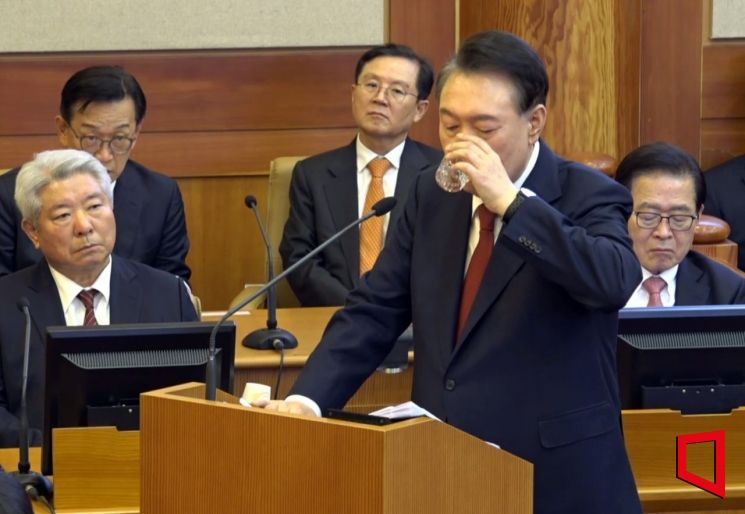 President Yoon Suk-yeol is drinking water during his final statement at the 11th impeachment trial hearing held at the Constitutional Court in Jongno-gu, Seoul, on February 25. Constitutional Court
On this day, Acting Chief Justice Moon Hyung-bae of the Constitutional Court will read the impeachment trial decision starting at 11 a.m. It is expected that the dismissal decision regarding President Yoon will be known as early as around 11:30 a.m. Previously, the announcements for former Presidents Roh Moo-hyun and Park Geun-hye each took about 20 minutes until the 'conclusion' was reached. The impeachment decision document for former President Roh was 61 pages, and for former President Park, 89 pages. Since President Yoon's case involves more issues and had a longer deliberation period than the two former presidents' cases, the impeachment decision document is also expected to be longer. The announcement will be broadcast live by TV stations and open to public attendance.
There are two ways to announce the verdict. One is to first read the conclusion part, or the order (主文), such as "The respondent President Yoon Seok-yeol is dismissed" or "This trial petition is dismissed," and the other is to read the reasons for the verdict in full and then announce the order at the very end. Usually, when the order is read first, it is when there is a split between majority and minority opinions. If all eight justices unanimously agree, the order may also be read first.
However, regarding the critically important 'presidential dismissal decision,' even if there is unanimity, it is highly likely that the entire decision document containing the reasons for the verdict will be read first, followed by the final conclusion order.
According to the Constitutional Court Act, for a dismissal decision in an impeachment trial case, the consent of six or more justices is required. Currently, one justice seat is vacant, so if three or more of the eight justices hold different opinions, the conclusion could change. An 'acceptance,' which requires the approval of six or more justices, means the Constitutional Court accepts the National Assembly's impeachment petition. If the Constitutional Court accepts the impeachment trial and issues a dismissal decision, President Yoon will immediately step down from the presidency. Except for security and protection, he will not receive the treatment guaranteed by the "Act on the Treatment of Former Presidents."
Conversely, if six or more justices do not approve, the petition is 'dismissed.' If five or more agree, 'rejection' is also possible, which means there is a procedural defect and the impeachment petition itself does not meet the trial requirements. If three justices vote for dismissal and rejection respectively, the dismissal decision will be made. In these two cases, President Yoon can immediately return to the presidency.
The Constitutional Court has identified five core issues, and the key is whether there is a serious legal violation that prevents the president from performing his duties. In other words, even if all five issues are violated, if it is not judged to be a serious constitutional violation, dismissal may not occur; conversely, if only one issue is violated, dismissal may be possible.
Tension at Constitutional Court Peaks... 8 Justices Hold Final Deliberation Just Before Verdict
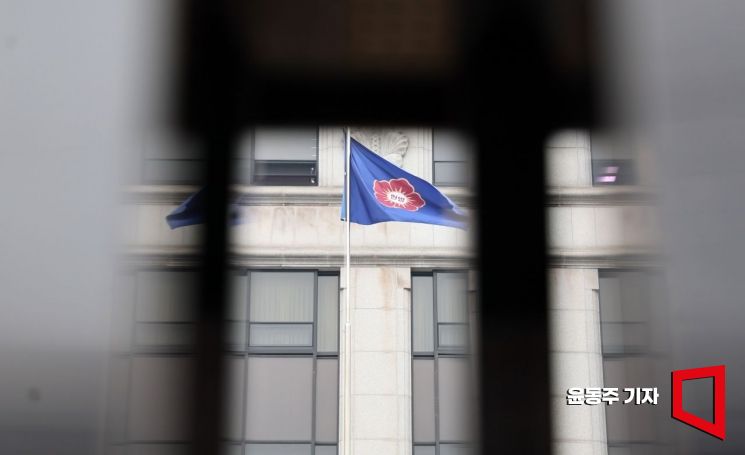 As the new ruling on President Yoon Suk-yeol's impeachment is delayed, conflicts between opposing support groups among the public are intensifying. On the 21st of last month, the flag at the Constitutional Court in Jongno-gu, Seoul, fluttered in the wind. Photo by Yoon Dong-ju
The tension inside and outside the Constitutional Court has reached its peak. Since the notification of the verdict date on the 1st, the Constitutional Court has controlled access to the main building where the justices' offices and deliberation room are located, and covered the windows of the justices' offices with curtains all day to prevent any internal situation from being known. To prevent leaks of the conclusion before the verdict, justices and staff have been required to have meals inside the Constitutional Court using lunch boxes and the exclusive cafeteria. The number of personnel covering the scene on the verdict day has also been limited. The Constitutional Court restricted internal reporters to three on the verdict day and requested prior submission of their personal information. Acting Chief Justice Moon Hyung-bae initially blocked video and photo coverage of the justices' arrival but later allowed some coverage after careful consideration and requests from the press.
As the verdict day approaches and tension rises, the area near the Constitutional Court has entered a so-called 'vacuum state' under police control. From 2 p.m. on the 2nd, the police expanded the blockade line around the Constitutional Court from 100 meters to 150 meters and completed the installation of barricades and blockade lines. Within the blockade zone, all assemblies and protests are prohibited, and passage on the four-lane road and sidewalks in front of the Constitutional Court is restricted. The police have deployed additional security teams to protect the justices and formed a dedicated team to protect reporters on the verdict day. Starting at midnight on the 4th, the police will implement the highest level of emergency duty system, 'Gapho Emergency,' and prepare for all scenarios.
The eight constitutional justices held two deliberations on the day before the verdict, in the morning and afternoon, and plan to conduct a final review of the decision document just before the verdict. The impeachment decision document will be finalized by obtaining the signatures of the justices after coordinating detailed opinions. Since there was a final vote just before the verdict in former President Park's impeachment trial, it is highly likely that the same procedure will be followed this time, with the decision document being sealed to mark the conclusion.
Meanwhile, President Yoon is not expected to appear at the Constitutional Court on the day. On the 3rd, President Yoon's legal team stated, "The president has decided not to attend the impeachment trial verdict scheduled for tomorrow," citing comprehensive consideration of order maintenance and presidential security concerns amid anticipated congestion. President Yoon is expected to watch the impeachment trial live broadcast on TV from his residence in Hannam-dong.
© The Asia Business Daily(www.asiae.co.kr). All rights reserved.
![Clutching a Stolen Dior Bag, Saying "I Hate Being Poor but Real"... The Grotesque Con of a "Human Knockoff" [Slate]](https://cwcontent.asiae.co.kr/asiaresize/183/2026021902243444107_1771435474.jpg)
















